

What Score Do You Need to Pass the G1 Test?
Ask ten people what score you need to pass the Ontario G1 knowledge test and nine of them will say the same thing: 32 out of 40. It is the number everyone remembers, and it is almost the rule. Almost.
Here is the version that actually decides whether you leave the DriveTest centre with a licence: you need at least 16 correct answers out of 20 in each of the two sections — road signs, and rules of the road.
Miss that detail and you can answer 34 questions correctly and still walk out without passing. That is not a trick of wording. The two halves of the test are scored independently, and each one has its own pass line.
This guide explains exactly how that works, why it fails so many well-prepared test-takers, and how to read your own practice scores through the same lens the test uses.
The Pass Rule, Stated Plainly
The G1 knowledge test is 40 multiple-choice questions split into two sections of 20. Section one covers road signs. Section two covers the rules of the road.
Each section is passed or failed on its own: 16 out of 20 correct per section, which is 80 per cent each. That is the whole rule. Everything below is just the consequences of it.
If you want the background numbers — the total question count, what each section contains, and how the test is put together — the companion guide on how many questions are on the G1 test lays them out. But the count is not what fails people. The structure is.
Why “32 Out of 40” Is a Dangerous Shortcut
The slogan version of the rule — get 32 right — is only true if those 32 are spread correctly. Because the sections are independent, your total is not the number that matters.
The computer does not add your two section scores together and check whether the sum clears 32. It checks section one against 16, then section two against 16. One section below the line fails the whole test, no matter how high the other one is.
Look at how that plays out in practice:
| Road signs | Rules of the road | Total | Result |
|---|---|---|---|
| 16 / 20 | 16 / 20 | 32 | Pass |
| 20 / 20 | 14 / 20 | 34 | Fail |
| 13 / 20 | 19 / 20 | 32 | Fail |
| 19 / 20 | 17 / 20 | 36 | Pass |
| 20 / 20 | 15 / 20 | 35 | Fail |
The second row is the one that stings. A perfect signs section and a 34-out-of-40 total — a result most people would describe as “I basically passed” — is still a fail, because the rules section came in two questions short.
The test does not average your strong half against your weak half. There is no partial pass and no credit carried forward: if you rewrite, you rewrite the full test.

The Mistake That Fails the Best-Prepared Test-Takers
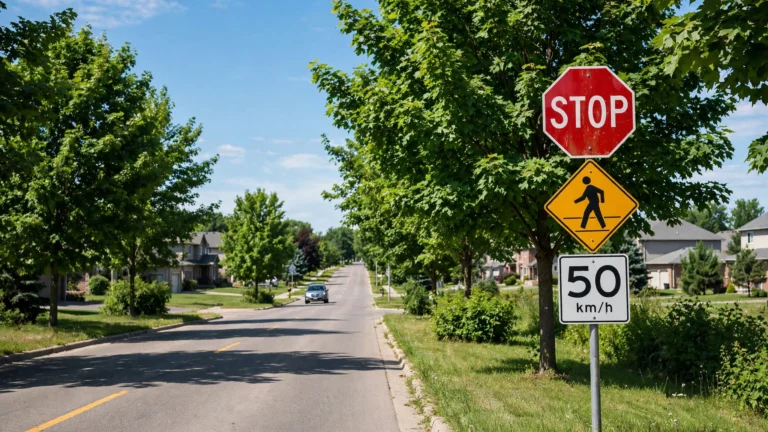
Road signs are the friendlier half of the test. The sign families — regulatory, warning, temporary, and information — are visual, and most people arrive already knowing stop, yield, and speed-limit signs from a lifetime of being a passenger.
Scores on the signs section run high, and that is exactly the problem.
High sign scores create a false sense of safety. Test-takers pour their study time into the half they already half-know, watch their sign scores climb, and unconsciously coast through the rules section.
But the rules of the road — right-of-way, following distances, signalling, parking on hills, demerit points, what to do at a four-way stop when everyone arrived at once — are the section with the most room to fail.
The rules are written in the Driver’s Handbook’s dense prose, they blur together under pressure, and they are where one misremembered detail costs a question.
The practical fix is blunt: study the rules section like it is the whole test. Keep your sign knowledge warm with quick reviews, but treat rules of the road as the section that decides your result — because for most people, it is.
The detailed breakdown of what the G1 test covers is a good place to see which rules topics carry the most weight.
How to Read Your Practice Scores Like the Test Does
Here is where the per-section rule becomes a study tool instead of just a warning. Most practice tests — including the 50-question practice tests on this site — show you an overall score. An 84 per cent overall looks like a pass.
But the real test does not score you overall, so your practice totals can lie to you in both directions.
To judge whether you are actually ready, split your practice results the way the test does. Take your last few practice runs and tally the sign questions and the rules questions separately, then score each half out of 20.
If either half keeps landing at 15 or below, you are not ready — even if the combined total clears 32. The fix is not “do more practice tests” in general; it is to drill the failing half specifically until both halves clear 16 consistently.
Give yourself a cushion, too. Walking into the centre scoring exactly 16 on a half means one unlucky question ends your attempt.
A comfortable readiness signal is 17 to 18 correct per half on recent practice runs — not a guarantee, just breathing room.
Treat a full-length run on our free G1 practice test the way the centre treats the real thing: split the score by section, hold each half to the 16 line, and don’t book your test day until both halves clear it with room to spare.
There is a reason the rule is built this way, and it is worth a moment. The two sections test two different jobs a driver has to do. Signs are about reading the road; rules are about sharing it.
A driver who can read every sign but doesn’t know who goes first at an uncontrolled intersection is not safe, and a driver who knows the rules but can’t read a warning sign is not safe either.
Scoring the sections independently is the province’s way of refusing to let one strength cover for the other. That is the standard you are being held to: competent at both, not excellent at one.

What the Screen Actually Tells You
You take the test on a touchscreen at a DriveTest centre, working through the questions at your own pace. When you finish, the system shows whether you passed.
If you did, you move on to the vision check and the licence paperwork — the whole “what happens next” side of test day is covered in our overview of what the G1 knowledge test is.
If you didn’t pass, the result is final for that attempt: there is no negotiating a 15 into a 16 and no partial credit. What you get instead is information — you now know exactly which half broke.
That is the single most useful diagnostic the test can hand you.
Most people who fail come back stronger the second time precisely because the fail tells them where to aim: rewrite the full test, pay the test fee again, and walk in with the weak half rebuilt.
Before you book a retake, check the current fee and retake details with DriveTest, since fees and procedures can change.

Questions About the Pass Score, Answered
Is the pass mark the same at every test centre? Yes. The knowledge test is set at the provincial level, so the scoring — 16 out of 20 per section — does not vary from one DriveTest centre to another.
Do wrong answers count against me? A wrong answer simply doesn’t add to your score; there is no extra penalty beyond losing the point. Since a blank answer scores nothing anyway, answer every question — an educated guess costs nothing.
Can I skip questions and come back to them? Don’t build a strategy around this. Work through each question as it comes and give your best answer on the spot; pacing yourself steadily beats hunting for skipped questions.
What if I pass one section and fail the other? The test is failed as a whole, and a retake means rewriting the full test — both sections, not just the one you missed. Plan and study for both halves every time.
How hard is it to go from 15 to 16 on a section? It is one question — and that is both the cruelty and the hope of it.
Closing a one-question gap usually means fixing a single recurring misunderstanding, like right-of-way at uncontrolled intersections or following-distance rules, not restudying everything. Diagnose the half, drill its weak topics, and retest.
A Quick Word Before You Book
Everything above describes how the Ontario G1 knowledge test is scored as of this writing — 40 questions, two sections of 20, 16 correct per section to pass — based on how DriveTest administers the test.
Test fees, retake procedures, and centre processes can change, so confirm the current details with DriveTest before your appointment.
Disclaimer: this is unofficial practice material prepared independently for study purposes. It is not affiliated with, endorsed by, or connected to DriveTest, the Ministry of Transportation, or the Government of Ontario, and practice questions here are not the real test questions.
For the authoritative current rules, fees, and procedures, always check DriveTest and the Ontario Driver’s Handbook.
Want 300 More Practice Questions?
The Premium Question Bank gives you 6 full mock exams with a plain-language explanation for every answer. Instant PDF download, yours to keep.
Get the Question Bank – $9.99Original handbook-mapped questions. Not real DriveTest questions. No pass promises – just serious practice.



7 Comments