
How to Know When You’re Ready for the G1 Test
Booking the G1 test feels like a guessing game for most learners. You have worked through the handbook and answered hundreds of practice questions. Now you are wondering whether to click the booking button.
This article gives you a way to stop guessing. It lays out the benchmarks and signals that show whether you are genuinely ready. Run these checks, and you will know the answer.
The Passing Rule, One Sentence
The G1 test has 40 questions in two sections: 20 on road signs and 20 on rules of the road. You need at least 16 correct in each section.
A high score in one section cannot rescue a low score in the other. You can read the full breakdown in this guide to what score you need to pass the G1 test.
Everything below assumes you know that rule. The checks here are not about the passing line itself. They are about whether your performance sits comfortably and consistently above it.
Check One: Your Scores Hold Steady Across Five Tests
A single good score proves almost nothing. Anyone can get lucky with a test that happens to ask questions they know.
What matters is what happens when you take five full-length practice tests in a row, each one a fresh set of questions.
The benchmark: score 16 or higher in both sections on five consecutive practice tests. Not your best five of ten. Five in a row, no dips.
If your scores bounce between 13 and 19, you are not ready. You are rolling dice.
Keep a simple log as you go. Write down each test’s date and your two section scores.
A ready learner sees a pattern like 17/18, 18/17, 19/18, 17/19, 18/18. An unready learner sees 19/14, 15/18, 18/13, 17/16, 16/14.
The first pattern shows solid knowledge. The second shows holes the test can find.
Pay special attention to which sections wobble. If your road-sign scores swing wildly while your rules scores stay steady, your sign knowledge is patchy.
That usually means a handful of unfamiliar sign shapes or colour meanings. It is fixable, and fixable quickly. What it is not is something to ignore.
One more detail: take your five tests on five different days, not all in one afternoon. Spaced testing proves you retained the knowledge instead of cramming it into short-term memory.
Check Two: Both Sections Clear the Bar With Room to Spare
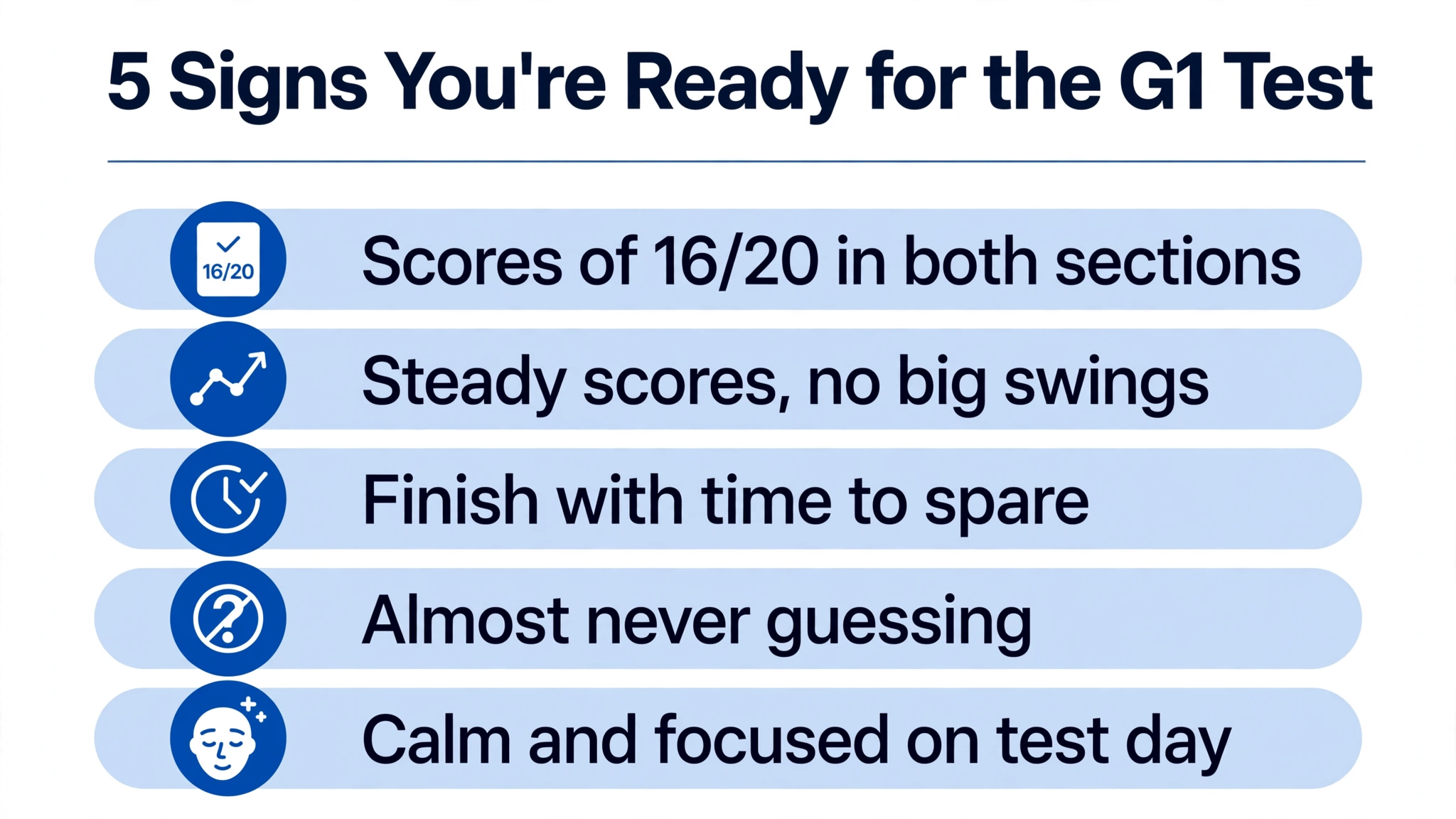
Passing with 16 in each section is the minimum. Aim for comfort, not the minimum.
A score of 16 leaves zero room for a bad guess, a misread question, or a moment of nerves. On the real test, something will go slightly sideways. Your scores need to absorb it.
A practical target: 17 or 18 in both sections, consistently. Sitting at 16, 16, 17, 16 means you technically pass every time — but one off day flips a pass into a fail.
Two more correct answers per section is the cushion that turns “probably fine” into “actually fine.”
This is where the two-section structure bites people. Many learners pass their rules section easily and treat signs as an afterthought.
The test does not care which section you find boring. A 19 in rules plus a 15 in signs is a fail, full stop.
If one section lags, stop splitting your study time evenly. Give the weak section double the attention until the gap closes.
The guide to memorizing Ontario road signs is a good place to rebuild the signs section from the ground up.
Check Three: You Finish Early Without Rushing
Time pressure changes how people answer. A learner who needs every second of the real test has no buffer for a tricky question.
A learner who finishes practice tests with time to spare has room to slow down on the questions that matter.
The real G1 test gives you plenty of time per question, and most people finish well within the limit. So this check is simple: time your practice tests and note how long they take.
The benchmark: finish a full 40-question practice test in under half the allotted real-test time, without feeling rushed.
If you agonize over each question, re-read it three times, or change answers at the last second, you are answering from uncertainty. That uncertainty follows you into the test centre.
Watch your answer-changing habit too. If you regularly change answers in the last few minutes and the changes are wrong more often than right, you are second-guessing real knowledge.
Ready learners change fewer answers. When they do change one, it is usually because they spotted a genuine misread.
Check Four: Your Guesses Are Rare — And Labelled
Here is a check almost nobody does, and it is one of the most revealing. On your next practice test, mark every question where you were not genuinely sure of the answer.
Put a star next to each one. Then score the test two ways: your full score, and your score with the starred questions removed.
If your “sure” score drops below 16 in either section, you are guessing your way over the line. Guessing is fine on the real test — you should never leave a question blank.
But if guesses are carrying you past 16, your real-test result depends on luck. Luck is not a study strategy.
Ready looks like this: you star two or three questions per section, and even without them you still clear 16.
The guesses are genuinely uncertain questions — an oddball sign shape, a rules scenario you have never quite seen — not half the test.
- 0–3 guesses per section: you know this material. Booking is reasonable.
- 4–6 guesses per section: borderline. Study the guessed topics, then re-test.
- 7+ guesses per section: not ready. The guessing is doing the heavy lifting.
Check Five: Your Mistakes Are Careless, Not Conceptual
Not all wrong answers are equal. When you review a practice test, sort your mistakes into two piles: the ones where you knew the rule but slipped, and the ones where the rule itself was fuzzy.
Careless mistakes look like this: you misread “must” as “must not.” You clicked the wrong option after knowing the right one. You confused two similar sign shapes in a hurry.
These are embarrassing but fixable — usually by slowing down and reading each question twice.
Conceptual mistakes look different: you genuinely believed the wrong answer was right. You thought a yellow diamond sign meant something it does not. You were sure about a rule that turns out to be wrong.
These mean the knowledge is not there yet. Slowing down will not fix them.
The benchmark: when you review a test, at least four out of five mistakes should be careless. And you should be able to spot exactly what went wrong without looking anything up.
If you need to re-open the handbook to understand why you were wrong, that is a conceptual gap. Write it down and study it specifically.
Check Six: You Recognize Signs Instantly
The signs section rewards a specific skill: instant recognition. On the real test, a sign question shows the sign and asks what it means.
The correct answer should reach you in one or two seconds. If you are reasoning it out from first principles, you know the system but not the signs.
Test yourself this way: go through a set of sign questions and time your first answer, not your final one. If most answers come within a couple of seconds, the visual vocabulary is in place.
If you regularly need five or more seconds to reason your way to an answer, keep drilling.
Cover the answer options and try stating what the sign means before looking. If you can answer without the multiple-choice hints, you truly know the sign.
Watch the classic confusion pairs. Learners report mixing up:
- regulatory signs (rectangles, often white or black-and-white) with warning signs (yellow diamonds);
- construction-area orange versions of signs they already know in other colours;
- signs that share a shape but differ in a small detail, like lane-use arrows.
Learn signs by shape and colour first, meaning second. Shape and colour narrow every sign down to one family before you even read the symbol.
If you can name the confusion pairs you personally struggle with, you are closer to ready than someone who just says “signs are hard.” Naming the gap is half of closing it.
Check Seven: You Can Explain Why Wrong Answers Are Wrong
This is the deepest check on the list. Pick five questions you got right on a recent practice test and ask yourself a question.
Could I explain, out loud, why each wrong option is wrong?
Memorized answers survive recognition: you see the question, you remember the answer. Understood rules survive explanation.
The real test will phrase things differently from any practice test you have seen. Memorized answers have a ceiling. Explanations have none.
Try it with a partner if you can. Say the question, say the right answer, then explain why the other three choices are wrong.
If you can do it for five random questions in both sections, your understanding is genuinely solid.
If you can only repeat the correct answer without knowing why the others fail, your knowledge is recognition-based. That is better than nothing, but it is brittle under rephrasing.
This check also fixes your weakest areas faster than anything else. Every wrong option you cannot explain points to a rule you have not fully learned. Note each one and look it up.
Check Eight: Your Mind Is Calm, Not Just Your Scores
Readiness is not only numbers. A learner can hit every score benchmark and still walk into the test centre so nervous that they misread half the questions.
Test anxiety is real, and it ruins prepared learners every week. Ask yourself honestly:
- When you sit down for a practice test, do you feel calm, or does your stomach tighten?
- Do you sleep normally the night before a big day, or does worry keep you up?
- Can you picture yourself at the test computer feeling neutral about it — not excited, not terrified, just ready?
If your answers lean anxious, treat calmness as a skill to practice. Take practice tests in slightly uncomfortable conditions: a noisy room, a timed session, a different device.
The goal is to teach your brain that answering questions is ordinary, not an event. Some learners find it helps to visit the test centre location beforehand, just to remove the unknown from the day.
One more honest question: do you want to book, or do you feel pushed to book? A learner who feels pulled toward the test — curious, a little nervous but basically willing — performs better.
One who is being dragged to it by a deadline or someone else’s impatience does worse. If you dread it, that is data.
The Final 48-Hour Sanity Check
Say you have passed every check above. Before you book, run this last sequence over two days.
- Day one: take one full practice test, timed, in one sitting, no interruptions. Score it. You should clear 17 in both sections with few guesses.
- Review the misses: every miss should be careless, and you should know exactly why you slipped. No new conceptual gaps allowed.
- Day two: take a second full test with a different question set. Same bar.
- The rephrase test: for any question you hesitated on, restate the rule in your own words without looking. If you can, the knowledge is yours.
- Sleep on it: if you still feel steady after a normal night’s sleep, book the test.
If anything wobbles during these two days, pause the booking and fix the gap first. A low section score, a batch of guesses, or a conceptual miss are all stop signs.
Two more days of targeted study is cheaper and less stressful than a failed test and a retake.

Red Flags That Mean “Not Yet”
Pull these together and they form a clear stop list. If any of these describe you right now, do not book yet:
- Your section scores swing by more than three points between tests.
- One section consistently scores lower than the other and the gap is not closing.
- You recognize practice questions and their answers, but a rephrased version of the same rule trips you up.
- More than a handful of guesses per section are getting you over 16.
- You need to re-read questions three times before answering.
- You feel dread, not just nerves, when you think about test day.
- You have not taken a full timed practice test in at least a week — your scores are old.
You can keep sharpening with more timed practice tests online, logging your scores in a notebook and watching the red flags turn green one at a time.
The free G1 practice tests on the homepage are a good source of fresh question sets.
Frequently Asked Questions
How Many Practice Tests Should I Pass Before Booking?
Five consecutive full-length tests, each scoring 16 or higher in both sections, is a solid benchmark. Scoring 17 or 18 in each gives you a real cushion.
One great score is not evidence. A steady run of them is.
I Keep Scoring 15 in the Signs Section. Should I Book Anyway?
No. A 15 in signs is a fail no matter what your rules score is, because each section is judged on its own.
Focus your study on the signs section alone until it clears 17 consistently, then book.
What If My Scores Are Good but I Feel Anxious?
Treat the anxiety as a separate skill to train. Take timed tests in slightly uncomfortable settings and visit the test centre area ahead of time.
Only book when the dread fades into ordinary nervousness. Good scores plus panic can still produce a fail.
Is It Better to Book Early and Retake If Needed?
That strategy costs you the retake wait and the stress of a failed attempt. It also teaches your brain that failing is the plan.
It is usually better to spend a few more days closing the gaps this article names, then book once — and pass.
How Do I Know My Mistakes Are Careless Rather Than Conceptual?
After a test, look at each wrong answer before checking the explanation. If you can immediately say “I misread that,” it was careless.
If you need to look up the rule to understand the correction, it was conceptual — and that topic needs real study.
Does Memorizing Practice Questions Count as Being Ready?
Only partly. Recognition helps, but the real test rephrases rules in ways you have not seen.
If you can explain why the wrong answers are wrong — not just pick the right one — your knowledge will survive unfamiliar wording.
This article is unofficial study guidance with no affiliation to DriveTest or the Ontario government. Practice questions and benchmarks here are study tools, not official test materials.
Passing practice tests does not guarantee any result on the real G1 test.
Want 300 More Practice Questions?
The Premium Question Bank gives you 6 full mock exams with a plain-language explanation for every answer. Instant PDF download, yours to keep.
Get the Question Bank – $9.99Original handbook-mapped questions. Not real DriveTest questions. No pass promises – just serious practice.