
How Long Does the G1 Knowledge Test Take?
Here is the answer most test-takers are looking for: the Ontario G1 knowledge test takes most people between 20 and 30 minutes to finish, and there is no official time limit published for it.
If you came here worried that the test is a race, you can exhale. It is not. But an untimed test has its own trap — this guide covers how long the test takes in practice, where minutes quietly disappear, and a simple pacing system that fits.
The Short Answer: 20 to 30 Minutes for Most People
That second fact — no official time limit — is the important one. Nobody is going to tap your shoulder at the 30-minute mark and collect your test.
The clock that matters is the one you bring in your head — a pacing plan that keeps you moving through 40 questions without rushing the ones that deserve a second read.
The G1 knowledge test is 40 multiple-choice questions split into two halves: 20 on road signs and 20 on rules of the road.
If you are solid on the material, you will likely answer the signs section quickly — many questions there are recognition questions that take five to ten seconds each.
The rules section takes longer because the questions are more situational, and that is where the minutes accumulate.
Twenty to thirty minutes is the range reported by driving schools and test-takers alike, and it lines up with the test’s design.
Forty questions in 30 minutes gives you 45 seconds per question, which is generous if you are prepared and comfortable if you need to re-read a tricky wording. If you finish in 15 minutes, that is fine too — speed is not scored.
The one timing fact to hold onto is not about the test itself. Plan for the whole visit to take one to two hours. The test is only one part of the trip: check-in, the vision screening, and the photo all happen around it. More on that further down.
Is There an Official Time Limit?
DriveTest does not publish a hard time limit for the G1 knowledge test. You may see older blog posts and driving school pages mention 30 minutes as a limit — treat that number as a guideline for pacing rather than a rule.
In practice, the expectation is that you complete the test during your visit, and staff will not let anyone sit in the testing room indefinitely.
This matters because the wrong belief costs people in both directions. If you believe there is a strict timer, you rush, misread questions, and change correct answers under pressure.
If you believe you have unlimited time, you can spend four minutes agonizing over one question while easy marks wait further down. The sweet spot is treating the test as comfortably paced: generous, but not infinite.
A practical target to set for yourself: finish the 40 questions in about 25 minutes.
That leaves you unhurried through the easy questions and gives you a buffer for the hard ones, plus time for one review pass at the end if the centre’s format allows it.
A Realistic Pacing Plan for 40 Questions
Not all 40 questions deserve equal time. A pacing plan that respects that looks roughly like this:
- Road signs section (20 questions): about 8 to 10 minutes. Recognition is fast. If you know a sign, you know it in seconds. Budget roughly 25 to 30 seconds per question, knowing most will take far less and a few unusual ones will take more.
- Rules of the road section (20 questions): about 12 to 15 minutes. These questions describe situations — intersections, following distances, right-of-way — and the correct answer often hides in one small detail. Give yourself 35 to 45 seconds per question.
- Review pass: 3 to 5 minutes. A final sweep for questions you flagged or answered hastily.
Add that up and you land around 25 minutes, with room to breathe. Notice what this plan does not do: it never asks you to sprint.
Even the signs section gives you half a minute per question, and most sign questions will be answered in a tenth of that.
One habit makes this plan work far better than it looks on paper: answer every question on the first pass, even the uncertain ones. A blank or skipped question is a mark you have already lost.
An educated guess keeps you in the game, and you can return to it during your review pass with fresh eyes.
This is especially valuable given the score you need to pass — you must clear 16 out of 20 in each section separately, so every section’s questions matter.
Where Your Minutes Actually Disappear
Ask people what slowed them down and the same three culprits come up. None of them is “the questions were too hard.”
The re-reading spiral. A question looks familiar, but one answer choice makes you doubt yourself, so you read the question a third and fourth time. Each re-read makes the wording feel less clear, not more.
The fix is mechanical: read the question twice, maximum. If you are still unsure, pick your best answer, make a small mark or mental note, and move on. The review pass exists precisely for these moments.
The rules-section slowdown. The signs section can create a false sense of speed. You fly through 20 sign questions in eight minutes and then hit the rules section, where every question is a little story with a twist.
What the test covers explains why: rules questions test judgment — right-of-way, safe following distances, what to do in specific situations — and judgment questions demand that you picture the scene before you pick an answer.
Slow down deliberately for this half instead of letting it surprise you.
The “one more check” trap. Some test-takers finish with plenty of time and then talk themselves out of correct answers during review.
The research on multiple-choice testing is consistent here: your first instinct is usually right, and changes made from doubt rather than new information tend to hurt.
Change an answer during review only if you spot something concrete you missed — a word like “except” or “not” that flips the meaning.

Rehearse Your Timing at Home
The best way to make test day feel unhurried is to practice under mild time pressure at home. Not panic-level pressure — just a timer running in the corner while you work through practice questions.
This is one of the few genuinely useful things a stopwatch can do for your preparation.
Run a full 40-question practice set with a 30-minute timer. Do not stop the timer to look things up; treat it like the real room. When you finish, check three numbers: your total time, your score in the signs half, and your score in the rules half.
Then ask yourself where the time went. Did one tricky question eat three minutes? Did you re-read the same question four times?
A useful readiness benchmark: when you can consistently finish a 40-question set in under 25 minutes with at least 16 correct in each half, your pacing is no longer a risk factor.
At that point, any remaining mistakes are knowledge gaps, not clock problems, and you know exactly what to study.
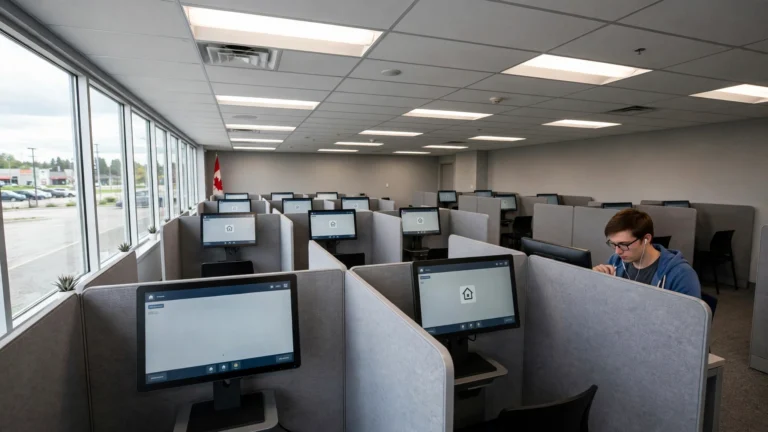
One more rehearsal tip: practice at a desk, not on the couch. The test happens at a workstation or a desk in a quiet room, and your focus behaves differently when you sit upright in a chair.
Small environmental details like this are why a timed desk session predicts your real performance better than a relaxed phone session on the sofa.
The Clock Around the Test: Plan for the Whole Visit
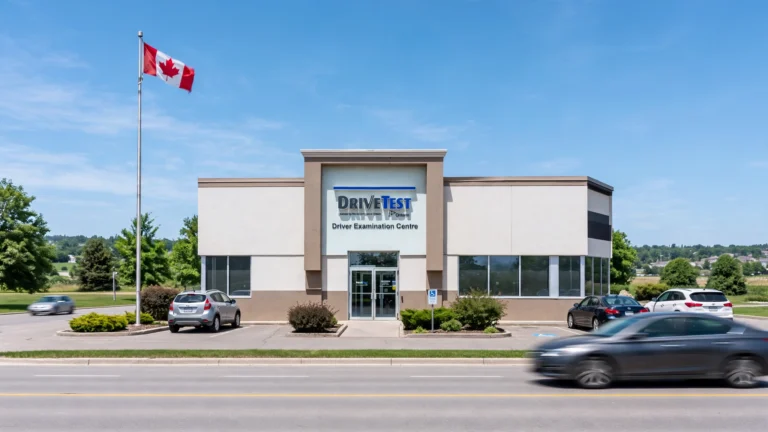
The test itself is the shortest part of your DriveTest visit. Before you answer a single question, you will check in, have your documents reviewed, and take a vision screening. Afterward, there is the licence photo and processing.
All told, expect the visit to take one to two hours, longer on busy days or at popular centres.
Two practical consequences follow from this. First, do not schedule anything tightly after your test.
An appointment booked an hour after your arrival is a recipe for rushed answers, because the pressure of the clock outside the testing room leaks into the room. Give yourself a clear, unhurried window.
Second, arrive early in the day if you can, and arrive at least one hour before the centre closes.
Centres stop accepting new test-takers before closing time, and if you arrive too late in the day, you may be turned away regardless of how prepared you are. Morning visits also tend to mean shorter lineups, which shortens the whole trip.
If reading is a difficulty for you, know that accommodations exist: DriveTest centres can arrange for the test to be read aloud, and computerized locations may offer audio versions. Arranging this ahead of time means one less unknown on the day.
Timing Questions, Answered
Can I Leave the Testing Room Early If I Finish Fast?
Yes. When you submit your test, it is marked right away and you get your result immediately. Finishing in 15 minutes is perfectly fine — there is no minimum time and no reward for using extra minutes you do not need.
What Happens If I Need More Time?
Since there is no published hard limit, you can take the time you need to read each question carefully. What you cannot do is leave the testing room and come back, or use a phone or notes — the usual testing-room rules apply for the whole session.
Should I Use All the Time Available?
Not necessarily. Extra minutes help only if you use them well — a calm review pass of flagged questions. Sitting and second-guessing answered questions tends to lower scores, not raise them. If your review pass is done and you feel steady, submit.
Is the Test Faster on Computer or on Paper?
Most centres offer the test on a computer, and some offer paper depending on location. The format does not change the content or the pacing advice in this guide.
Choose whichever you are comfortable with — and if you want to know how many questions are on the G1 test and how they are divided, that stays the same either way.
How Long Should I Study Before Booking?
That is a different clock from the test-day one, but it matters more. Rather than counting days, count timed practice sets: when you repeatedly finish 40 questions in under 25 minutes with strong scores in both halves, you are ready.
If you are still fuzzy on the fundamentals, what the Ontario G1 knowledge test is is a good place to start before you worry about the clock at all.
A note on this guide: this article is unofficial study material created to help you prepare for the G1 knowledge test.
It is not affiliated with, endorsed by, or connected to DriveTest, the Ministry of Transportation of Ontario, or the Government of Ontario. Test procedures can change, so confirm current details with official sources before your visit.
Want 300 More Practice Questions?
The Premium Question Bank gives you 6 full mock exams with a plain-language explanation for every answer. Instant PDF download, yours to keep.
Get the Question Bank – $9.99Original handbook-mapped questions. Not real DriveTest questions. No pass promises – just serious practice.

2 Comments