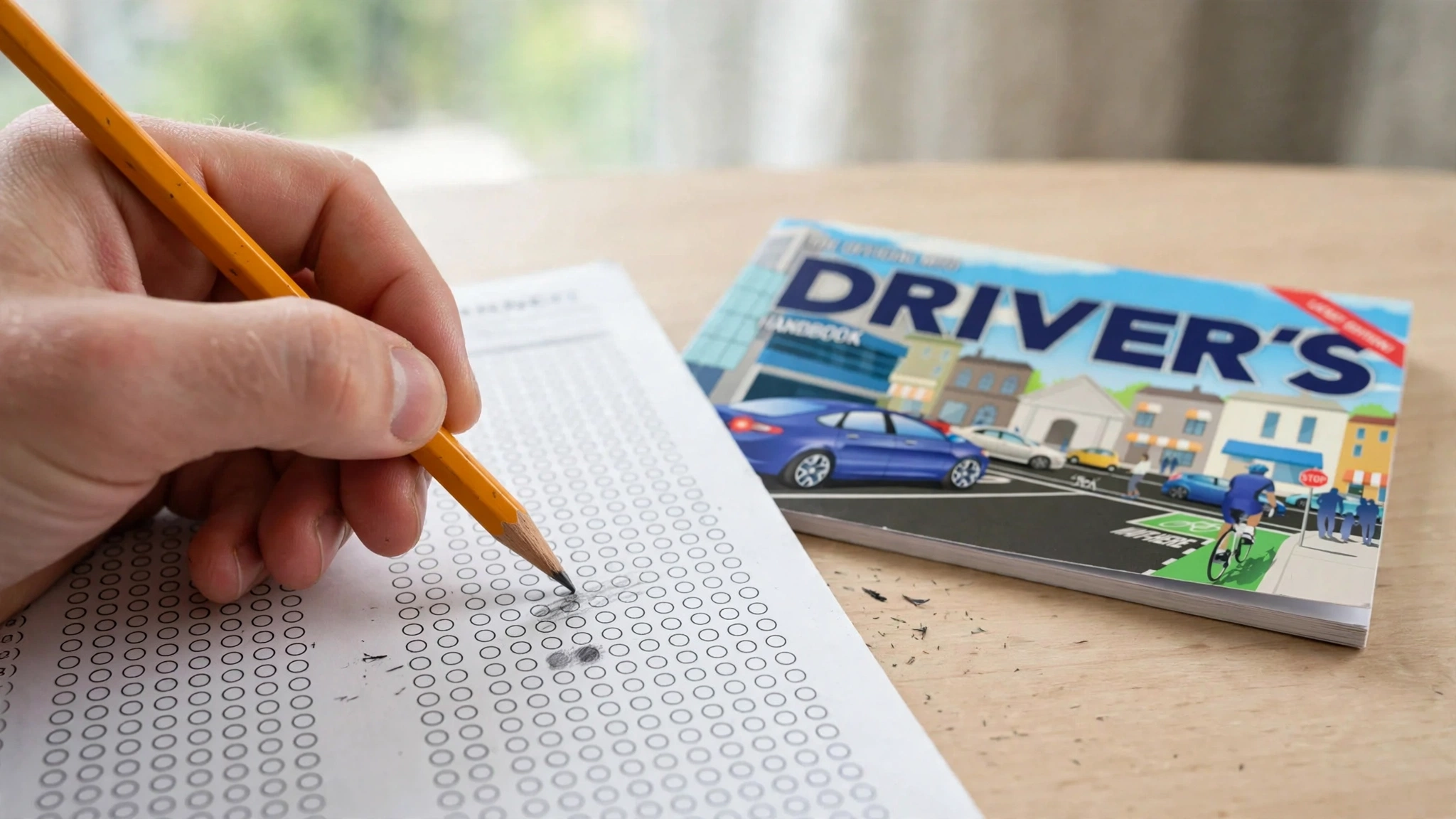
Is the Ontario G1 Test Multiple Choice?
If you are getting ready to write your G1 in Ontario, the format of the test matters almost as much as what you study.
So let us settle the question properly: is the Ontario G1 test multiple choice, and what does that mean for how you prepare?
Yes — Every Single Question Is Multiple Choice
A multiple-choice test rewards a different kind of preparation than an essay or a short-answer exam, and a surprising number of people walk into the DriveTest centre without knowing exactly what is about to be put in front of them.
The entire G1 knowledge test is multiple choice, all 40 questions. You will never be asked to write out an answer, explain a rule in your own words, or draw a sign from memory.
Each question gives you a set of answer options — typically four — and your job is to pick the one correct answer.
The 40 questions are split into two sections of 20: one on road signs and one on rules of the road. You must get at least 16 out of 20 in each section to pass — the requirement is per section, not just a combined total.
If that detail surprises you, our guide to what score you need to pass the G1 test walks through the rule in full.
Everything on the test is drawn from the Ontario Driver’s Handbook.
The questions are selected from a larger pool, so no two people necessarily get the same 40 questions — which is exactly why memorizing a fixed answer key is a dead end and understanding the material actually works.
What a Question Actually Looks Like
A typical G1 question is short and direct. It might show you a road sign and ask what it means, or describe a driving situation and ask what you should do. Underneath the question sit the answer options, labelled A, B, C, and D.
Exactly one of them is correct.
The questions are plain in their wording. They are not trying to test your vocabulary or your reading comprehension — they are checking whether you know the rule or the sign. That said, reading carefully is part of the skill.
Words like except, always, and never flip the meaning of a question, and missing one of them is one of the most common reasons people get questions wrong that they actually knew the answer to.
There are no trick questions in the unfair sense — nobody is asking you to parse legal riddles. But there are absolutely questions designed to separate people who truly understand a rule from people who have only half-memorized it.
That distinction matters more than anything else in this article, so let us dig into it.
Paper or Computer: Two Versions of the Same Format
Depending on the DriveTest centre, you will take the test either on paper or on a computer — the format of the questions is multiple choice either way.

On paper, you get a printed question booklet and an answer sheet with rows of bubbles. You shade in the bubble for each answer, one question at a time.
It is the most forgiving version of the format: you can skip ahead freely, come back to questions you were unsure about, change any answer before you hand the sheet in, and visually scan your sheet at the end to make sure you didn’t skip a row.
On the computer version, you read each question on screen and click or tap your answer.
The mechanics differ by centre, so before you begin, take a moment to check whether you can navigate back to earlier questions — on most setups you can move back and forth freely until you finish, but it is worth confirming so you can plan your approach.
Either way, the answering itself is the same skill: read, decide, select.
One genuine advantage of multiple choice in both versions: your final answer is always fully under your control at the moment you submit. There is no partial credit to chase and no examiner interpreting your handwriting.
The Two Kinds of Multiple-Choice Questions You Will Meet
Not all 40 questions ask the same kind of thing. Recognizing the two flavours helps you prepare for each correctly.

Recognition questions make up most of the road-signs section. You see a sign — or a description of one — and pick what it means from the options. This is pure knowledge: either you have learned the sign or you haven’t.
There is no reasoning your way out of it if you haven’t studied. The good news is that recognition is the easiest kind of question to practice, because a few dozen repetitions with flashcards or a practice test lock each sign into memory.
Our breakdown of what the G1 test covers in Ontario lists the sign families you need to know.
Application questions dominate the rules-of-the-road section. These describe a situation — an intersection, a school bus with its lights flashing, a car ahead of you at night — and ask what the correct action is.
You are not just recalling a fact; you are applying a rule to a scenario. The handbook gives you the rules, but the test checks whether you can use them.
This is where reading the full question matters most, because the scenario usually contains the detail that decides the answer.
When you practice, pay attention to which kind of question you keep missing.
People who ace recognition questions but stumble on application questions need to spend more time with the rules chapters of the handbook, not more time with sign flashcards — and vice versa.
How the Wrong Answers Are Built
Here is the part most study guides skip. The wrong options — the distractors — are not random. They are written to catch specific misunderstandings, and knowing the patterns makes them much easier to spot.
- The almost-right answer. This is the distractor that looks correct if you read fast. It often restates the real rule with one detail changed — a distance, a speed, a condition. Example pattern: a question about following distance where one option says the rule applies at all times and another says it applies only in good weather. If you know the rule properly, the difference jumps out. If you skimmed the handbook, you will pick the wrong one with confidence.
- The answer to a different question. Some distractors are perfectly correct statements that just don’t answer what was asked. The question asks what you must do, and one option correctly describes what another driver must do. The question asks about a red light, and one option correctly describes a flashing yellow. These punish people who read the options before fully reading the question.
- The extreme answer.Options containing words like always and never are wrong more often than they are right in real-world driving rules, because most rules have conditions and exceptions. “Always honk at intersections” or “Never slow down on a highway” should set off alarm bells. This is a useful heuristic, not a guarantee — some correct answers do use absolute language — but it is a good prompt to double-check.
⚠️ Note: Options containing always or never are wrong more often than they are right, because most driving rules have exceptions. Treat absolutes as a prompt to double-check, not a guarantee.
Understanding these patterns changes how you study. You stop asking “what is the answer?” and start asking “what would the wrong answers try to trick me with?” — which is a much stronger form of preparation.
A Method for Answering: Eliminate, Then Commit
With four options and one correct answer, random guessing gives you a one-in-four shot. But you are rarely guessing blindly. A simple elimination method turns most questions into something much better than a coin flip:
- First pass: answer what you know. Go through the test and answer every question you are confident about. Don’t linger — if you know it, answer it and move on. This builds momentum and, just as importantly, banks your easy points early.
- Second pass: eliminate. For each remaining question, read all four options and cross out the ones you know are wrong. Most questions let you eliminate at least one or two options immediately. Once you are down to two, slow down: compare them directly against the question, word by word, and pick the one that actually answers what was asked.
- Third pass: commit to the leftovers. For the few questions where you genuinely don’t know, pick your best guess and move on. Do not leave blanks — there is no benefit to leaving a question unanswered, which brings us to the most important rule of the format.
Should You Guess When You Don’t Know?
Yes. Absolutely yes.
There is no penalty for a wrong answer on the G1 test. Your score is simply the number of questions you got right — a wrong answer costs you nothing beyond not earning that point.
No marks are deducted, no extra penalty applies, and a blank answer scores exactly the same as a wrong one: zero.
This is the single biggest tactical fact about the multiple-choice format, and it surprises people. On some exams, guessing is punished and skipping is the smart move.
On the G1, the math is simple: a guess on a question you don’t know gives you a chance at the point, while leaving it blank gives you no chance at all. Even eliminating one option before guessing doubles your odds from one in four to one in three.
So the rule is: answer everything. On paper, double-check at the end that every bubble row has a mark. On the computer, make sure you have selected an answer for every question before you finish.
Format Questions, Answered
Are All G1 Questions Multiple Choice, or Are There Other Types?
All 40 are multiple choice. There are no true/false questions, no fill-in-the-blank, and nothing you have to write out. Every question presents a set of options and asks you to choose the correct one.
How Many Answer Options Does Each Question Have?
Typically four options labelled A through D, with exactly one correct answer. Your job is always the same: find the best of the four.
Can I Change My Answer After Selecting It?
On the paper version, yes — erase and re-shade the bubble any time before you hand in your sheet.
On the computer version, you can generally change your selection as long as you can still navigate to that question, so confirm how the navigation works before you start.
Can I Skip a Question and Come Back to It?
On paper, freely — the booklet and answer sheet are entirely under your control. On the computer version it depends on the centre’s setup, so check whether you can move back and forth between questions before you begin.
If skipping isn’t possible, your best move is to make your best guess on the spot rather than staring at one question while the rest of the test waits.
Is the Test Timed?
There is no strict time limit in the way most exams have one — but you also shouldn’t treat it as unlimited. Most people finish in about 20 to 30 minutes.
If you want a pacing plan for those minutes, our guide to how long the G1 knowledge test takes breaks it down question by question.
Does the Multiple-Choice Format Make the Test Easy?
It makes the test fair, not easy. You never have to produce an answer from nothing — but the wrong options are deliberately written to catch shallow studying.
People fail a multiple-choice test by recognizing the right answer in practice and then picking the almost-right answer under pressure. Depth of understanding is what separates the two.
The Bottom Line
Yes, the Ontario G1 test is multiple choice — 40 questions, four options each, one correct answer, split across road signs and rules of the road.
The format is on your side: there is no penalty for guessing, you can use elimination to shrink every question down, and on paper you control your navigation completely.
But the format only helps people who have actually learned the material. The best use of knowing it is multiple choice? Practice in the same format.
Run through free G1 practice tests until answering feels mechanical — the elimination method, the careful reading, the disciplined guessing — so that on test day the format is one thing you never have to think about.
Disclaimer: this article is unofficial practice material for study purposes only. It is not affiliated with, endorsed by, or connected to DriveTest, the Ontario Ministry of Transportation, or the Government of Ontario.
Test formats and procedures can change — always confirm the details of your test with your local DriveTest centre.
Want 300 More Practice Questions?
The Premium Question Bank gives you 6 full mock exams with a plain-language explanation for every answer. Instant PDF download, yours to keep.
Get the Question Bank – $9.99Original handbook-mapped questions. Not real DriveTest questions. No pass promises – just serious practice.