
Free G1 Practice Test Ontario
A free, exam-style G1 practice test that mirrors the widely reported real test format: 40 questions, two sections, and the 16-out-of-20 pass mark in each. No sign-up, no fees.
40 questions in two sections, just like the widely reported real test format: Part A · Road Signs (20) and Part B · Rules of the Road (20). Answer at least 16 out of 20 in each section to pass.
Exam Mode: no instant answers — submit all 40 for your score. Practice Mode: instant feedback with explanations.
Getting your G1 is the first step toward driving in Ontario, and the knowledge test is the gate you walk through. This page gives you a free practice test built to feel like the real thing, plus a plain-language guide to what the test covers and how to pass it.
Every question below is original practice material mapped to the topics in the Official MTO Driver’s Handbook. Take the test in Exam Mode when you want a realistic rehearsal, or switch to Practice Mode to learn as you go.
What Is the Ontario G1 Knowledge Test?
The G1 knowledge test is the written exam you pass to earn your G1 licence in Ontario. You write it at a DriveTest centre, along with a vision test, and you must be at least 16 years old and an Ontario resident to apply. Ontario’s official new-driver page lists exactly what to bring and where to go.
The test is multiple choice and computer-based at most centres. Your result is marked on the spot, so you know before you leave whether you passed. If you are riding instead of driving, try our M1 motorcycle practice test, which follows the same study-then-test approach.
Key fact: The knowledge test is only the first hurdle. Passing it earns you a G1 licence, which lets you practise driving under supervision before your road tests.
What Is on the G1 Test?
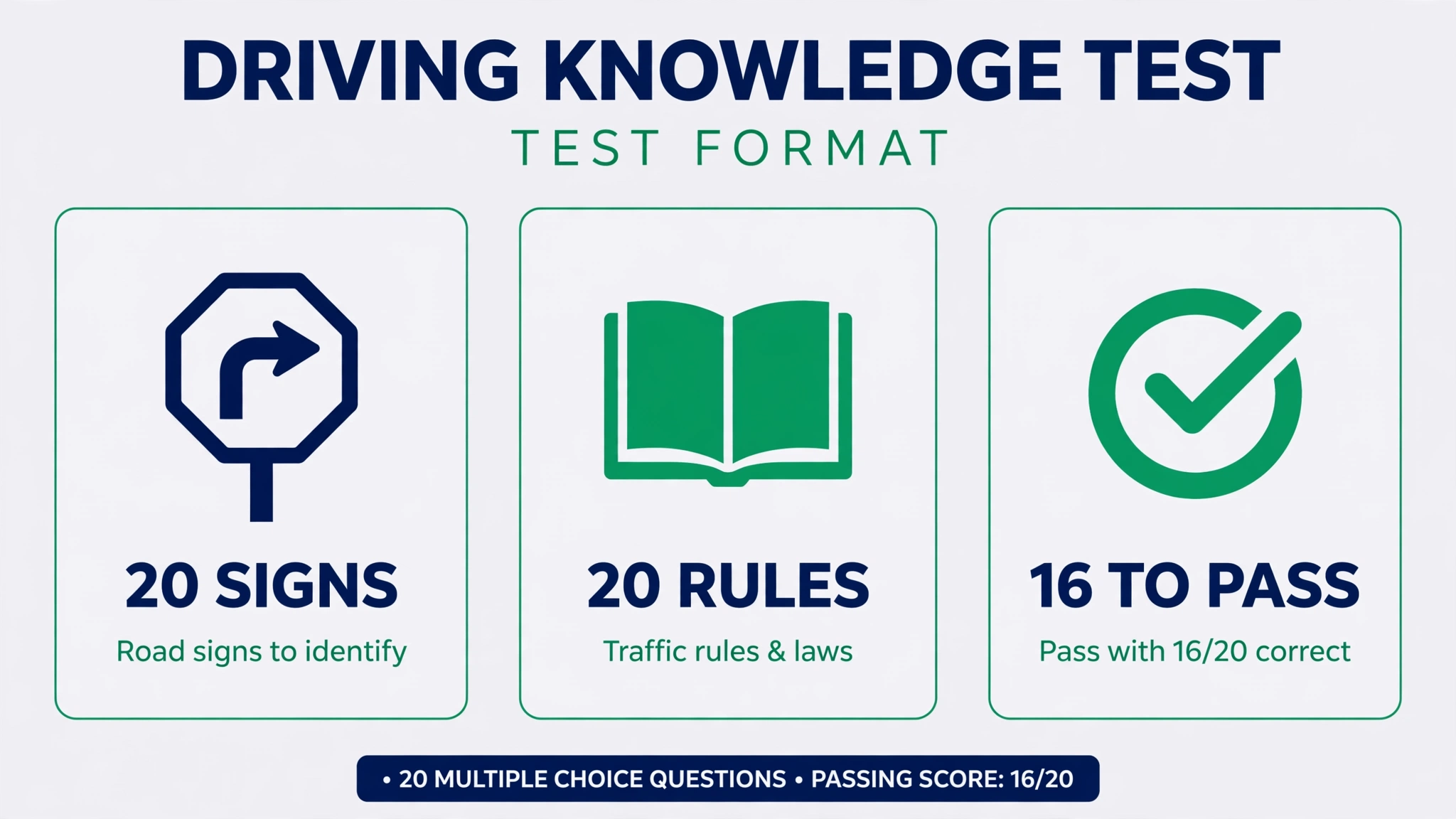
The widely reported format of the G1 knowledge test is 40 multiple-choice questions split into two sections: 20 on road signs and 20 on rules of the road. The signs section covers regulatory, warning, and information signs. The rules section covers right-of-way, speed limits, parking, turning, signalling, and safe-driving rules from the handbook.
Because the two sections test different skills, most learners find one harder than the other. Road signs reward visual memorisation — our guide to Ontario road signs you need to know breaks the big ones down. Rules reward understanding how situations work — see how to study G1 rules of the road for a method that sticks.
How G1 Scoring Works
Here is the part that surprises people: you need at least 16 correct out of 20 in each section. A perfect score on signs cannot rescue a weak rules section. Both sections must be passed in the same sitting.
That is why this practice test scores the two sections separately and tells you exactly where you stand. If you want to play with the numbers, the G1 score calculator shows what different scores mean for your result.
Note: The 40-question, 16-per-section format is widely reported by test-takers and prep providers. The Ministry does not publish the exact question count, so treat this practice test as a realistic rehearsal, not a copy of the official exam.
Road Signs: What to Study
Sign questions are the most visual part of the test. Study regulatory signs first (stop, yield, speed limits, one-way, do-not-enter), then warning signs (curves, pedestrian crossings, railway crossings, construction zones), then information and direction signs.
Do not just memorise shapes — learn what each sign asks you to do. A warning sign for a hidden intersection means something different from a regulatory sign banning a turn, and the test loves that distinction. Our road-sign memorisation guide and the warning-signs explainer go deeper on each family.
Rules of the Road: What to Study

The rules section is where most failures happen. Focus on right-of-way at intersections, school bus rules, following distance, speed limits in school and community zones, parking on hills, signalling distance, emergency vehicles, and railway crossings.
Read each practice question twice before answering — the wrong options are designed to sound almost right. In Practice Mode above, every explanation tells you the reasoning, not just the answer, so a mistake becomes a lesson.
Tip: Study in short daily sessions rather than one long cram. Twenty focused minutes a day for two weeks beats a single frantic weekend.
How to Use This Practice Test
Start in Practice Mode. Answer questions, read every explanation, and note the topics you miss. When your weak spots shrink, switch to Exam Mode for a full 40-question run with no hints — that is your dress rehearsal.
Aim to pass both sections comfortably several times in a row before booking your test day. If you are unsure whether you are ready, this readiness checklist helps you decide honestly.
Practice in your language: this test is also available in several languages.
G1 Licence Restrictions You Must Know
Passing the test is only the beginning. As a G1 driver, Ontario law requires you to keep your blood alcohol at zero, make sure every passenger wears a working seatbelt, never drive between midnight and 5 a.m., and stay off 400-series highways and other high-speed expressways.
You must always drive with a fully licensed driver who has at least four years of experience and a blood alcohol level under 0.05 — and that person must be the only other person in the front seat. Breaking these conditions can cost you the licence you just earned.
Remember: Zero alcohol means zero. As a G1 driver, any detectable alcohol in your system while driving violates your licence conditions.
After You Pass: Your Next Steps
With a G1 in hand, you practise under supervision — usually for 12 months, or 8 months if you complete an approved beginner driver education course. Then comes the G2 road test, then more supervised-free practice, then the full G road test.
Want the whole journey mapped out with dates? The G licence timeline planner builds a personal schedule from your G1 pass date.
Test-Day Tips
- Sleep well the night before. A tired brain misreads questions.
- Arrive early with the identification listed on Ontario’s official new-driver page.
- Read every question twice. The test rewards careful readers.
- If a question stumps you, eliminate the obviously wrong options first.
- Trust your preparation. Second-guessing right answers is a classic way to lose marks.
For a fuller game plan, read how to pass the G1 test on your first try.
Frequently Asked Questions
How many questions are on the Ontario G1 knowledge test?
The G1 knowledge test has 40 multiple-choice questions: 20 on road signs and 20 on rules of the road.
What score do you need to pass the G1 test?
You must answer at least 16 out of 20 questions correctly in each section — 80% on road signs and 80% on rules of the road.
Is the Ontario G1 test multiple choice?
Yes. Every question on the G1 knowledge test is multiple choice with four answer options.
How long does the G1 knowledge test take?
Most people finish in 20 to 30 minutes. The test is not strictly timed, and your answers are marked immediately.
What do you need to bring to the G1 test in Ontario?
Bring acceptable identification that proves your legal name, date of birth, and signature. Check the DriveTest website for the current list of accepted documents before you go.
Do you have a motorcycle (M1) practice test?
Yes — try our free M1 motorcycle practice test with 64 questions on motorcycle skills, road signs, and rules of the road, plus a 200-question M1 question bank for deeper study.
An Important Note About This Practice Test
This is a free, unofficial practice test created for study purposes. It is not affiliated with, endorsed by, or connected to DriveTest, the Ontario Ministry of Transportation, or the Government of Ontario. The real G1 knowledge test is written at a DriveTest centre, and its questions will differ from the ones here.
Use this test alongside the Official MTO Driver’s Handbook for the best preparation. Good luck — study well, drive safe.