

How to Practice for the G1 Test Online
Online practice tests are the closest thing to a rehearsal for the Ontario G1 knowledge test. They show you the question style, the pacing, and the gaps in your knowledge before test day ever arrives.
But clicking through random questions teaches you very little. This guide shows you how to practice online with a real method — so every session moves your score upward.
What Online Practice Actually Does for You
Practice tests train recognition. You learn how road signs look in question form, how rules get phrased, and how test writers try to trip you up.
They also build stamina. Forty questions demand steady focus, and that focus is a skill you can train at your desk.
What practice cannot do is teach a topic you never learned. If an entire subject feels foreign, read the chapter first — our guide to studying with the Ontario Driver’s Handbook shows a chapter-by-chapter method — then practice it.
- Faster recognition of sign shapes and colours
- Familiarity with how rule questions are worded
- A clear, honest list of your weak topics
- Confidence built from real, tracked progress
Start With Short Section Drills
Begin with ten-question sets on a single topic — just road signs, or just right-of-way. Small sets isolate your gaps instead of hiding them.
Full mock exams too early create noise. You finish with a score but no idea which topic dragged it down.
Spend your first practice days on drills. Mocks come later, once the drills feel steady.
Grow your drill size as your accuracy improves. Move from ten-question sets to fifteen, then twenty — longer sets build the focus the full test demands.
Keep drills untimed at first so you can think each question through. Add a loose timer only after your accuracy is solid — speed without accuracy is just fast guessing.
The Practice Loop That Makes Scores Stick
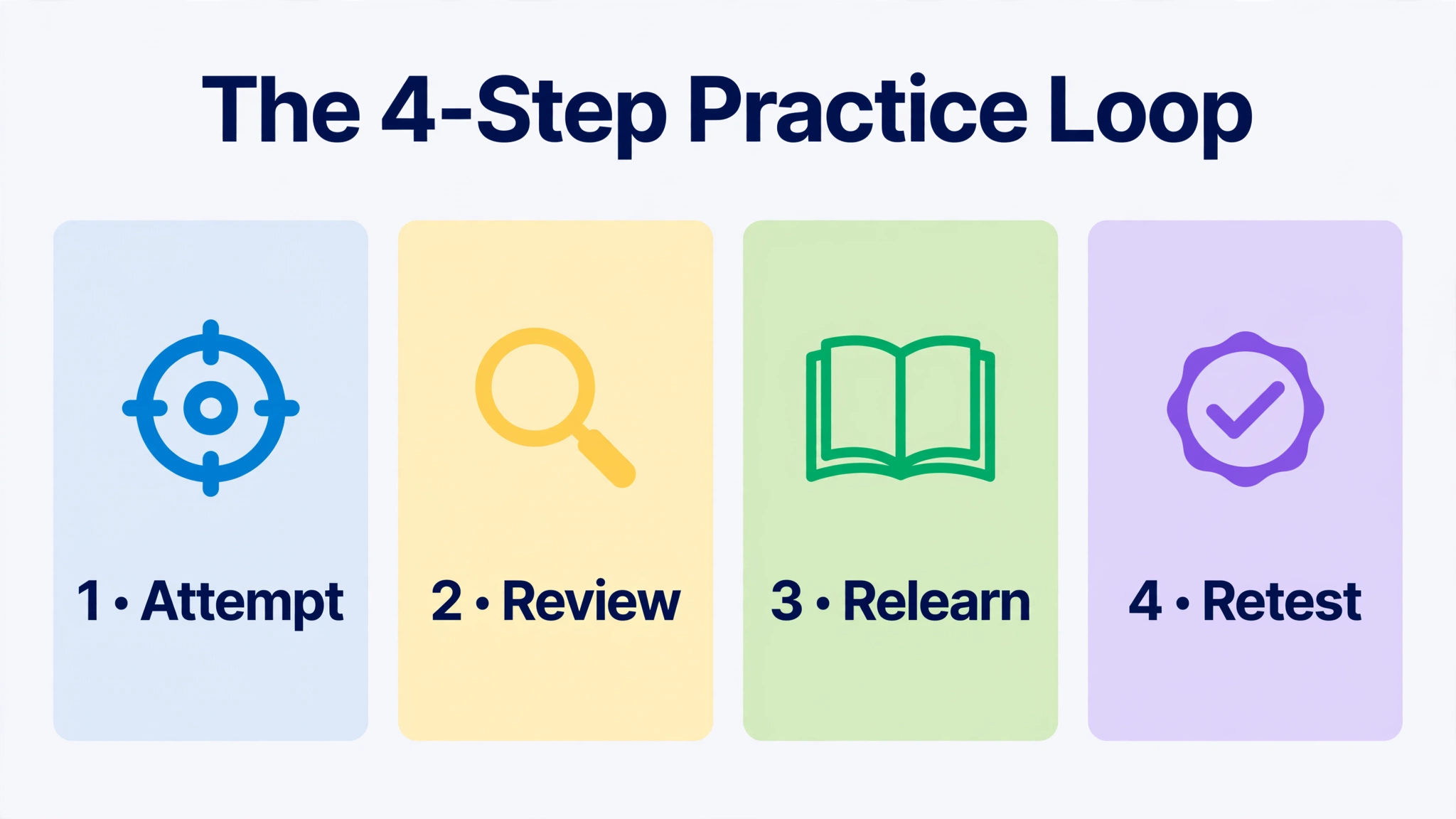
The difference between learners who improve and learners who plateau is what happens after they answer. Follow this loop every session:
- Attempt a set without looking anything up. Guessing is fine — it shows you the truth.
- Review every wrong answer, plus every right answer you guessed on.
- Relearn the rule or sign behind each miss from the handbook or your notes.
- Retest the same topic the next day to confirm it stuck.
Four steps, repeated daily. That loop turns a question bank into a teacher.
How to Review a Wrong Answer So It Sticks
Never settle for memorizing the correct letter. Letters change from test to test; the rule behind the question does not.
Write the rule in your own words — one sentence. Then picture the situation: the sign on its post, or your car at that intersection.
Keep an error log: one line per miss, in a notebook or a phone note. Read it before every practice session.
Mix Signs and Rules the Way the Test Does
The G1 test has two sections: twenty sign questions and twenty rules questions. You need 16 out of 20 in each section to pass.
The passing rule applies to each section separately, as explained in our guide to what score you need to pass the G1 test — a strong signs score cannot rescue weak rules.
So train both sides every session. One sign drill plus one rules drill keeps you balanced.
Vary the order too. Always doing signs first teaches your brain a sequence; the real test mixes everything, so your practice should shuffle as well.
Learners who drill only signs often discover — too late — that right-of-way scenarios were their real weakness.
Practice Under Real Conditions Once a Week
At least weekly, simulate test day. Quiet room, phone away, no pausing, and answer every question in one sitting.
The real test is multiple choice with four options. Train yourself to read all four before choosing — rushing to the first plausible answer is the most common way to lose marks.
Time yourself loosely. The centre gives you plenty of time, but hesitation on a question is a signal — it marks a topic to relearn.
After each simulated test, do a full review before your next session. A mock without review is just a score — the learning happens in the hour after.

Track Your Scores and Read What They Tell You
Log every set: date, topic, score. A notebook or a simple spreadsheet works — the tool matters less than the habit.
After two weeks, your log becomes a map of exactly where your study time should go.
Watch for these patterns in your log:
- The same sign shapes keep tripping you → drill sign families together
- Right-of-way scenarios keep failing → relearn intersection rules
- Scores swing wildly → you are guessing too much, so slow down
- One topic lags everything else → give it a dedicated day

Hitting a plateau usually means the method needs to change, not the effort. Switch drills for mocks, or relearn the weak chapter from scratch.
Mistakes That Make Online Practice Useless
Online practice fails for predictable reasons. Avoid these five:
- Retaking the same question set until you memorize the answers instead of the rules.
- Skipping the explanations and moving on to the next question.
- Practicing only your strong topics because high scores feel good.
- Cramming hundreds of questions the night before the test.
- Using a single question bank forever — different phrasings build real flexibility.
On that last point: trying a second source of questions exposes you to new wording. Our honest comparison of free G1 practice sites in Ontario can help you pick one.
Notice what all five mistakes share: they protect your comfort instead of attacking your gaps.
When to Move From Drills to Full Mock Exams
Switch to full 40-question mocks when your section drills score steadily above the pass mark. Mocks test stamina and balance, not just knowledge.
Space mocks two or three days apart. Use the days between for targeted relearning of whatever the mock exposed.
The day before the test, go light. A short review of your error log beats a marathon session.
You can run full practice sets right here with our free Ontario G1 practice test — fifty questions, no signup needed.
A Simple Weekly Practice Routine
You do not need a complicated schedule. This one works for most learners:
- Monday, Wednesday, Friday: two 10-question drills (signs plus rules), about 20 minutes
- Tuesday, Thursday: review your error log and relearn the weak topics
- Saturday: one full mock under test conditions
- Sunday: rest — or a light sign review if you feel like it
Short on time? Even three 20-minute sessions a week beat one exhausting weekend marathon.
Quick Answers About Practicing Online
How Many Practice Questions Should I Do Before the Test?
There is no magic number. Aim for steady scores above the 16-out-of-20 section pass mark on mixed mocks — that signal matters more than any question count.
Can I Pass Using Only Online Practice Tests?
Some learners do, but practice tests check knowledge — they do not teach it from zero. Pair them with the handbook for any topic that feels new.
Are Online Practice Questions the Same as the Real Test?
No. Good practice questions mirror the style and topics of the real test, but nobody outside the test centre has the actual questions. Be wary of any site claiming otherwise.
Should I Practice on My Phone or a Computer?
Either works for learning, but the test centre uses a computer screen. Do at least some of your mocks on a larger screen so the format feels familiar.
Is It Better to Practice Signs or Rules First?
Start with whichever is weaker, then alternate. The test weights them equally, so your practice should too.
How Do I Stop Second-Guessing My Answers?
Second-guessing without new information usually hurts more than it helps. If you studied the topic, trust your first answer and move on.
Flag the question mentally instead of agonizing over it. You can review the topic afterward — during the test, momentum matters.
What Should I Do the Day Before the Test?
Go light. Review your error log once, skim your weakest sign families, and stop early — no new topics the night before.
Sleep matters more than one more drill. A rested brain recalls rules far better than a crammed one.
This guide is unofficial study material for practice purposes only. It is not affiliated with DriveTest, the Ministry of Transportation of Ontario, or the Government of Ontario, and it does not use real test questions.
Want 300 More Practice Questions?
The Premium Question Bank gives you 6 full mock exams with a plain-language explanation for every answer. Instant PDF download, yours to keep.
Get the Question Bank – $9.99Original handbook-mapped questions. Not real DriveTest questions. No pass promises – just serious practice.





2 Comments