

What Are the Requirements for a G1 Licence in Ontario?
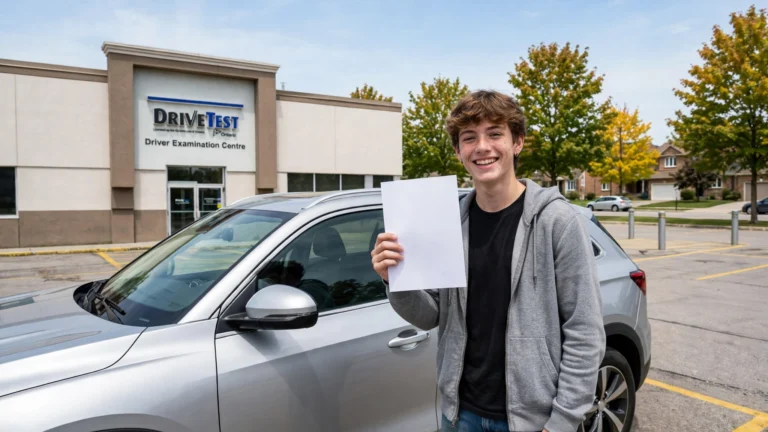
You can walk into a DriveTest centre as early as your sixteenth birthday — but only if every box on the requirements list is checked first.
Miss one, and the most common outcome is a wasted trip: you get turned away at the counter before you ever sit down at the test screen.
The Complete G1 Requirements Checklist
This guide puts every Ontario G1 requirement in one place, so you can confirm you qualify, gather what you need, and apply with confidence.
To apply for a G1 licence in Ontario, you must:
- Be at least 16 years old on the day you apply.
- Prove your identity with accepted documents showing your legal name, date of birth, and signature.
- Pass a vision test at the DriveTest centre.
- Pass the 40-question G1 knowledge test — at least 16 out of 20 in each of the two sections.
- Pay the required fee for the knowledge test and licence package.
- Bring a parent or legal guardian to sign your application if you are under 18.
The rest of this guide explains each requirement in detail: exactly which documents count, what the vision test involves, how the knowledge test is scored, what the fee covers, and what trips people up most often.
If you are in a hurry, the checklist above is genuinely everything — the details below just make sure you don’t stumble on a technicality.
Requirement 1: You Must Be at Least 16 Years Old
Ontario sets the minimum age for a G1 at 16, with no exceptions and no early-application window. Your sixteenth birthday is the earliest day you can apply — not the week before, not with a parent’s permission, not if you are “almost” 16.
The date of birth on your identity documents is what counts, which is one more reason those documents need to be correct (more on that below).
If you are reading this months before your sixteenth birthday, use the time well: work through the 40 questions on the G1 test format now, and start reading the Ontario Driver’s Handbook.
Age is the one requirement you can’t rush, but preparation is the one thing you can get ahead of.
Requirement 2: Prove Who You Are — the Identity Documents That Count
This is the requirement that sends more people home than any other. DriveTest needs proof of three things from your documents: your legal name, your date of birth, and your signature.
Acceptable documents include a Canadian or U.S. birth certificate, a passport, a Canadian citizenship card, a permanent resident card, or a record of landing, along with documents that establish your signature.
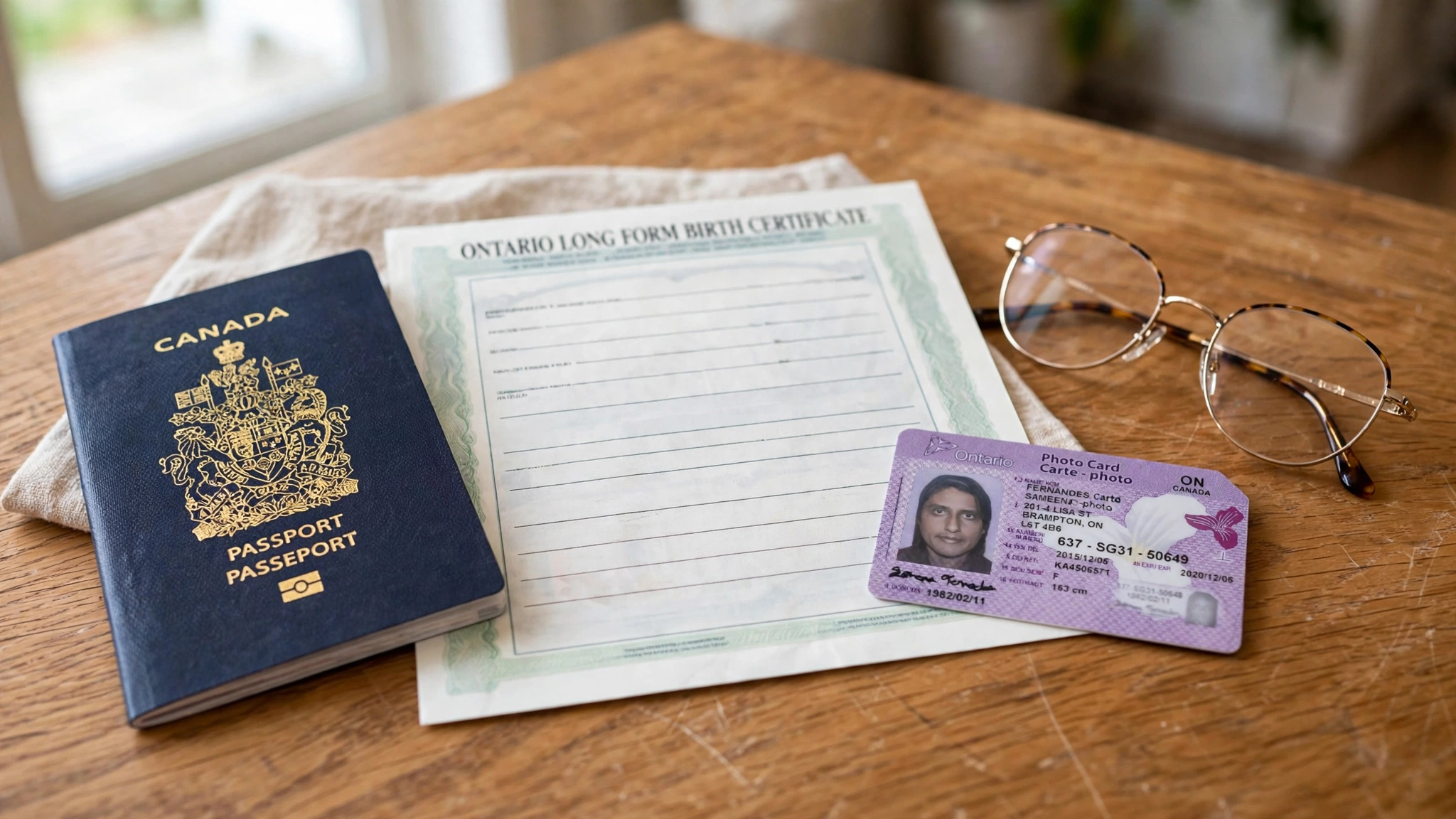
Four document rules catch first-time applicants off guard:
- Originals only. Photocopies and phone photos will not be accepted, no matter how crisp they look.
- Names must match. If your name has changed or differs between documents, bring supporting proof of legal name such as a marriage certificate, change-of-name certificate, or court order.
- A parent or guardian cannot vouch for you. Direct identification by a parent or guardian is explicitly not acceptable — your documents have to speak for themselves, even if your parent is standing right there.
- Expired or damaged documents can be refused. A passport with a missing page or an ID card that is unreadable is as good as no ID at all.
If you are a newcomer to Ontario, bring your immigration documents (such as a permanent resident card or record of landing) alongside proof of your Ontario address, like a bank statement or utility bill with your current address.
DriveTest may also ask for proof that you live in Ontario, so having one piece of mail with your name and Ontario address in your folder costs nothing and can save your trip.
Requirement 3: Pass the Vision Test
Before you touch the knowledge test, you will take a short vision test at the DriveTest centre.
It checks that your eyesight meets Ontario’s minimum standard for driving — reading letters or symbols at a distance, much like the chart at your optometrist’s office.

The practical upshot is simple: if you wear glasses or contact lenses, bring them.
If you fail the vision screening, you can’t continue with the application that day — you’ll need to get your vision corrected (usually a trip to your optometrist for a prescription or updated lenses) and come back.
Nobody fails this test because they didn’t study; they fail it because they left their glasses on the kitchen counter. Don’t be that person.
Requirement 4: Pass the 40-Question Knowledge Test
The knowledge test is the centerpiece of the requirements — it’s the only part you actually study for.
The format: 40 questions split into two sections of 20 (road signs, and rules of the road), and you must score at least 16 out of 20 in each section. Passing one section brilliantly doesn’t cover a weak score in the other.
Here’s exactly how the passing score works, including what happens when you pass one section and fail the other.
A few facts that surprise first-timers:
- Every question is multiple choice. There are no written answers and no trick formats — every single G1 question works the same way, so you can prepare one strategy and use it forty times.
- Most centres run it on a computer, though paper versions exist at some locations.
- It is offered in many languages at most DriveTest centres — English and French are standard everywhere, with additional languages available on computer-based tests at many locations.
- You can retake it if you fail. There is no waiting period that locks you out permanently, and no limit on attempts — here’s how retakes work and what each one costs. You just pay the fee again and go when you’re ready.
The honest version of this requirement: the knowledge test is the only requirement you can fail because of you, which makes it the only one worth losing sleep over — and the only one practice fixes.
Our free practice tests on the homepage follow the same two-section structure, so you can rehearse under realistic conditions before you pay for the real thing.
Requirement 5: Pay the Fee
Getting your G1 costs money — there is no free version of the licence. What you pay covers a package: the knowledge test itself, your future G2 road test further down the line, and a five-year licence.
Think of it as the entry fee to the whole graduated licensing journey, not just a single test.
The knowledge-test portion runs about $16 at the time of writing; the full package costs more, so check the current total on the DriveTest website before you go — fees change, and this article won’t chase them.
Bring a debit card, credit card, or cash to pay at the counter. And note the retake rule from the previous section: each additional knowledge-test attempt costs the fee again, so every failed attempt literally costs you.
Preparation is cheaper than retakes.
Under 18? One Extra Requirement: a Parent or Guardian’s Consent
If you are under 18, DriveTest needs a parent or legal guardian involved in your application. In practice, this means bringing a parent or guardian with you so they can sign the application on your behalf at the centre.
Remember the document rule from Requirement 2: they can sign for you, but they cannot vouch as your identity — your own documents still have to check out.
The most common under-18 failure mode is logistical: the teenager shows up alone, everything else is perfect, and the application can’t proceed without a guardian’s signature.
If you are 16 or 17, your parent or guardian is part of your checklist, not optional company.
What to Bring on Test Day: the Short Version
Pulling the requirements together, here is your bring-list for the day you walk into a DriveTest centre:
- Identity documents proving legal name, date of birth, and signature (originals, not copies)
- Proof of Ontario address, just in case (a bank statement or bill with your name on it)
- Glasses or contact lenses, if you use them
- A way to pay the fee (debit, credit, or cash)
- A parent or legal guardian, if you are under 18
- A studied brain — the one requirement no counter can provide

Pack all of it the night before. The counter staff process hundreds of applicants; they can’t bend document rules for a good story.
Where You Apply: DriveTest Centres
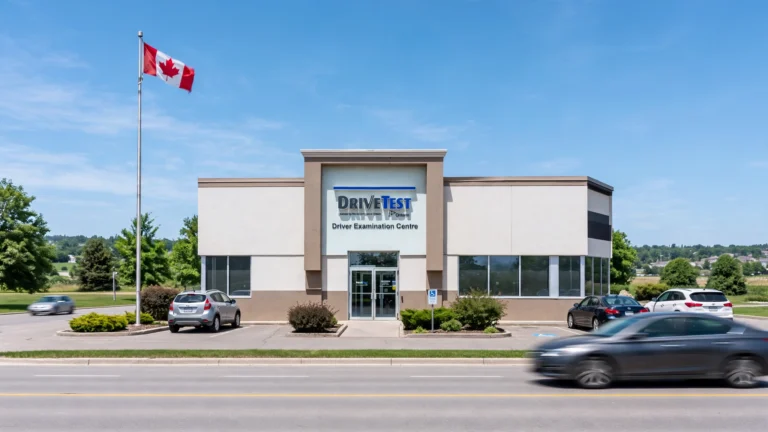
G1 knowledge tests are taken at DriveTest centres across Ontario — the same network that handles road tests.
Most centres accept G1 applicants as walk-ins, so no appointment is needed at many locations, though arriving early matters: centres can fill up, and some locations have specific hours for knowledge tests.
Look up your nearest centre and its hours on the DriveTest website before you make the trip, and bring everything on the list above the first time.
What the Requirements Unlock: Your G1 Licence
Meet all six items on the checklist and you walk out with a G1 licence — the first level of Ontario’s graduated licensing system.
It comes with training-wheels restrictions: you must always drive with a fully licensed driver (at least four years of experience) beside you, keep your blood alcohol at zero, and stay off high-speed roads and out of late-night driving hours.
These restrictions aren’t punishments; they’re the guardrails of the graduated system, and they fall away as you move toward your G2 and full G.
Requirements Questions, Answered
Can I Apply for My G1 Before I Turn 16?
No. You must be at least 16 years old on the day you apply, and your date of birth is verified from your identity documents. There is no early-application option.
Do I Need an Ontario Health Card for ID?
Your health card alone isn’t the standard route — DriveTest wants documents proving legal name, date of birth, and signature, such as a birth certificate, passport, or citizenship card. Bring the strongest documents you have, originals only.
Can I Take the Knowledge Test in a Language Other Than English or French?
At many DriveTest centres, yes — the computer-based test is available in many languages. Paper versions are English and French only. Check with your local centre about language availability before you go.
What If I Fail the Knowledge Test?
You can retake it — there is no cap on attempts, and you pay the knowledge-test fee again each time. Study the sections you missed, practise until your scores are consistently above the pass line, then go back.
Do I Need to Be an Ontario Resident?
The G1 is an Ontario licence, so yes — this process is for Ontario residents. If you’ve just moved to the province, bring proof of your Ontario address along with your identity documents.
Is There a Medical Exam?
There is no separate medical exam for a standard G1 application. The vision test at the centre is the health-related screening most applicants encounter.
If you have a medical condition that could affect your ability to drive safely, disclose it as the application asks — honesty at this stage protects your licence later.
Your Move: Run the Checklist Tonight
The G1 requirements are not hard — they’re just unforgiving of assumptions. Tonight, pull your documents out of wherever they live, check the name and birth date on each one, confirm they’re originals, and find your glasses.
If you’re under 18, text your parent now and lock in the trip. Then spend your remaining energy where it actually changes the outcome: studying.
The age, ID, vision, and fee requirements are pass/fail at the counter — the knowledge test is the one requirement you earn. Earn it with practice, and walk in ready.
Disclaimer: This article is unofficial practice and information material for the Ontario G1 knowledge test. It is not affiliated with, endorsed by, or connected to DriveTest or the Government of Ontario.
Requirements, fees, and procedures can change — always confirm current details on the official DriveTest website before your visit.
Want 300 More Practice Questions?
The Premium Question Bank gives you 6 full mock exams with a plain-language explanation for every answer. Instant PDF download, yours to keep.
Get the Question Bank – $9.99Original handbook-mapped questions. Not real DriveTest questions. No pass promises – just serious practice.

3 Comments