Ontario School Bus Rules for the G1 Test
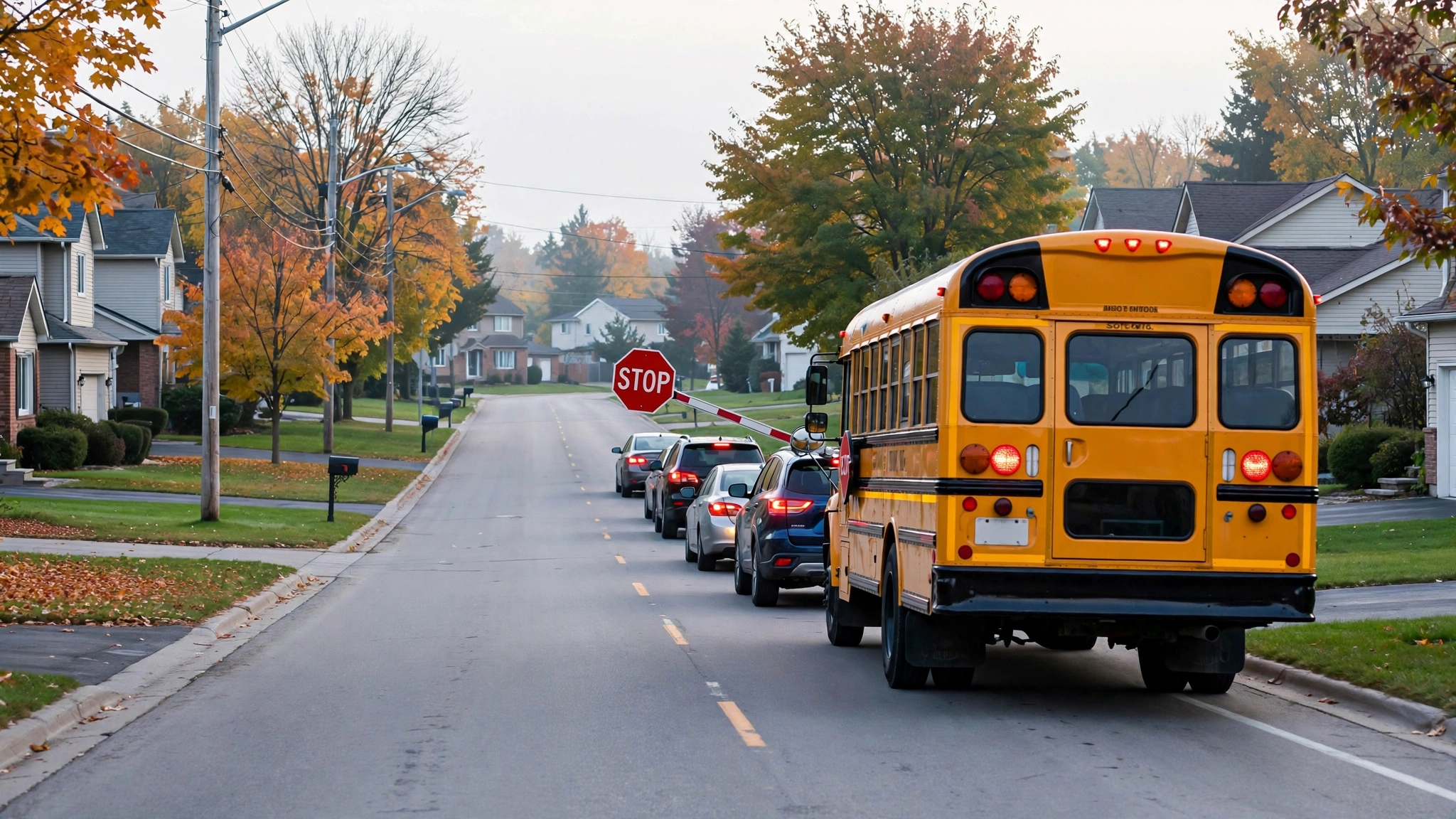
Picture this: you’re driving down a quiet residential street when the yellow bus ahead slows, its red lights start flashing, and a stop sign swings out from its side. What you do in the next five seconds is one of the most-tested rules on the entire G1 knowledge test — and one of the easiest to get wrong under pressure.
Ontario’s school bus law is short, strict, and unforgiving. This guide breaks it into plain language: exactly when you must stop, the one exception most learners miss, how far back to stay, and what happens if you blow past those flashing reds.
The Core Rule in One Sentence
Whenever you approach a stopped school bus with its upper red lights flashing — from behind or head-on — you must stop. You then stay stopped until the bus moves or the lights stop flashing.
That is the entire rule in one breath. Everything else on this page is detail around it: how far back, who is exempt, and how the G1 test tries to trip you up.
Key fact: The school bus law applies on every road in Ontario — highways, county roads, city streets, and village roads — no matter the speed limit or the number of lanes.
Who Has to Stop: Both Directions
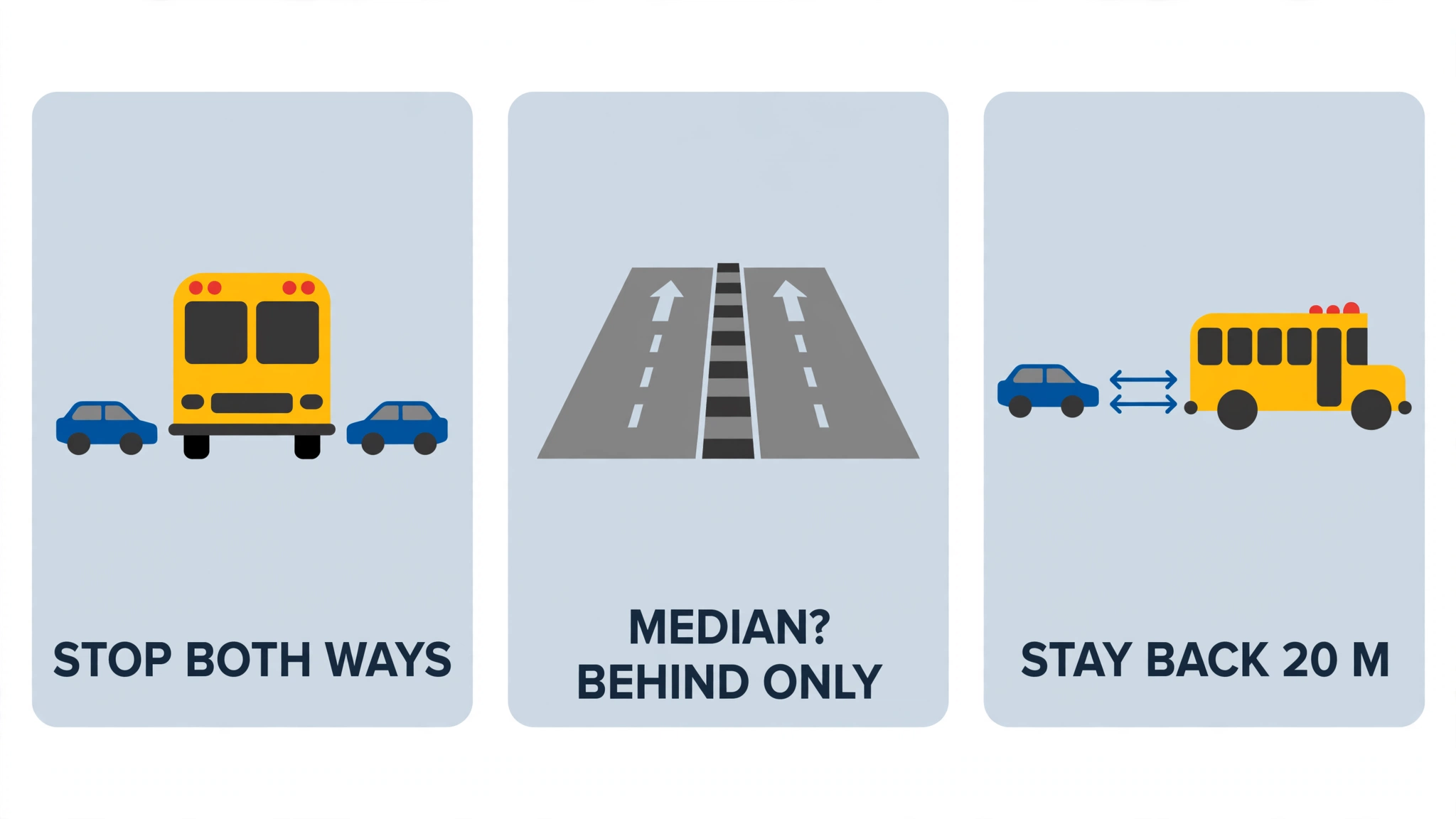
Traffic in both directions must stop. That surprises new drivers, because most stopping rules apply only to your own lane. With a school bus, the oncoming lane stops too.
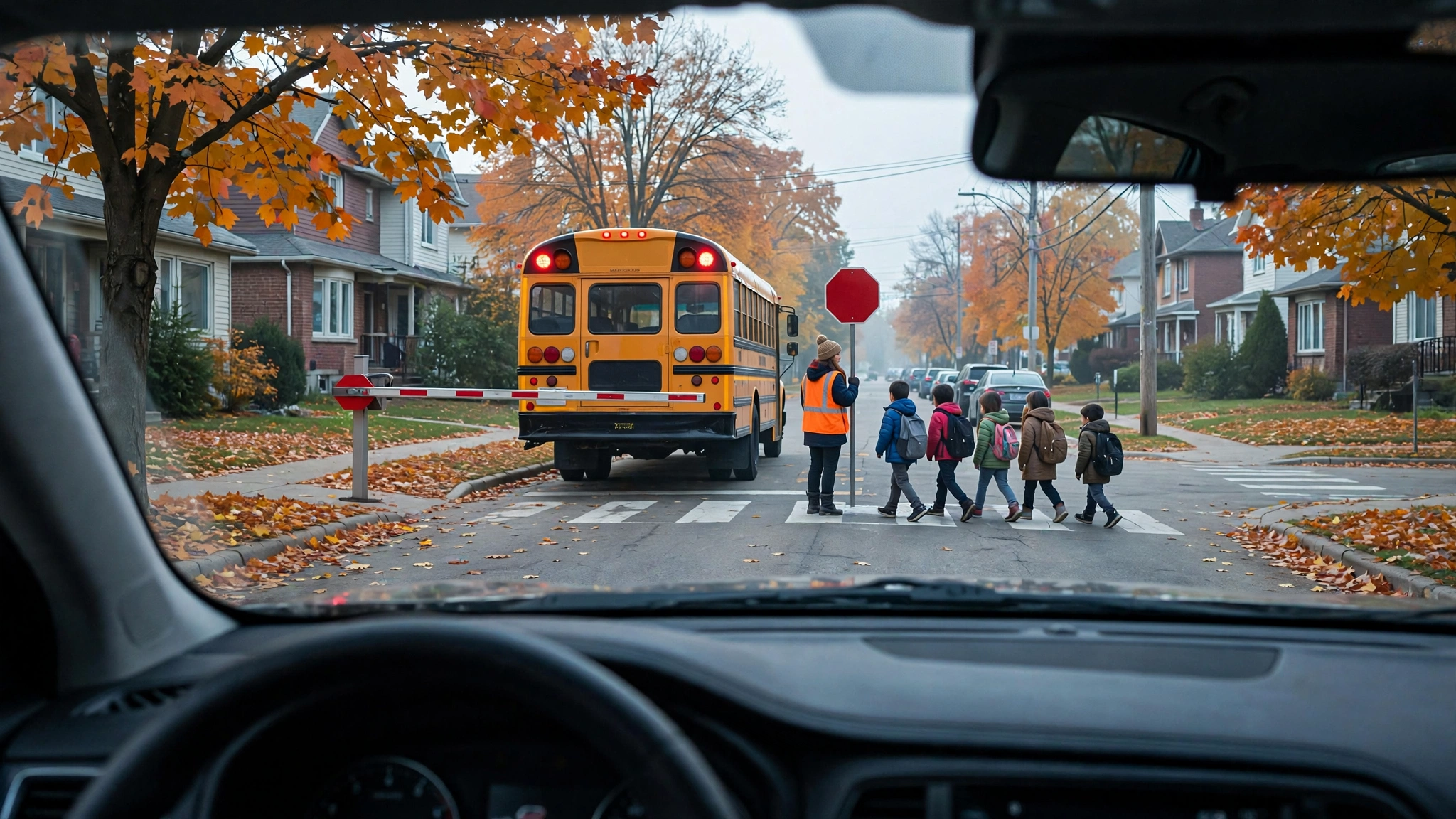
The reason is straightforward. Children step off the bus and may cross the road right in front of it. An oncoming driver who keeps rolling would drive straight through their path.
It makes no difference whether the bus is picking children up or dropping them off, and it does not matter how wide the road is. Red lights flashing means a full stop, both ways.
Tip: On the test, treat “both directions” as the default answer. The only thing that can change it is a median — which gets its own section next.
The One Exception: A Road With a Median
There is exactly one exception, and the G1 test loves it. On a road divided by a median — a raised, lowered, or earth strip separating the two directions of travel — only the vehicles behind the bus must stop.
Traffic on the far side of the median may keep going. The physical barrier is what makes it safe: children cannot cross a strip they cannot walk through.
Caution: A painted centre line is NOT a median. If the two directions are separated by paint alone, oncoming traffic must still stop.
If a test question shows a divided road, check what the divider is made of. A concrete barrier, grass strip, or raised island counts as a median. Paint is just a line — and with paint, everyone stops.
How Far Back to Stop
Approaching from behind the bus, stop at least 20 metres before reaching it. That is roughly four to five car lengths — noticeably more room than most new drivers leave.
Approaching from the front, the handbook phrases it differently: stop at a safe distance so children can get off and cross in front of you. Memorize the exact 20-metre figure for the from-behind case — the test asks for it directly.
Once you are stopped, stay stopped. Do not creep forward for a better view, and do not inch toward the bus while children are still around it.
Read the Bus Before the Reds Come On
School buses telegraph their stops. The upper alternating red lights start flashing first, and then the stop arm — a small stop sign on the driver’s side with its own flashing red lights — swings out into the lane.
Your stop is not over when the arm folds away if the lights are still flashing. Wait until every light has stopped flashing, or the bus starts moving — whichever comes first.
One odd detail worth banking: school buses must stop at every railway crossing, and they do it without the red lights. If you see a bus paused at the tracks with no lights on, just wait behind it — that stop is mandatory for the driver.
A School Bus Is Not a School Zone
Learners mix these two up constantly. A school zone sign with a reduced speed limit controls how fast you may drive near a school. The school bus law controls whether you stop for a stopped bus. Different signs, different rules.
The bus rule also follows the bus, not the clock. Be ready to stop for a school bus at any time of day — not just during school hours and not just near a school.
Tip: On the test, a question mentioning a speed number near a school is testing speed limits. A question mentioning flashing red lights on a bus is testing the stopping rule. Spot which one you are being asked.
The Penalty Is Steeper Than You Think
Failing to stop for a school bus carries some of the harshest penalties in the Ontario driver’s handbook. A first conviction brings a fine of $400 to $2,000 — plus six demerit points on your driving record.
A second conviction within five years pushes the fine to $1,000 to $4,000, keeps the six points, and can add up to six months in jail. These figures were checked against current Ontario sources while writing this article.
Owners are not off the hook either. If the driver cannot be identified, the registered owner of the vehicle can still be fined. School bus drivers and other witnesses are allowed to report vehicles that pass illegally.
How the G1 Test Actually Asks About School Buses
School bus questions sit in the rules-of-the-road half of the test: twenty questions, and you need at least sixteen correct to pass that section. You can check exactly how the 16-out-of-20 passing rule works before you book your test.
The questions cluster around four scenarios: whether oncoming traffic must stop, the median exception, the 20-metre distance, and when you may start moving again. If you can answer those four without hesitating, you own this topic.
The classic trap shows a divided road and invites you to stop both directions. A real median lets the far side keep driving — but a painted line does not. Read what the divider is made of before you answer.
School buses are one small piece of the rules of the road every G1 student should know, and the stopping rule is really a yielding rule: the children crossing in front of the bus always have the right of way, no matter who arrived first.
Your Four-Step Stop Routine
Turn the law into a habit with the same four steps every time you see a school bus ahead:
- Scan ahead. When a yellow bus appears ahead, ease off the gas and watch its lights. Anticipation gives you a smooth stop instead of a panic brake.
- Stop early. Reds on means wheels stopped: at least 20 metres back when you are behind the bus, or at a safe distance when you are facing it.
- Check both ways. Glance at oncoming traffic. If there is no median, they should be stopping too — children may be crossing in front of the bus.
- Wait it out. Stay put until the bus moves or every light stops flashing. Take one last look for stragglers before you roll forward.
Key fact: Never pass a stopped school bus to save time — on a residential street the bus will stop again in a few hundred metres anyway, and the penalty for passing starts at $400 plus six demerit points.
School Bus Questions, Answered
Do I have to stop if the bus is on the other side of a wide four-lane road?
Yes. The number of lanes changes nothing. Only a physical median excuses oncoming traffic — paint, no matter how wide the road, does not.
What if the bus is slowing down but the red lights are not on yet?
Cover your brake and get ready. The law triggers when the red lights flash and the stop arm swings out, but a slowing bus is your early warning — never try to squeeze past before the lights come on.
Can I drive past a school bus that is stopped with no lights flashing?
Yes. With the reds off and the stop arm folded in, the bus is just another vehicle in traffic. Proceed normally — but stay alert, because children may still be nearby.
What are “upper alternating red lights”?
That is the handbook’s formal name for the pair of red lamps at the top front and rear of the bus that blink back and forth. G1 questions often use this exact phrase instead of just saying “red lights” — when you see it, they are describing the full stop rule.
Do G1 drivers face any extra school-bus restrictions?
No. The school bus law applies equally to every driver, G1 holders included. Six demerit points is six points, whatever licence is in your wallet.
This article is unofficial study material for the Ontario G1 knowledge test. It is not affiliated with DriveTest, the Ministry of Transportation, or the Government of Ontario, and it does not use real test questions. Road rules can change, so confirm the current wording in the Ontario Driver’s Handbook before your test.
Want 300 More Practice Questions?
The Premium Question Bank gives you 6 full mock exams with a plain-language explanation for every answer. Instant PDF download, yours to keep.
Original handbook-mapped questions. Not real DriveTest questions. No pass promises – just serious practice.