Ontario Lane Change Rules Explained
Every drive you will ever take is stitched together from lane changes. Merging onto a road, moving over for a cyclist, setting up for a turn — each one is a small negotiation with the traffic around you. The G1 test treats it that way too.
Lane-change questions on the test are rarely about the manoeuvre alone. They test the judgment behind it: when to signal, what to check, and which markings forbid the move entirely. This guide breaks it all down so you answer the way the handbook expects.
What Counts as a Lane Change on the G1 Test
A lane change is any move from one marked lane to another on the same road. That covers moving over to pass, shifting lanes to set up for an exit, and repositioning on a busy multi-lane street.
Turning from a side street into a multi-lane road counts as well. You are not just joining traffic — you are choosing a lane, so every check in the sequence still applies.
What is not a lane change: following your lane through a curve, or drifting slightly within a wide unmarked lane. Even then, keep your position steady and predictable so others can read your intentions.
SMOG: The Four Moves in Order
Driving instructors teach lane changes with a four-letter memory aid: SMOG — Signal, Mirror, Over-the-shoulder, Go. The order is the whole point. Each step feeds the next, and skipping one breaks the chain.
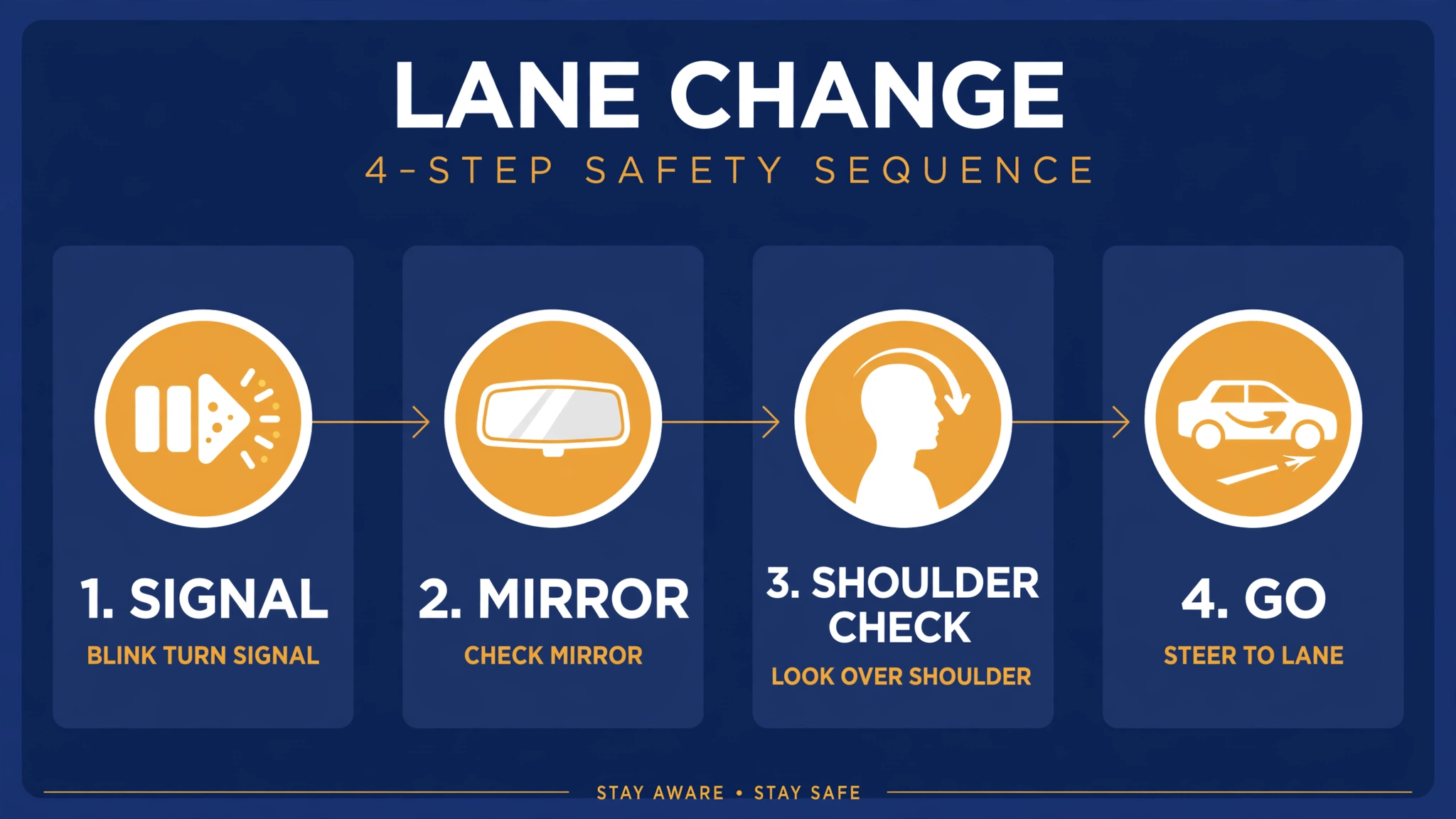
- Signal. Flip the indicator toward the lane you want before anything else. The signal is a message to surrounding drivers, and messages must go out before the action starts.
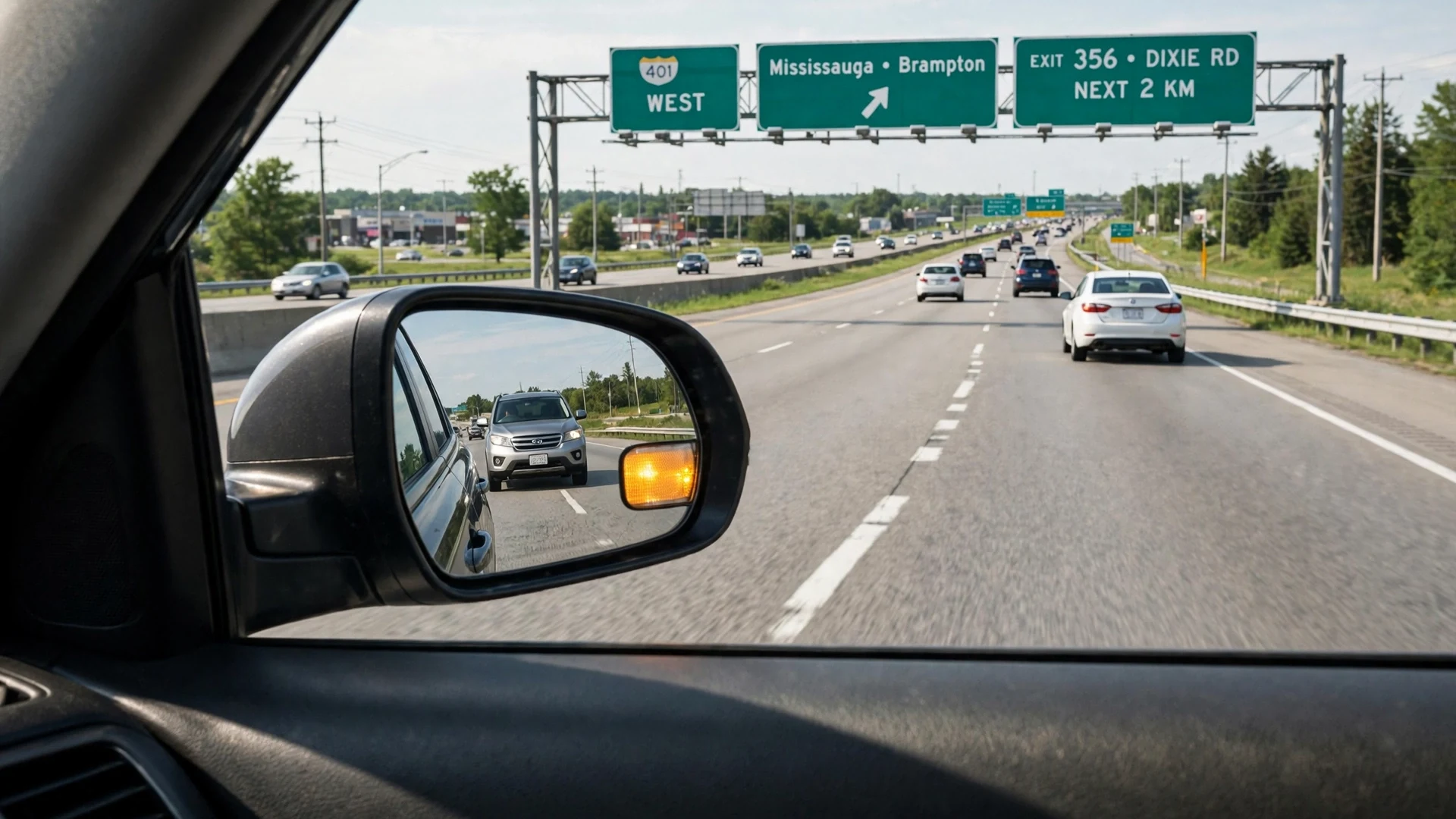
- Mirror. Check the rear-view mirror, then the side mirror on the side you are moving toward. You are looking for vehicles approaching in the target lane and judging their speed.
- Over-the-shoulder. Turn your head for a quick glance at the blind spot beside your car. This is the step mirrors cannot do for you.
- Go. If the lane is clear, steer smoothly into it without jerking the wheel. Hold your speed steady and cancel the signal once you are centred.
Tip: Signal before you check, not after. Many learners check first and signal while moving — but surrounding drivers need the warning before you start drifting toward them.
Judging the Gap Before You Move
A safe gap is space and time. There must be room in the target lane, and that room must still be there by the time your car arrives. Distance alone tells you nothing if the approaching vehicle is closing fast.
Watch the speed of traffic in the lane you want, not just the size of the opening. A distant car travelling much faster than you will reach the gap before you do.
Leave yourself a cushion you could defend. The same three-second following idea you use behind other cars works for the space you are moving into.
If you would be tailgating after the move, the gap is too small. A stopping distance calculator shows how quickly that cushion disappears at higher speeds.
Apply one brutal rule: if your lane change forces another driver to brake or swerve, it was not safe. A proper lane change is invisible to everyone else on the road.
Merging from an on-ramp is a lane change with a running start. Match the speed of highway traffic first, then run the same SMOG sequence. When two streams of traffic become one, the right-of-way rules decide who adjusts — the merging driver yields.
Blind Spots: Where Your Mirrors Stop Helping
Your mirrors show most of the road behind and beside you, but not all of it. Every vehicle has wedge-shaped blind zones just behind the rear side windows, exactly where a neighbouring car sits during a lane change.
Motorcycles and bicycles fit entirely inside a blind spot. The shoulder check exists largely for them — a rider you never saw in any mirror can be exactly where your car is heading.
The check itself is a quick glance, not a stare. Turn your head briefly toward the blind spot while keeping the steering wheel straight, then face forward again. Looking away for more than a heartbeat creates a new danger ahead.
Caution: A mirror check alone is never a complete lane change. On the G1 test, any answer that offers “check your mirrors” as the full procedure is the wrong answer — the shoulder check is mandatory.
When the Lines Say No
Lane markings are instructions painted on the asphalt, and the test expects you to read them. The two white lines that matter most for lane changes could not be more different.

- Broken white line: you may change lanes when it is safe. The dashes are permission, not an order — the SMOG sequence still applies.
- Solid white line: stay in your lane. The test treats crossing a solid white line to change lanes as the wrong choice, so treat it as a wall.
Never change lanes inside an intersection. Decide which lane you need before you enter, and hold it until you are through. Intersections already demand your full attention for signals, pedestrians, and turning traffic.
Bicycle lanes get the same respect as a full lane. Do not drive in them, and check them with a mirror and shoulder glance before crossing one to turn right — a cyclist may be riding exactly where your fender is going.
Lane Discipline: Pick a Lane and Own It
On multi-lane roads, the right lane is your home base. Use the left lanes for passing or when traffic ahead forces you over, then return. Cruising in the left lane blocks faster traffic and invites risky passes around you.
Weaving between lanes to gain a car length achieves nothing. It multiplies your blind-spot checks, startles other drivers, and rarely saves measurable time. Smooth drivers pick a lane and stay in it.
Choose your lane early for turns and exits. The classic test trap is the driver who realises at the last moment they need the far lane and dives across two lanes of traffic. Plan one intersection ahead instead.
Signal every lane change, even when the road looks empty. Lane changes are a habit, not an occasion — the one time you skip the signal is the time a vehicle sits in your blind spot.
Remember: Signal every time, empty road or not. The G1 test treats an unsignalled lane change as a wrong move, period — consistency is what the examiners are really testing.
New drivers should also know that a G1 licence carries extra limits on high-speed expressways. If you are unsure what applies to your licence level, the G1/G2 rules checker lays out exactly where each licence can and cannot go.
Lane Changes at Night and in Bad Weather
Darkness shrinks the information your mirrors give you. At night they show headlights, not positions or speeds, which makes judging gaps harder — so the shoulder check matters more, not less.
Rain and snow stretch every distance on the road. Braking takes longer, visibility drops, and spray from trucks can white out your mirrors for seconds at a time. Take a bigger gap than feels necessary on a dry day.
Keep your headlights on in poor conditions so others can read your signal. A blinking indicator is useless if the driver behind you cannot see your car clearly through the gloom.
Tip: In rain or snow, double the gap you would accept on a dry day. Grip and visibility fall together, so your safety margin needs to grow to cover both.
Five Traps the G1 Test Sets Around Lane Changes
The test rarely asks “what is a lane change?” Instead it hides the concept inside scenario questions. Here are the five traps that catch the most learners:
- The mirror-only answer. “Check your mirrors before changing lanes” sounds complete, but without the shoulder check it is wrong every time.
- Signalling too late. Any option where the driver signals while moving over — instead of before — is the trap. Signal first, move second.
- The intersection lane change. A scenario where a driver changes lanes inside the intersection and the question asks what they did wrong. The answer: everything should have been decided before entering.
- Crossing the solid line. Slow traffic ahead, a solid white line, and an answer suggesting you cross it to get around. The line says no, and so should you.
- The side-street turn. Turning right from a side street into the far lane of a multi-lane road without checking. Choosing a lane means running the full sequence, even from a stop.
Passing and lane changes overlap constantly — most passes begin and end with one — so the Ontario passing rules guide is the natural companion to this one.
Your Lane Change Checklist
Run this list in your head until it becomes reflex. It is the same sequence the test expects, in the order the test expects it:
- Decide early — choose your lane before you need it, never at the last second.
- Signal first, so surrounding drivers get the message before you move.
- Check mirrors, then take a quick look over your shoulder at the blind spot.
- Judge the gap for speed as well as space — and never force others to brake.
- Steer smoothly into the lane, hold your speed, and cancel the signal.
- Never change lanes across a solid line or inside an intersection.
This is unofficial practice material for the Ontario G1 knowledge test, created independently. It is not affiliated with DriveTest, the Ministry of Transportation, or the Government of Ontario. Road rules can change — always confirm current requirements in the official Ontario Driver’s Handbook.
Want 300 More Practice Questions?
The Premium Question Bank gives you 6 full mock exams with a plain-language explanation for every answer. Instant PDF download, yours to keep.
Original handbook-mapped questions. Not real DriveTest questions. No pass promises – just serious practice.