
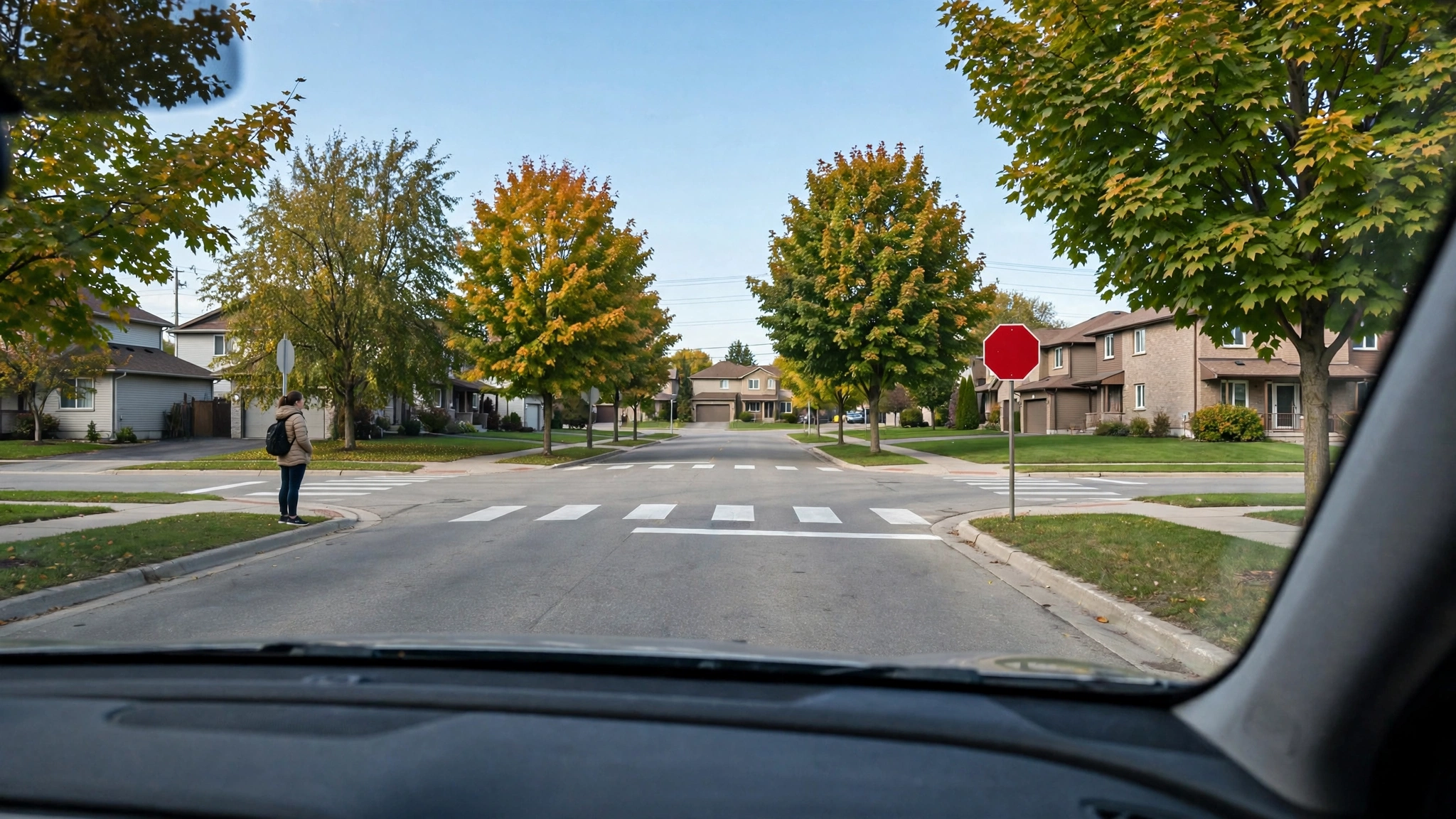
Ontario Rules of the Road You Should Know for the G1 Test
Half of the G1 knowledge test asks about rules of the road, not signs. These questions describe real driving decisions — who yields, when you may pass, and how closely you may follow.
This guide walks through the rule families that matter most: right-of-way, intersections, turning, speed and space, sharing the road, and the special conditions that apply to G1 drivers.
How the Rules Half of the G1 Test Works
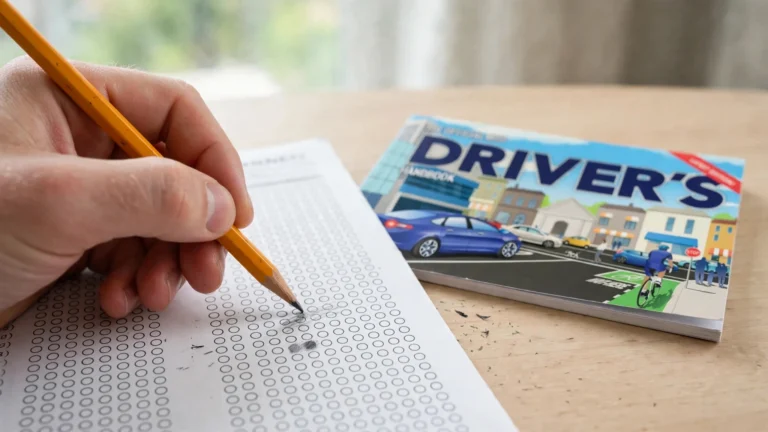
The knowledge test has 40 multiple-choice questions in two sections of 20: road signs and rules of the road. You need at least 16 correct in each section.
A strong signs score cannot rescue a weak rules score. Each half stands entirely on its own.
Signs and rules work as a pair. Signs post the law’s instructions, while rules describe how you behave around them. If your sign recognition is shaky, our road signs guide is a useful warm-up before the rules below.
To feel what the 16-out-of-20 bar really means, run a few practice rounds through a G1 score calculator. You will see how quickly three or four wrong answers erase your cushion.
Remember: the rules half stands alone. Sixteen correct out of 20 is the bar, no matter how well you know your signs. Budget your study time with that split in mind.
Right-of-Way: Who Goes First and Why
Right-of-way is never something you own. It is something other drivers give you, and the test returns to this idea again and again.
At a four-way stop, the vehicle that stops first goes first. When two vehicles stop at the same moment, the one on the right goes first.
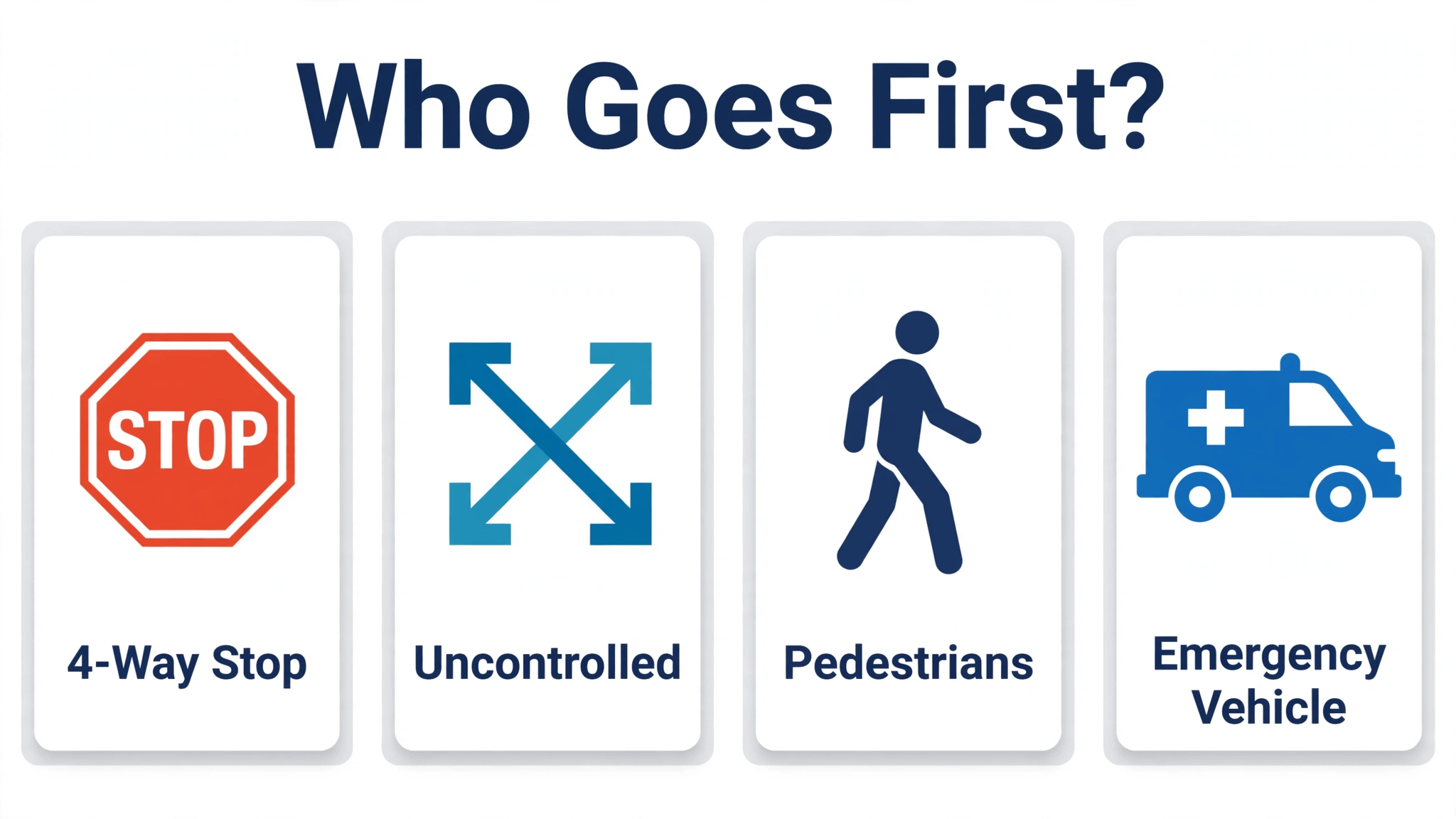
- At uncontrolled intersections with no signs or lights, yield to traffic already in the intersection, then to the vehicle on your right.
- When turning left, yield to oncoming traffic and to pedestrians — even if you arrived first.
- Pedestrians at crosswalks, crossovers, and intersections always get priority. Stop and wait until they are fully clear.
- Emergency vehicles with flashing lights and sirens outrank everyone. Pull to the right edge and stop until they pass.
- In a roundabout, vehicles already circulating have the right-of-way. Yield before you enter.
Tip: when two drivers hesitate and nobody is sure, let the other go first. Yielding when unsure is always the safe choice — and it is the answer the test rewards.
Stop Signs, Traffic Lights, and Controlled Intersections
Controlled intersections carry the strictest rules, because that is where vehicle paths cross at speed. Small mistakes here become test questions.
- Stop fully behind the stop line or crosswalk. A slow roll still counts as running the sign.
- On a green light you may go, but you must still yield to pedestrians and vehicles already in the intersection.
- An amber light means stop if you can do so safely. Entering on a late amber to beat the red is the wrong call.
- A red light means stop and wait. Turn on red only where it is permitted, after a full stop and a clear check both ways.
- A flashing red light works like a stop sign. A flashing amber means slow down and proceed with caution.
Where every approach has a stop sign, the four-way-stop order applies. Where only your approach has one, cross traffic does not stop for you — wait for a safe gap.
Turning, Lane Changes, and Passing With Room to Spare
Turning and passing questions test one habit above all: looking before you move. Most wrong answers describe a move made blind.
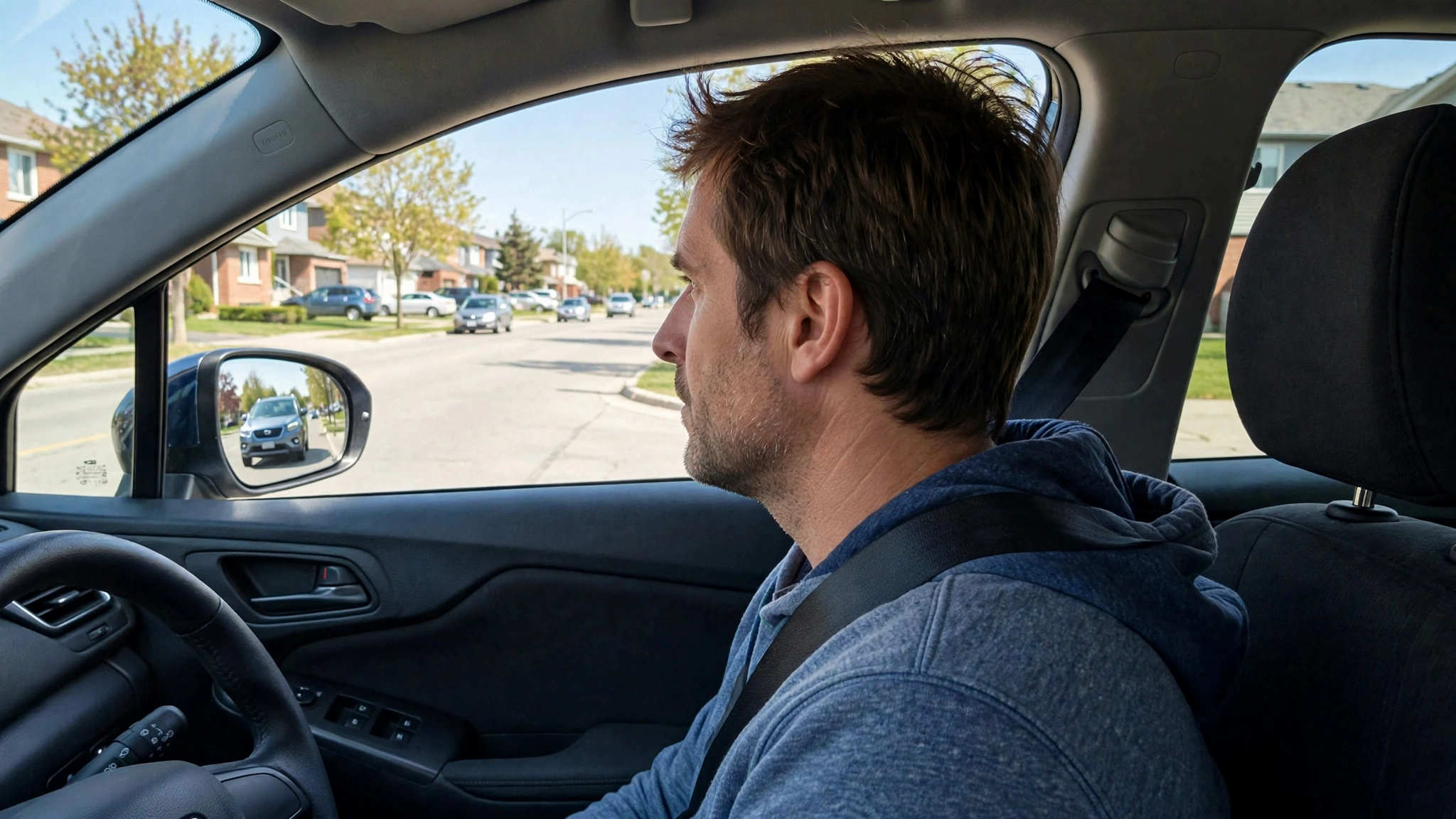
- Signal every turn and lane change early enough that other drivers can react to it.
- Check your mirrors, then glance over your shoulder. The blind spot can hide an entire car.
- Turn left from the leftmost lane into the leftmost open lane. Keep right turns tight into the nearest lane.
- Pass only on the left, only where the centre line permits it, and only with a long clear view ahead.
- Never pass on a hill, on a curve, at an intersection, or where a sign or solid line forbids it.
A useful instinct for test day: if a manoeuvre would feel rushed or blind in real life, the answer choice describing it is almost certainly wrong.
Speed Limits, Space Cushions, and Following Distance
Speed questions are rarely about one posted number. They test whether you adjust your speed and your space to match conditions.
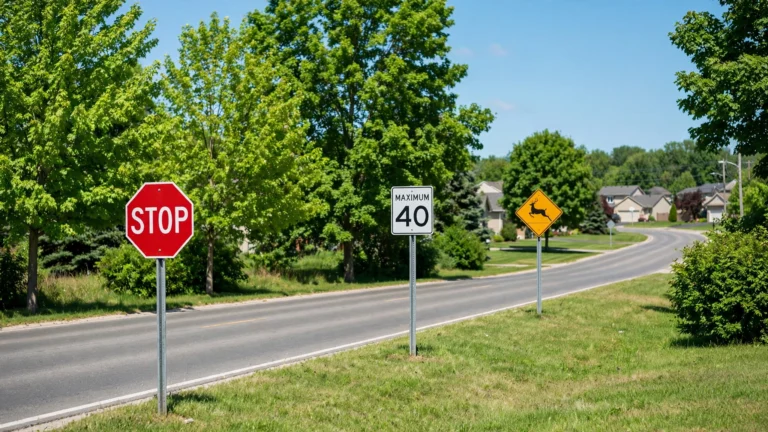
- Where no sign is posted, the default limit is 50 km/h in cities, towns, and villages, and 80 km/h on most other roads.
- Slow down for rain, fog, snow, and darkness. A posted limit is a maximum for good conditions, never a target.
- Keep at least a two-to-three-second gap behind the vehicle ahead. Stretch it in bad weather and behind large vehicles.
- Speed affects stopping distance more than most learners expect. Doubling your speed roughly quadruples braking distance.
To see the physics behind the gap, try a stopping-distance calculator at a few different speeds. The numbers make the two-to-three-second rule feel obvious.
Tip: pick a fixed roadside object and count the seconds between the car ahead passing it and you passing it. If you reach three, your cushion is healthy.
Sharing the Road With Pedestrians, Cyclists, School Buses, and Emergency Vehicles
The hardest judgment questions involve the road users you could hurt — not the ones who could hurt you. The law protects them with extra-clear rules.
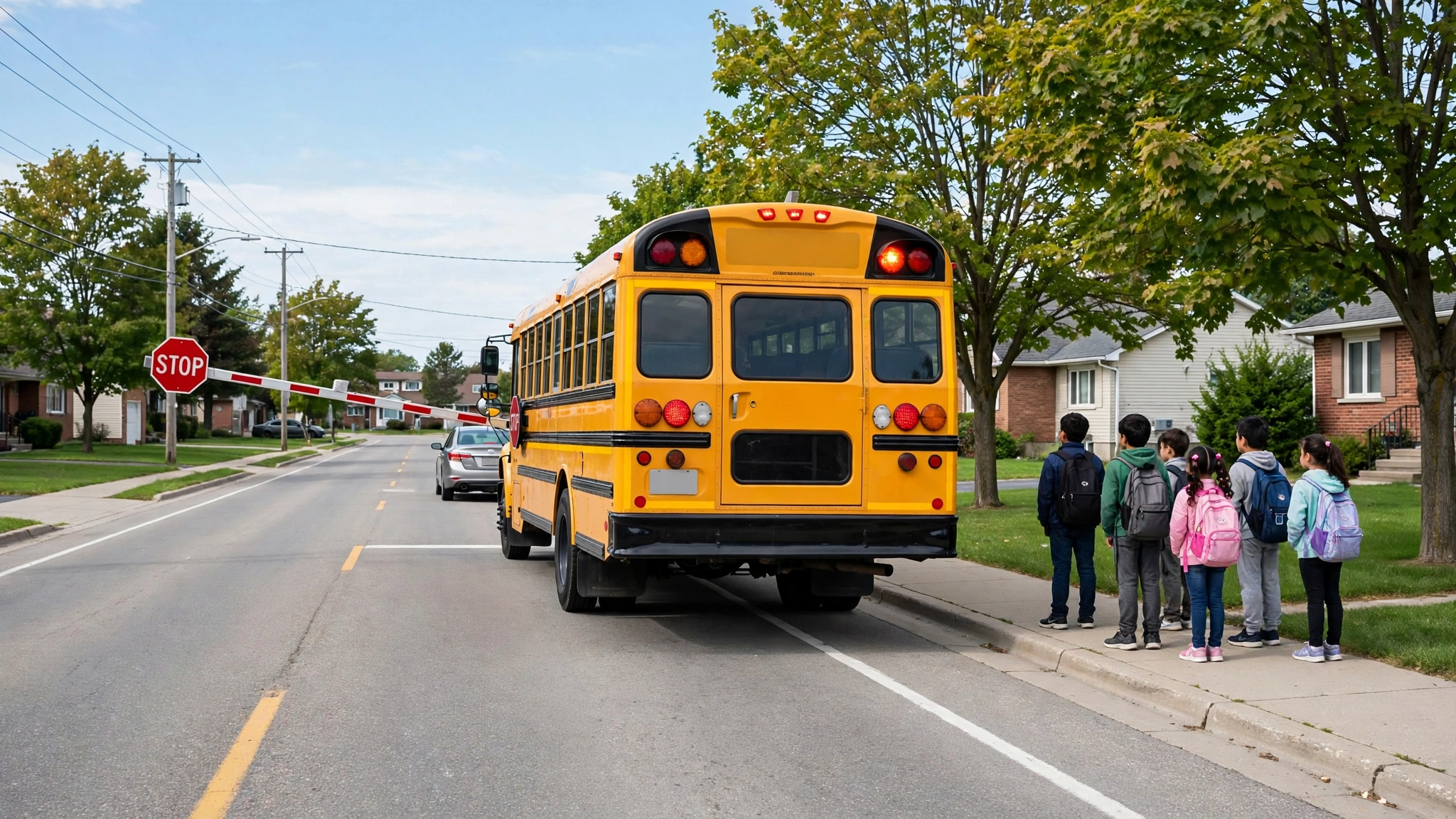
- Stop for pedestrians at crosswalks, crossovers, and intersections, and wait until they are fully clear of your path.
- Leave at least one metre of room when passing a cyclist, and give more space at higher speeds.
- When a school bus stops with red lights flashing and the stop arm out, you stop too — in both directions, unless a physical median divides the road.
- Coming from behind the bus, stop at least 20 metres back. Wait until the bus moves and the lights stop flashing.
- For emergency vehicles with lights and sirens, pull to the right edge of the road and stop until they pass.
Caution: painted lines do not count as a median. If the road is divided only by paint, traffic in both directions must still stop for the school bus.
Freeways, Roundabouts, and Railway Crossings
Each of these three settings has one rule that overrides normal habits, which is exactly why the test asks about them.
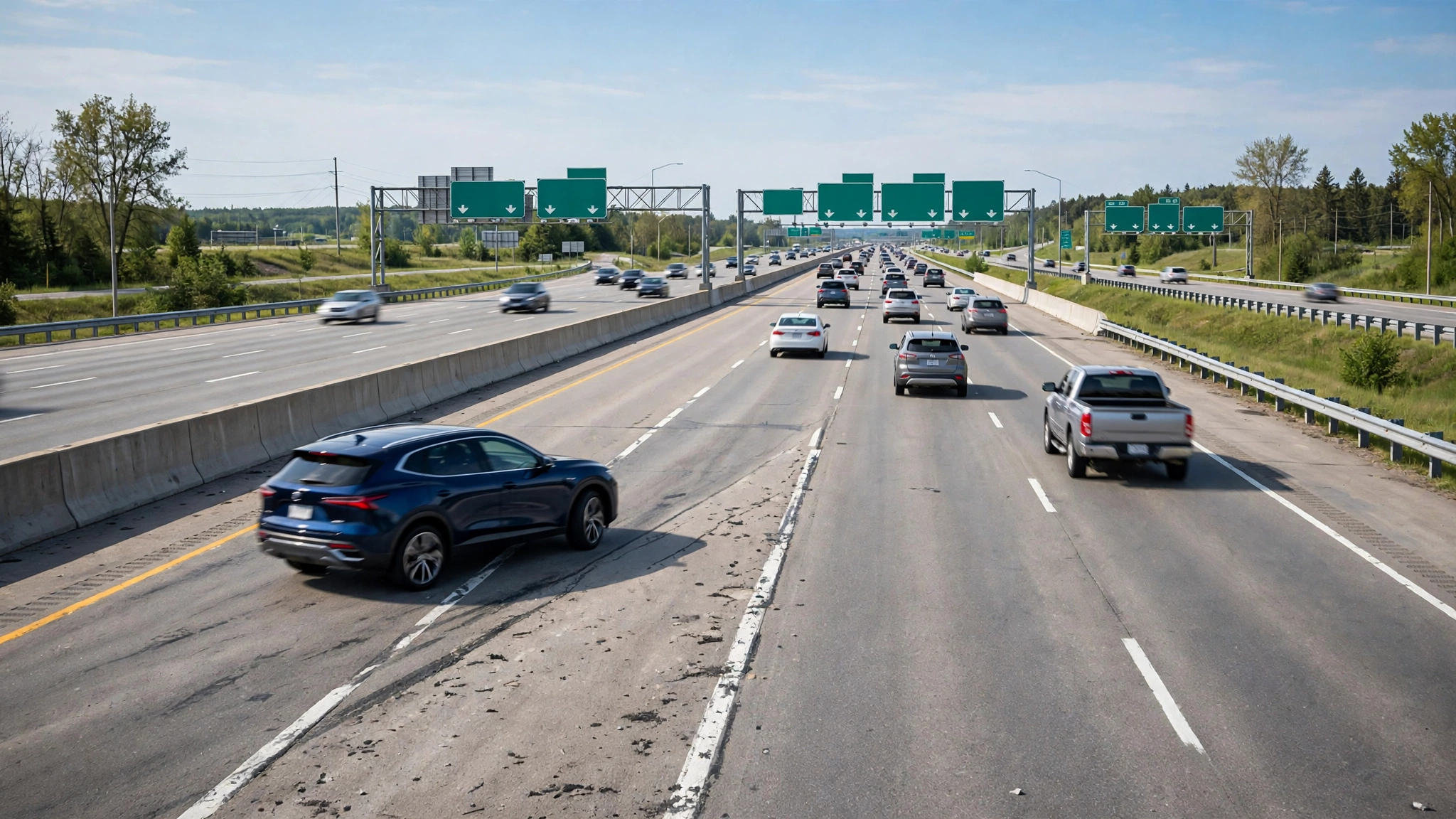
- Freeway: use the acceleration lane to match the speed of traffic, merge into a gap, and never stop on the ramp unless traffic forces you to.
- Roundabout: yield to traffic already circulating, enter to the right, and signal as you leave.
- Railway crossing: stop when the lights flash or the gates lower, never shift gears while crossing, and never try to beat a train.
As a G1 driver you will meet freeways mostly as a passenger. The test still asks about them — which leads to the conditions that apply to you specifically.
G1 Licence Conditions That Override the Usual Rules
Until you graduate to G2, extra conditions sit on top of every rule above. The test checks that you know them cold.
- Your blood-alcohol level must be zero whenever you drive.
- An accompanying driver with a full G licence and at least four years of experience must sit in the front passenger seat.
- Every person in the vehicle must wear a working seatbelt.
- You must not drive between midnight and 5 a.m.
- You must not drive on 400-series highways with a posted limit over 80 km/h, or on expressways such as the QEW, the Don Valley Parkway, and the Gardiner Expressway — unless your accompanying driver is a licensed driving instructor.
Notice the pattern. Every G1 condition removes one risk — impairment, distraction, fatigue, or speed — while you are still learning.
Seven Traps That Catch First-Time Test Takers
These are the mistakes our practice users make most often on rules questions. Read them once and they stop being traps.
- Treating right-of-way as something you own instead of something other drivers give you.
- Rolling through stop signs instead of stopping fully behind the line.
- Forgetting the 20-metre gap when approaching a stopped school bus from behind.
- Passing where the centre line is solid or where the view ahead is short.
- Keeping the same following gap at 100 km/h as at 50 km/h.
- Turning left across oncoming traffic on a late amber instead of waiting it out.
- Counting on a perfect signs score to carry a weak rules half. It cannot — each half stands alone.
A One-Week Plan for Learning the Rules
You do not need to learn everything in one sitting. One rule family per day, with review at the end, beats a single long cram session.
- Days one and two: right-of-way and controlled intersections — the highest-value scenarios on the test.
- Day three: turning, lane changes, and passing, with blind-spot checks as the anchor habit.
- Day four: speed, space, and following distance, including the stopping-distance math from the section above.
- Day five: pedestrians, cyclists, school buses, and emergency vehicles.
- Day six: freeways, roundabouts, railway crossings, and the G1 conditions.
- Day seven: mixed review of everything, spending most time on the questions you missed earlier in the week.
For the study-method side of this plan — flashcards, error logs, and spaced repetition — see our focused study method for the rules half. Method plus material is what turns a plan into a pass.
Rules Questions New Drivers Ask Most
Do I Need 16 Out of 20 on Each Section?
Yes. The signs half and the rules half are scored separately, and you must reach 16 correct in both. A perfect score on one side cannot make up for 15 on the other.
Which Rule Family Should I Learn First?
Right-of-way. It connects intersections, turning, and pedestrian rules, so learning it first makes every later family easier to understand.
Can I Drive on 400-Series Highways With a G1?
Not where the posted limit is over 80 km/h, and not on expressways like the QEW or the Don Valley Parkway. The exception is when your accompanying driver is a licensed driving instructor.
How Far Back Must I Stop for a School Bus?
At least 20 metres, when you approach from behind a bus with its red lights flashing. Traffic in both directions must stop unless a physical median separates the road.
What Is the Speed Limit When No Sign Is Posted?
It is 50 km/h in cities, towns, and villages, and 80 km/h on most other roads. These are defaults — always obey a posted sign when you see one.
Are Your Practice Questions the Real G1 Questions?
No. Our practice material is original and unofficial, written from the Ontario Driver’s Handbook. Nothing here claims to be a real, leaked, or official test question.
This article is unofficial practice material for the Ontario G1 knowledge test. It is not affiliated with DriveTest, the Ministry of Transportation, or the Government of Ontario.
It does not contain real or leaked test questions. Traffic rules are summarized here as general guidance — check the official Ontario Driver’s Handbook for the current law.
Want 300 More Practice Questions?
The Premium Question Bank gives you 6 full mock exams with a plain-language explanation for every answer. Instant PDF download, yours to keep.
Original handbook-mapped questions. Not real DriveTest questions. No pass promises – just serious practice.

2 Comments