
How to Prepare for the Ontario G1 Test (Study Plan & Checklist)
Most people study for the G1 the way they studied for school exams: read, highlight, re-read, and hope it sticks. The G1 knowledge test punishes that approach. It checks whether you can recognise a sign at a glance and apply a rule to a situation you have never seen before.
A good study plan fixes this. It is not about studying longer. It is about learning in the right order, testing yourself constantly, and proving you are ready before you walk into the DriveTest centre. Here is a plan that does exactly that.
Why Most G1 Study Plans Fail
The G1 is a recognition and application test, not a memorisation contest. Reading the handbook cover to cover feels productive, but recognition only comes from repeated retrieval — pulling answers out of your own memory.
The second failure is section blindness. The test has two separately graded sections, road signs and rules of the road, and many learners pour all their time into one half while the other quietly collapses.
The third failure is untested confidence. Scoring well on the same ten practice questions five times feels like progress. It is not. A plan needs fresh questions and honest score tracking to mean anything.
The Three-Phase Study Method
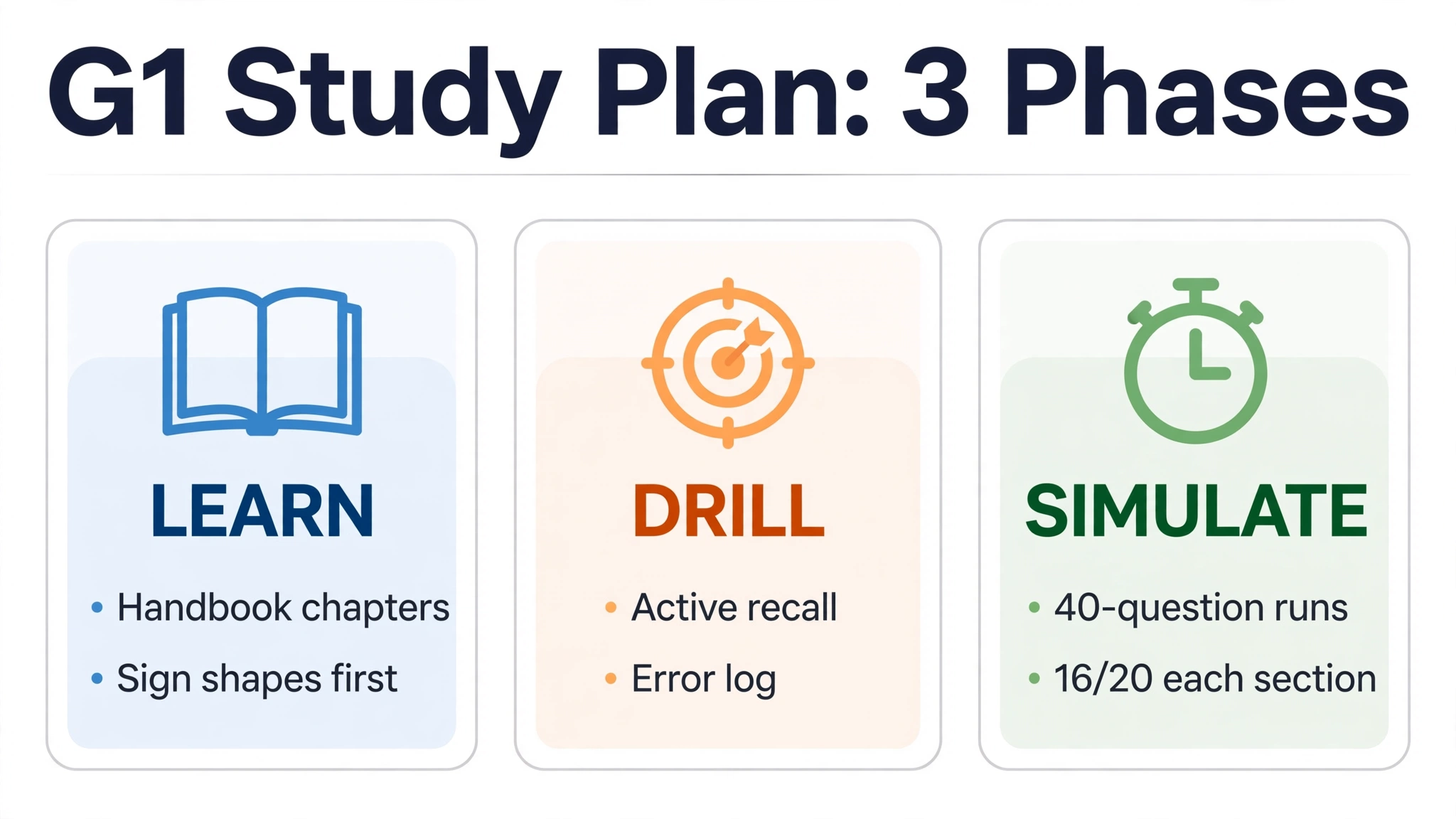
This plan has three phases: Learn, Drill, and Simulate. Each phase has one job, and you do not move on until that job is done. Most learners spend a few days in each phase, but the phases matter more than the calendar.
Learn means building real understanding from the Driver’s Handbook. Drill means forcing your memory to retrieve answers under light pressure. Simulate means proving you can pass under test-like conditions.
Phase 1: Learn the Material in the Right Order
Start with road signs, not because rules matter less, but because signs are half the test and they follow a visual system. Learn the shapes first: an octagon always means stop, an upside-down triangle means yield, a diamond warns of hazards ahead, and a circle marks a railway crossing. Rectangles regulate or inform.
Once you know the shape families, individual signs become variations on a theme instead of a hundred unrelated pictures. Group them as you learn: all the warning diamonds together, all the regulatory rectangles together. Your brain stores patterns far better than isolated facts.
Then move to rules of the road in topic blocks: right-of-way, intersections, speed and space, parking, and sharing the road. Read one block at a time, then close the book and write down everything you remember.
What you cannot recall is what you have not learned yet. For a full breakdown of the topics, see what the G1 test covers in Ontario.
Studying with a licensed driver helps here. Talk through real situations together — who goes first at a four-way stop, when passing is legal, what a flashing amber light means. Connecting rules to the road makes them stick.
Phase 2: Drill With Active Recall
Reading builds familiarity. Only retrieval builds memory. Phase 2 is where you stop inputting information and start pulling it out. Flashcards are the simplest tool: sign on one side, meaning on the other. Shuffle them every session so you never learn the order instead of the content.
The most powerful habit in this phase is the error log. It takes five minutes and it changes everything:
- Take a short drill of 15 to 20 questions.
- For every question you miss, write down the correct answer and the rule behind it in your own words.
- Two days later, re-drill only the questions from your log.
- Any question you miss twice gets a star. Those starred items are your personal syllabus — review them daily until they stop appearing.
Mix old and new material in every drill session. Ten questions on this week’s topic plus ten drawn from everything you have covered so far. That mix stops earlier topics from fading while you learn new ones.
A priority-ranked list of G1 topics can help you decide which weak areas deserve extra drill time.

Phase 3: Simulate Test Conditions
When your error log is shrinking and drills feel comfortable, switch to full simulations. Take complete 40-question runs in one sitting: no pausing, no notes, no looking things up. The goal is no longer learning — it is proof.
Track your scores per section, not just the total. This matters because the G1 is graded in two halves: 20 road-sign questions and 20 rules-of-the-road questions, and you need at least 16 correct in each half. Read how many questions are on the G1 test if you want the full format breakdown.
If one section lags, go back to Phase 2 drills for that section only, then simulate again. Two or three full simulations that clear the line in both sections is a strong sign you are ready. Run your simulations on free G1 practice tests so the format feels familiar on the day.
A 25-Minute Study Session That Actually Works
You do not need marathon sessions. A focused 25-minute block, done daily, beats a sleepy three-hour Sunday. Here is the recipe:
- Minutes 0–5: Review your error log. Cover the answers and recall each one.
- Minutes 5–15: Learn one small new chunk — one sign family or one rule topic.
- Minutes 15–20: Close the book and write down everything you remember from that chunk.
- Minutes 20–25: Take a 10-question drill mixing the new chunk with older material.
Do one block on busy days and two or three on free days. The daily rhythm matters more than the total hours. Your brain consolidates memories between sessions, especially overnight, so consistency beats intensity.

Mistakes That Quietly Cost People Points
- Studying signs only. Signs feel easy to drill, so they get all the attention. Rules questions are wordier and trickier — they need equal time.
- Re-reading instead of self-testing. Every minute spent re-reading a page you already understand is a minute stolen from retrieval practice.
- Memorising questions instead of rules. The real test will phrase things differently. If you only remember that “the answer was B,” you have learned nothing. Learn the rule behind every answer.
- Practising only your strong section. It feels good to score high on signs. It does not help if rules are below the line. Attack the weak half.
- Cramming the night before. Last-minute panic adds stress and almost no knowledge. The night before is for rest, not new material.
Your G1 Study Checklist
Work through this checklist in order. Do not book your test until every box is honestly ticked:
- ☐ I can name what each sign shape means (octagon, triangle, diamond, circle, rectangle).
- ☐ I have worked through every rules topic at least once from the handbook.
- ☐ I keep an error log, and no question in it has been missed twice in a row.
- ☐ I have completed at least three full 40-question simulations.
- ☐ Every simulation cleared 16 out of 20 in both sections.
- ☐ I reviewed my weakest topics the day after each simulation.
- ☐ My ID and documents are gathered and ready (see the requirements guide).
- ☐ I know where my DriveTest centre is and how I am getting there.
The Night Before and Test Morning
Stop studying by the evening. Pack your bag: ID, glasses or contacts if you need them, and anything else on your document checklist. Lay out what you will wear. Decide how you are getting to the centre so the morning holds no surprises.
Eat normally, arrive a little early, and give yourself a calm buffer before check-in. If you want to know exactly what the visit looks like, read our walkthrough of what happens at the G1 test centre — knowing the process removes the last bit of mystery.

Frequently Asked Questions
How Long Does It Take to Study for the G1 Test?
It depends on your schedule and starting point. With one focused 25-minute session a day, many learners work through all three phases in a couple of weeks. Two or three sessions a day shortens that. Judge by the checklist above, not the calendar.
Should I Read the Whole Driver’s Handbook?
Yes. Test questions can be drawn from anywhere in it, so skipping chapters is gambling. But read it actively — one section at a time, then close the book and recall. Passive cover-to-cover reading without self-testing is the slowest way to learn.
Can I Pass by Only Taking Practice Tests?
Practice tests measure knowledge; they do not build it. Use them in Phases 2 and 3 to drill and simulate, but learn the underlying material from the handbook first. A question you have never seen is only answerable if you know the rule behind it.
What Score Should I Aim For on Practice Tests Before Booking?
Aim to clear 16 out of 20 in each section with a comfortable cushion, several times in a row — not just once on a lucky run. Consistent section-by-section results are a far better readiness signal than one high total score.
Study materials on this site are unofficial practice aids for the Ontario G1 knowledge test. They are not affiliated with DriveTest, the Ministry of Transportation, or the Government of Ontario, and practice questions are not the real test questions.
Want 300 More Practice Questions?
The Premium Question Bank gives you 6 full mock exams with a plain-language explanation for every answer. Instant PDF download, yours to keep.
Get the Question Bank – $9.99Original handbook-mapped questions. Not real DriveTest questions. No pass promises – just serious practice.