
Stopping Distance Calculator for Ontario Drivers
Interactive Tool
Assumptions: reaction distance uses your chosen reaction time; braking distance uses friction values of 0.7 (dry), 0.4 (wet), 0.15 (icy) with level, flat asphalt and standard physics approximations. Car length assumed 4.5 m for the car-length equivalent. These are estimates only — real stopping distances vary with tyres, brakes, vehicle weight, road grade, and road surface.
From behind the wheel, stopping a car feels quick: you press the brake, the car slows, you stop. The reality is less reassuring. A vehicle travelling at highway speed covers ground so fast that the distance between first seeing a hazard and standing still can stretch well past the length of an entire city block — and on ice, that distance can multiply to something truly frightening.
The calculator above shows those numbers for your own speed and road conditions, broken into the two parts that make up every stop. Below, we explain what each part means, why speed affects stopping distance so brutally, how rain and ice change the math, and what this topic looks like when it shows up on the G1 knowledge test.
What Stopping Distance Really Means
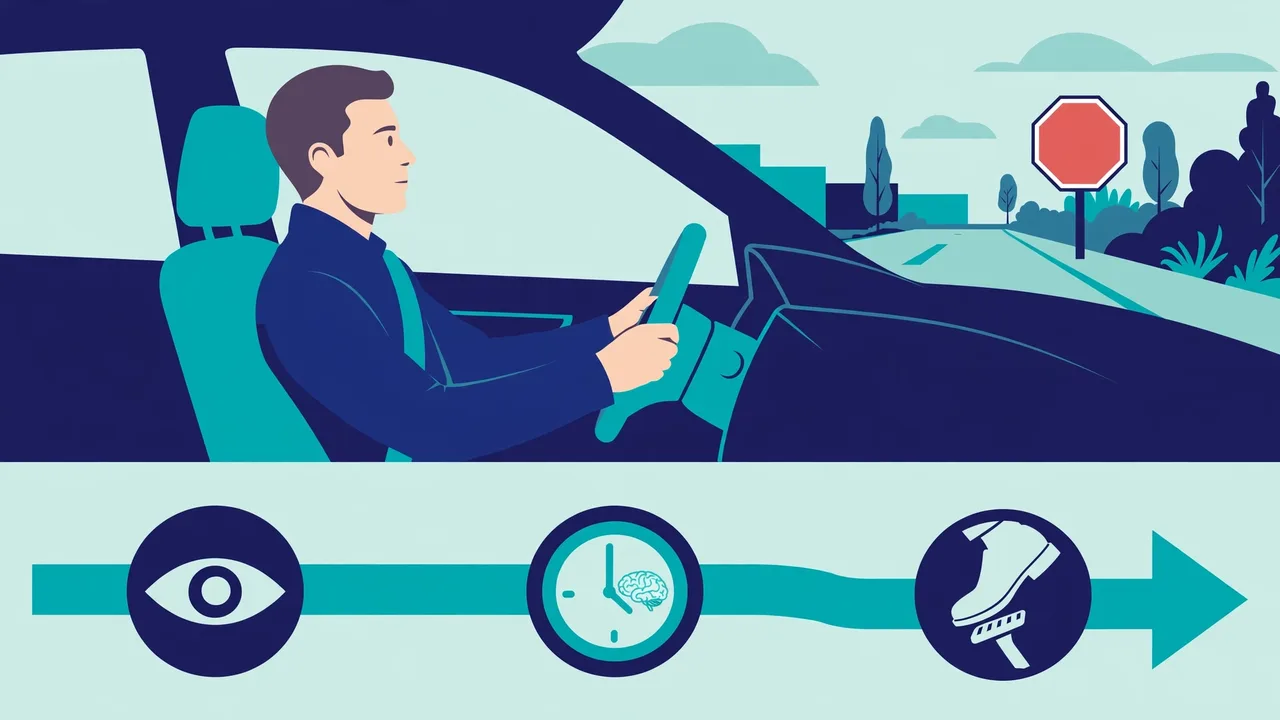
Every stop is really two journeys added together. The first is reaction distance: the metres your car travels in the time between you spotting a hazard and your foot pressing the brake pedal. During that window you are moving at full speed, because nothing has slowed you yet.
The second is braking distance: the metres the car travels after the brakes engage, while friction between the tyres and the road burns off your speed. The sum of the two is the total stopping distance — the full gap you need between seeing trouble and avoiding it.
This split matters because the two halves answer to different masters. Reaction distance answers to you: how alert you are, whether you are distracted, and how much following distance you leave. Braking distance answers to physics: your speed and the grip of the road surface. You can improve one with attention and good habits; the other you simply have to respect.
Why Speed Hits Harder Than You Think
Here is the fact that surprises almost every new driver: doubling your speed quadruples your braking distance. Drive twice as fast and it does not take twice as far to stop — it takes four times as far. This is not a rule of thumb or a safety slogan; it falls straight out of the physics of motion.
The reason is energy. A moving car carries kinetic energy that grows with the square of its speed. The brakes have to absorb all of that energy through friction, and friction does a fixed amount of work per metre. So when speed doubles, the energy the brakes must dump quadruples, and the distance needed to dump it quadruples with it.
Caution: try 40 km/h and 80 km/h in the calculator above. The braking distance at 80 is roughly four times the braking distance at 40 — not twice. This is the single most important number to internalize as a new driver.
Reaction distance, by contrast, grows in a straight line with speed: double the speed, double the distance, because you are simply travelling twice as far each second. Put the two together and the total stopping distance grows faster than your speed does — which is why even small increases in speed near a hazard cost so much room.
How Rain and Ice Multiply the Danger
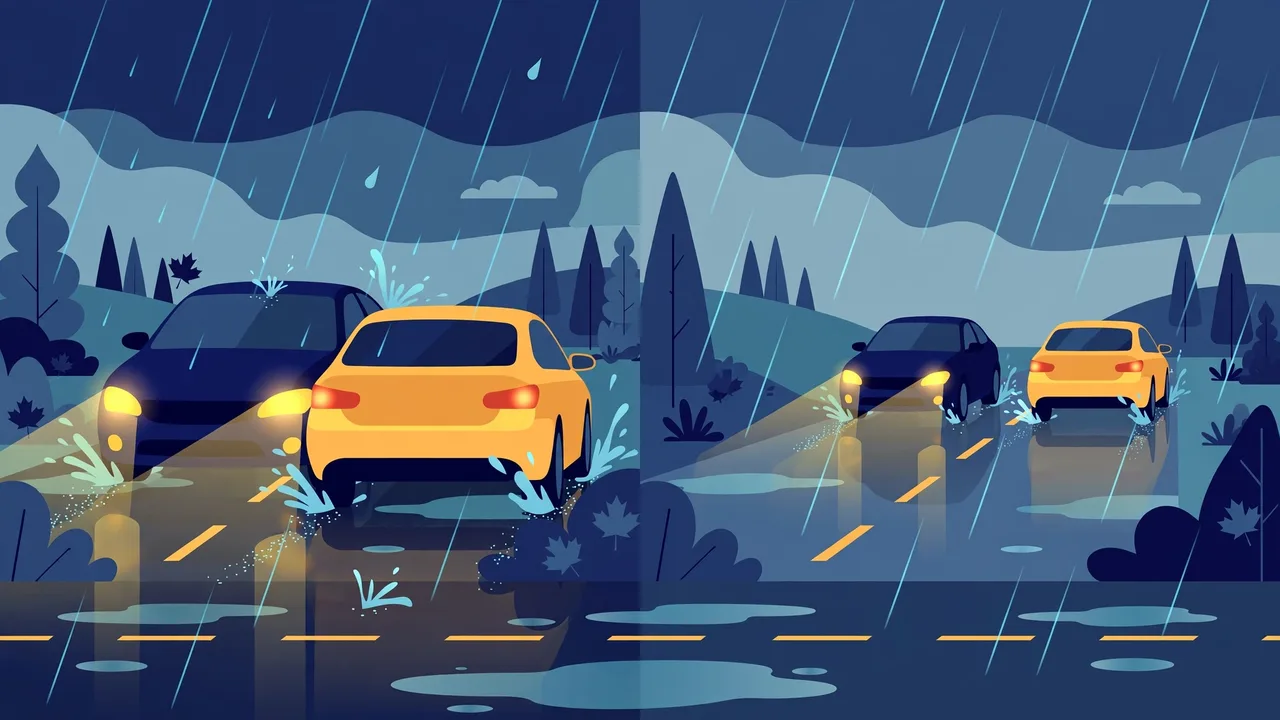
The calculator lets you switch between dry, wet, and icy roads, and the difference is dramatic. The physics term behind it is the friction coefficient — roughly 0.7 for dry asphalt, 0.4 for wet pavement, and 0.15 for ice. Since braking distance is divided by this number, each drop in grip multiplies how far you slide.
On a wet road, braking distance is roughly 1.75 times what it is on dry asphalt at the same speed. On ice, it is roughly 4.6 times the dry-road distance. Add your reaction distance on top, and a stop that takes a comfortable 50 metres on dry pavement can need well over 150 metres on ice.
Real roads add more wrinkles. Worn tyres, painted lines, metal covers, and black ice patches all offer less grip than the headline numbers assume. That is why the calculator states its assumptions plainly and why experienced drivers treat any slick surface as worse than the numbers suggest. If you plan your driving around the G licence timeline, remember that winter driving in Ontario will test this knowledge for real long before your G2 road test.
Key fact: wet roads cut tyre grip nearly in half; ice cuts it to about a fifth of dry grip. Speed must come down by at least the same proportion — and more is safer.
The 3-Second Rule for Following Distance
Because your total stopping distance is always unknown in practice — you cannot know the exact grip of the road under your tyres — defensive driving uses a simple proxy instead: the 3-second rule. When the vehicle ahead passes a fixed point like a sign or shadow, start counting. If you reach that point before three seconds pass, you are following too closely.
The calculator shows the 3-second following distance for your speed so you can see what it means in metres: at 100 km/h it is over 80 metres, which feels enormous from the driver’s seat. That is the point. Most tailgating drivers have no idea how short their gap really is until they measure it.
Three seconds is the minimum for good conditions. In rain, double it to six seconds. In snow or on ice, take even more. And if a heavy truck or trailer is tailgating you, add space ahead so you can brake gradually instead of forcing them into a hard stop. Following distance is the one part of stopping distance you control completely, and it costs nothing.
How Stopping Distance Appears on the G1 Test
Stopping distance is a classic G1 knowledge test topic because it tests understanding, not just memory. Typical questions ask which two components make up stopping distance, how speed affects braking distance, or what following distance rule to apply in different weather. The questions are multiple-choice, and the wrong answers are designed to catch people who memorized slogans without understanding the physics.
The trap answers usually play on the quadratic rule: if doubling speed quadruples braking distance, then questions about driving “a little faster” try to make tripling sound like a small change. Once you know the rule, these questions become free marks. Drill them with free G1 practice tests until the doubling-and-quadrupling relationship is automatic.
Related topics travel together on the test: reaction time and impaired or distracted driving, following distances, and speed limits in school zones and community safety zones. Our Ontario licence class finder will not help here, but reviewing the rules questions in our practice bank will. If you know what licence class you are aiming for and how the scoring works, check your readiness with our G1 score calculator before booking your test.
Practical Tips for Shorter Stops
You cannot rewrite physics, but you can stack the controllable half of stopping distance in your favour. These habits are what examiners and experienced drivers mean by “defensive driving,” and several of them are testable knowledge on the G1:
- Scan far ahead, not at the bumper. Look 12 to 15 seconds down the road. The earlier you spot a hazard, the shorter your effective reaction time becomes, because your brain starts processing before the danger is critical.
- Cover the brake in risk zones. In school zones, near intersections, or behind a car with flickering brake lights, lift off the accelerator and hover your foot over the brake. This trims a fraction of a second off your reaction — at highway speed, each second is nearly 28 metres.
- Slow down before the curve, not in it. Braking in a curve spends tyre grip on turning instead of stopping, lengthening your braking distance and risking a skid. Slow to a safe speed before you enter.
- Keep your tyres and brakes healthy. Properly inflated tyres with good tread and well-maintained brakes move your real-world braking distance closer to the calculator’s estimates. Bald tyres on wet pavement can be worse than the “icy” setting above.
- Never tailgate to “save time.” No gap can compensate for physics. If the car ahead brakes hard and your following distance is under your reaction distance alone, a collision is already unavoidable.
Tip: new drivers often focus only on braking distance and forget reaction distance. But at 100 km/h, an average 1.5-second reaction already costs you about 42 metres — before the brakes do anything at all. Staying alert is free stopping distance.
Frequently Asked Questions
What is the difference between reaction distance and braking distance?
Reaction distance is the distance your vehicle travels during the time it takes you to recognize a hazard and apply the brakes — typically estimated at 1 to 2 seconds depending on alertness. Braking distance is the distance the vehicle travels while the brakes are actually slowing it down. Total stopping distance is the sum of both.
Why does doubling speed quadruple braking distance?
Braking distance depends on the vehicle’s kinetic energy, which grows with the square of speed. The brakes remove energy through friction at a roughly constant rate per metre, so twice the speed means four times the energy to absorb — and roughly four times the distance. The calculator above demonstrates this if you try two speeds that differ by a factor of two.
How much longer is stopping distance on ice compared to dry roads?
Using standard friction approximations, braking distance on ice is roughly 4.6 times the dry-road braking distance at the same speed. Reaction distance is unchanged, so the total stopping distance multiplies somewhat less — but a stop that needs 50 metres on dry asphalt can easily need over 150 metres on ice.
What is the 3-second rule?
The 3-second rule is a simple way to maintain a safe following distance: pick a fixed point the vehicle ahead passes, then count three seconds. If you reach the point before you finish counting, you are too close. Increase the gap to six seconds in rain and even more in snow or ice.
Does stopping distance appear on the G1 knowledge test?
Yes. The G1 test commonly covers the components of stopping distance, the effect of speed on braking distance, and safe following distances in different weather conditions. These are rules-of-the-road questions, so they fall in the section where many test-takers lose marks — see our Ontario M1 motorcycle practice test page as well if you are planning a motorcycle licence, since the same physics applies to two wheels.
Estimates only — not legal or professional advice. This calculator and guide are unofficial practice material for study purposes only. We are not affiliated with the Ontario Ministry of Transportation or DriveTest. Stopping distances shown are educational physics estimates and will differ for real vehicles, tyres, and road conditions. Confirm rules and procedures with the official MTO Driver’s Handbook before your test.