How to Pass the G1 Test on Your First Try
Most learners who fail the G1 test do not fail because they studied too little. They fail because of small, avoidable mistakes: a misread question, a rushed answer, a section they assumed would take care of itself.
These seven tactics address exactly those mistakes. They are simple habits you can practise before test day and use at the test centre. None of them replaces studying, but all of them protect the knowledge you already have.
Tactic 1: Fix the Small Details the Week Before
A smooth test day starts days earlier. The learners who struggle most at the centre are often the ones dealing with a surprise — a missing document, the wrong ID, or a forgotten pair of glasses.
Start by gathering your identification and checking it against the accepted ID list. Make sure every document is current and that the names match. If your glasses or contact lenses help you see, plan to bring them.
Confirm how you will get to the test centre and how long the trip takes. DriveTest centres serve walk-in customers, so a quieter weekday morning can mean a shorter wait.
This guide to what to bring to the G1 test covers the full checklist so nothing is left to chance.
Tactic 2: Study the Traps, Not Just the Topics
By now you probably know the main topics: signs, right of way, parking, speed limits. The questions that trip people up are rarely about brand-new topics. They are familiar questions asked in tricky ways.
Watch for questions with words like except, always, or never. A question asking what you should not do reads very differently from one asking what you should do. Underline those words in your mind as you read.
Sign questions are another classic trap. Signs with similar shapes or colours get confused constantly — a regulatory sign and a warning sign can share symbols but mean different things.
If two answer choices both look plausible, compare them against the sign’s shape and colour before deciding.
Numbers deserve extra attention. Distances, blood-alcohol limits, and demerit thresholds are easy to mix up under pressure. Practise them as flashcards until you can answer them without thinking. Our guide to practising for the G1 test online shows how to drill these weak spots efficiently.
Tactic 3: Arrive Early and Settle Your Nerves
Test-day anxiety is the silent killer of first attempts. A racing mind misreads questions and second-guesses good answers. The antidote is not willpower — it is routine.
Arrive at the test centre at least 30 minutes before you plan to check in. Use the extra time to visit the restroom, drink some water, and sit down. Rushing through the door with your heart pounding is the worst way to start.
While you wait, do a quiet review pass in your head: the passing rule, a few tricky signs, one or two rules you tend to forget. Keep it light. You are warming up, not cramming.
When you sit down at the test computer, take three slow breaths before touching anything. The test is computer-based and you answer one question at a time, so there is no audience and no one watching your pace.
Tactic 4: Read Every Question Twice
The single most useful habit on the G1 test is reading every question twice before looking at the answers. Your first read tells you what the question is about. Your second read tells you exactly what it is asking.
This matters because G1 questions are written to test careful reading. A question about a four-way stop might hinge on which vehicle arrived first.
A parking question might hinge on whether the hill has a curb. Those details sit in plain sight — but only if you read the whole question.
Cover the answer choices with your hand while you do the second read. Decide what the answer should be before you see the options. This keeps a tempting wrong choice from talking you out of the right one.

Tactic 5: Eliminate the Wrong Answers First
Most G1 questions have four choices, and usually one or two of them are clearly wrong. Cross those out in your mind before anything else. A question with two options left is much easier than a question with four.
Look for answers that contradict each other. In many question sets, one pair of choices says opposite things — the correct answer is often one of the pair, because the test is checking whether you know which version is right.
Be careful with absolute words in the answers. Choices containing always, never, or only are frequently the distractors, because real road rules usually have exceptions. That said, treat this as a tendency, not a rule — check each question on its own facts.
Once you have eliminated two choices, commit to your best answer and move on. Lingering on a single question for minutes drains the calm you need for the rest of the test.
Tactic 6: Treat the Two Sections as Separate Tests
The G1 test has two sections of 20 questions: road signs and rules of the road. You need at least 16 correct in each section.
A perfect score in one section cannot make up for 15 in the other. You can review the full breakdown in this guide to what score you need to pass the G1 test.
First-attempt failures often come from uneven preparation: strong on rules, shaky on signs, or the other way around. Before test day, check your practice scores section by section. If one section consistently scores lower, give it most of your remaining study time.
During the test, the computer typically groups the sign questions and the rules questions separately. Keep your focus even when you switch sections. Do not let a hard sign question follow you into the rules section — reset and start fresh.
Tactic 7: Never Leave a Question Unanswered
You will almost certainly meet one or two questions you simply do not know. That is normal, and it does not have to end your attempt. The key is having a plan before it happens.
First, try the elimination habit from Tactic 5. Even a partial memory usually lets you drop one or two choices, which turns a pure guess into a reasonable one.
Then pick the answer that fits the safest driving behaviour. When two choices both seem possible, the one that prioritises safety is more likely to be correct.
Slowing down, yielding, keeping distance — the test is fundamentally checking whether you will be a safe driver.
What you should never do is skip questions or leave them blank. There is no penalty for a wrong answer, so an unanswered question is a guaranteed zero while a guess is a live chance. Answer everything.
Finally, if you change an answer, change it for a reason — new information, a reread that reveals a different meaning. Avoid changing answers out of pure anxiety. Your first considered answer is often the right one.
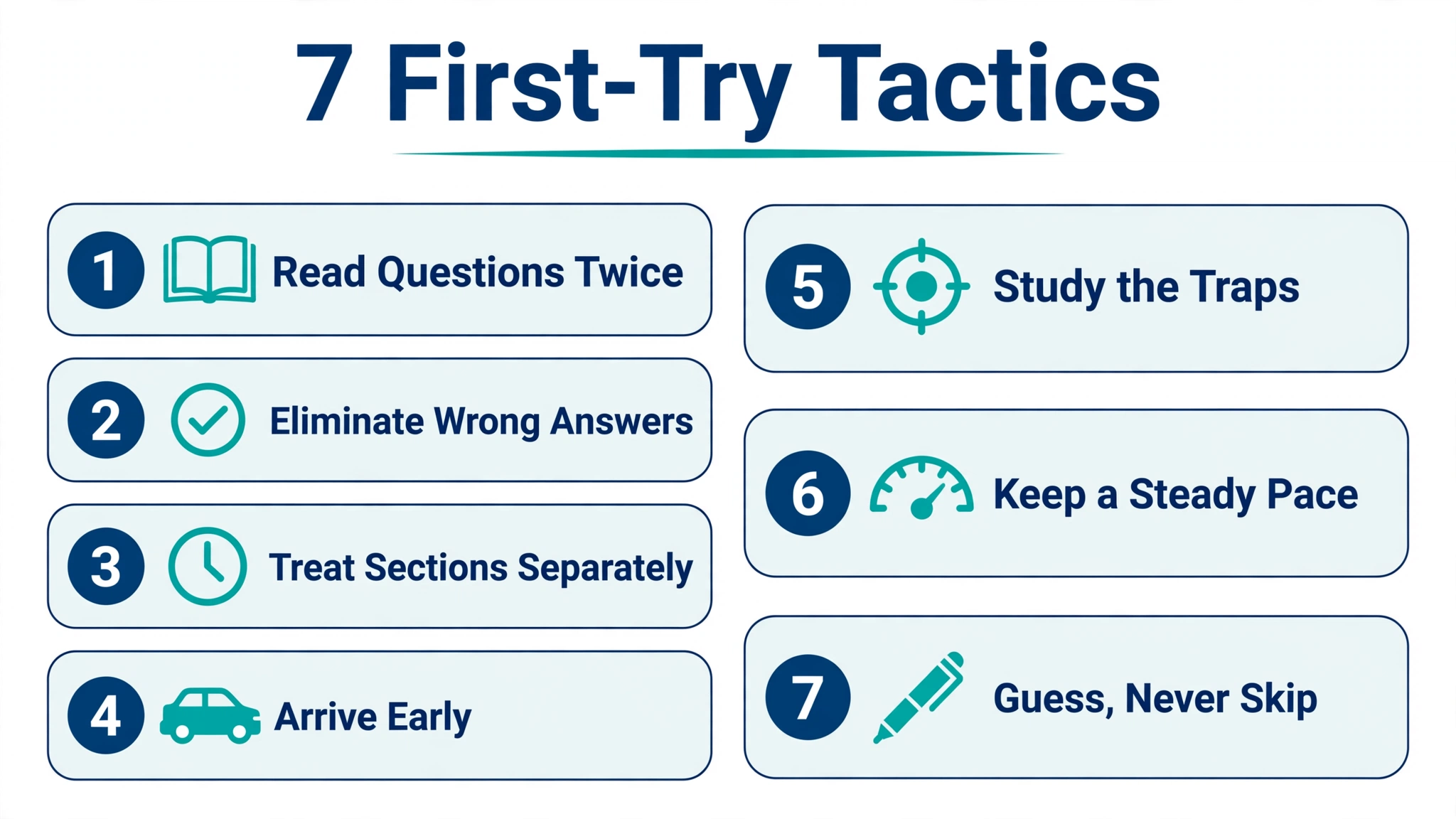
Your Test-Day Sequence, Step by Step
Here is how the tactics fit together into one smooth day:
- The night before: Set out your ID documents and glasses. Stop studying and sleep well.
- Morning: Eat a normal breakfast, arrive 30 minutes early, and settle in.
- At the computer: Take three slow breaths before you begin.
- Every question: Read it twice, decide the answer before looking at the choices, then eliminate the wrong ones.
- Unknown questions: Eliminate what you can, favour the safest behaviour, and never leave a blank.
- Between sections: Reset your focus. Treat the second section as a fresh start.
Frequently Asked Questions
Can I Pass the G1 Test Without Studying?
In theory, a person with strong driving knowledge could get lucky. In practice, the sign section alone trips up most unprepared learners. Studying is what turns your attempt into something you can repeat, not something you hope for.
How Should I Spend the Last Week Before the Test?
Shift from learning new material to drilling weak spots. Take full practice tests, review every mistake, and re-drill the topics you got wrong. This readiness checklist — how to know when you’re ready for the G1 test — gives you benchmarks to check yourself against.
What Happens If I Fail on My First Try?
You can retake the test. Many learners pass on a later attempt after fixing the specific gaps the first test exposed. If it happens, treat the experience as a diagnostic: note which section was weaker and drill it before your next attempt.
Is the G1 Test Timed?
The computer-based test does not reward speed, but you should still keep a steady pace. Spending several minutes on one question is a sign you are stuck — make your best choice and move on.
Disclaimer: This article is unofficial practice material for the Ontario G1 knowledge test. It is not affiliated with DriveTest, the Ontario Ministry of Transportation, or the Government of Ontario, and it is not a substitute for the Ontario Driver’s Handbook.
Want 300 More Practice Questions?
The Premium Question Bank gives you 6 full mock exams with a plain-language explanation for every answer. Instant PDF download, yours to keep.
Get the Question Bank – $9.99Original handbook-mapped questions. Not real DriveTest questions. No pass promises – just serious practice.