

How Does the Ontario G1 Test Work?
Most guides about the G1 tell you what to study. This one answers a different question: what actually happens between the moment you walk through the door of the testing centre and the moment you walk back out.
If you’re still fuzzy on what the Ontario G1 knowledge test is in the first place, start there — then come back here for the full mechanical walkthrough of test day, step by step.
Test Day in Five Acts
The whole visit follows the same sequence for nearly everyone: check in at the counter, wait your turn, sit the test in a supervised room, get your score on the spot, and then either head to the licensing counter or plan your next attempt.
Five acts, no mystery. Once you have seen the whole sequence laid out, nothing on the day itself will catch you off guard — and that alone takes a surprising amount of pressure off.
Act One: the Check-In Counter
Give yourself more time than you think you need. Centres are busiest on weekday afternoons and Saturdays, and a line at the front counter is normal.
When your turn comes, staff will check your identification and confirm your eligibility, then register you for the knowledge test and collect the applicable fees.
This is also the visit where a short vision screening happens — it is a standard part of getting licensed, not something you book separately.
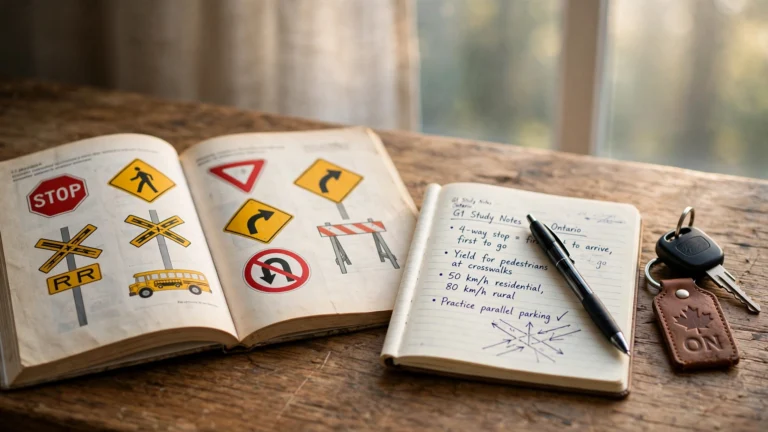
After check-in, you wait. Bring something to do, but keep it calm: this is a good window for a final skim of the trickiest signs, not for cramming a whole handbook chapter.
When your name or number is called, a staff member directs you to the testing room. From this point on, the process is tightly supervised, which is exactly what you want — it means the test is run fairly for everyone in the room.
Act Two: the Testing Room
The testing room is quiet by design. A proctor runs the room, explains the rules before anyone begins, and stays for the whole session.
You will be assigned a spot — at most centres that means a computer terminal; a few locations still run the test on paper, and your centre decides which format you get.
If anything is wrong with your station — a frozen screen, a wobbly chair, a pencil with no eraser — speak up before you start. Once the clock is effectively running, you do not want to be troubleshooting furniture.
The rules that matter: phones and smartwatches must be switched off and put away, out of reach, for the entire session. Notes, handbooks, and study sheets stay outside the room.
This is not the moment to test the boundaries — being caught with a phone or any form of cheating means an automatic fail and a lost fee, and you will be starting over another day.
Two accommodations are worth knowing about in advance. At computerized centres, the test is offered in many languages and usually comes with an audio version.
And if a disability makes reading the test difficult, you can arrange ahead of time for a centre worker to read the questions to you verbally. Both of these need to be sorted out before test day, not at the door.

Act Three: Answering the 40 Questions
On screen, the test presents one question at a time. Each question gives you four choices and asks for the single correct one — the 40 questions split into two blocks of 20: road signs first, then rules of the road.
The questions are drawn from a large bank, so the exact set you see will differ from the person sitting next to you. Memorizing someone else’s answer key is useless; understanding the material is the whole game.
Our breakdown of what the G1 test covers shows how those two blocks divide up.
Pace yourself like this: read every question twice, all the way through, before you touch an answer.
The test is deliberately written to punish skimming — the wrong answers are usually plausible, and they are usually plausible in a way that rewards the second read. Most people finish in roughly 20 to 30 minutes.
There is no prize for speed and no reason to race; the room will not rush you. If a question stumps you, sit with it for a minute rather than guessing on impulse — then commit and move on.
Lingering too long on one question is how easy marks at the end get missed.
One more mechanical detail that surprises people: the two sections are scored independently, back to back, in a single sitting. You cannot bank a brilliant signs section to rescue a weak rules section.
Treat both halves with equal respect from the first question.
Act Four: Your Score, Seconds Later
Here is the part everyone fixates on, and it is refreshingly anticlimactic: the test is marked immediately. You will know your result before you leave the room — either on screen or from the proctor, depending on the centre.
There is no waiting period, no mailed results, no refreshing a portal at midnight.
The pass rule is simple and strict: you need at least 16 correct out of 20 in each section. Sixteen in signs and fifteen in rules is a fail, and so is the reverse. Staff will explain exactly what your result means and what your options are.
If you passed, they will point you toward the licensing counter for the final steps.
If you did not, they will explain how to book another attempt — each attempt carries its own fee, so it pays to arrive prepared rather than treating the first sitting as a practice run.

Act Five: the Licensing Counter
Passing the test is not the last thing that happens — it is the second-to-last thing.
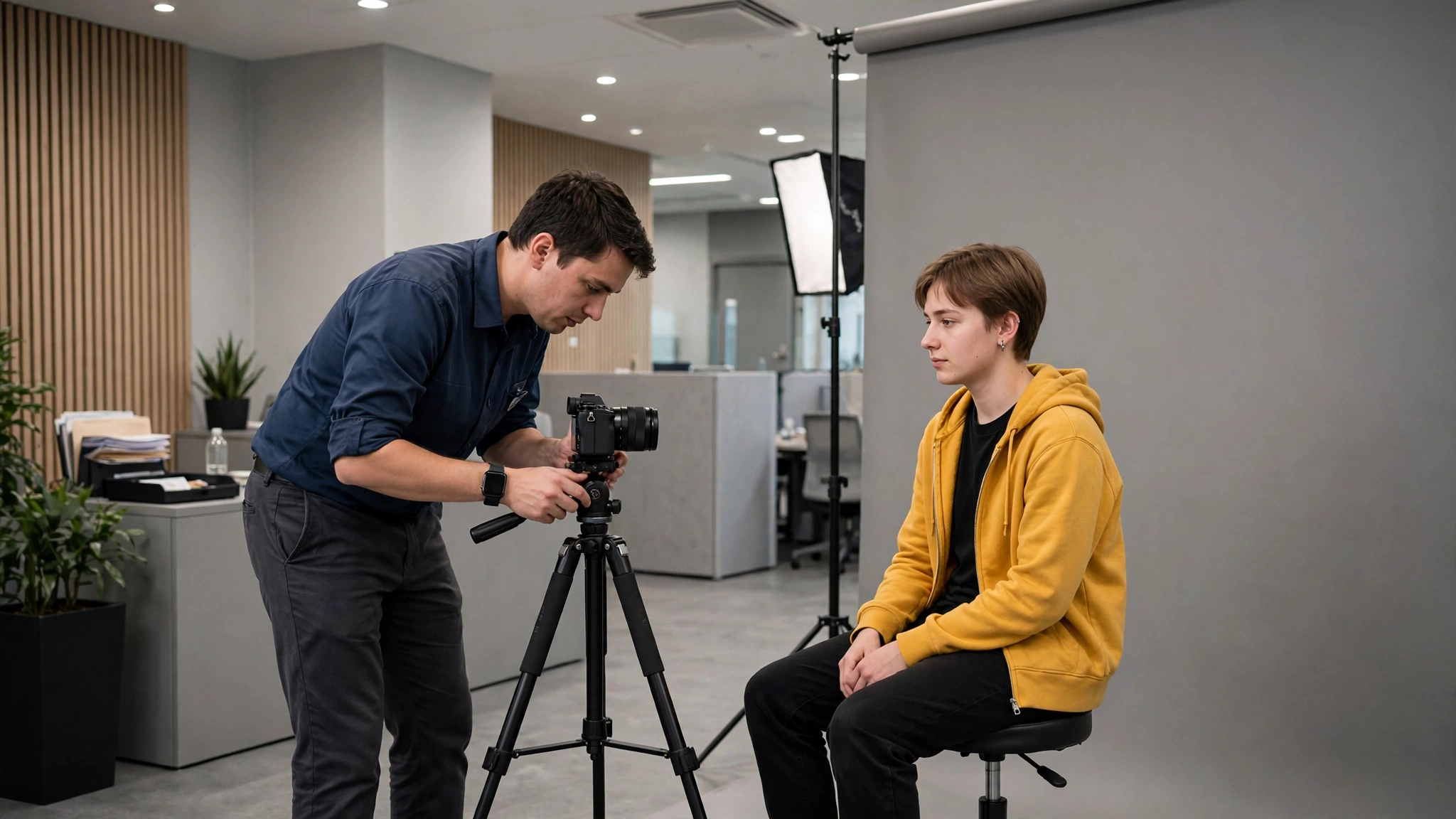
You head back to the main counter, where staff finalize your file: your photograph is taken for the licence card, remaining fees are collected, and you are issued a temporary licence on the spot.
That temporary document is your licence until the plastic card arrives in the mail, so keep it somewhere safe and treat it like the real thing, because for now it is.
Then you walk out licensed.
The G1 comes with real restrictions — a qualified accompanying driver, zero alcohol, no driving between midnight and 5 a.m., and limits on high-speed roads — and the clock starts on the graduated licensing journey toward your G2 road test. The mechanics of the day are over; the practice begins.
The Small Mechanics People Ask About Most
Language. The computerized test is available in many languages, and audio versions are common. Paper versions, where they are still used, are typically English or French.
If you need the test in a specific language, confirm with your centre ahead of time rather than assuming.
Paper or computer. You do not get to choose — the centre’s setup decides. Prepare for the content, not the medium: the questions test the same handbook knowledge either way.
On paper, fill in your answers carefully and double-check them before handing the sheet in; a stray mark is an unforced error.
Phones. Off and away for the whole session. Not on silent in your pocket — off and put away. The proctor’s job is to protect the integrity of the room, and the penalty for cheating is an automatic fail.
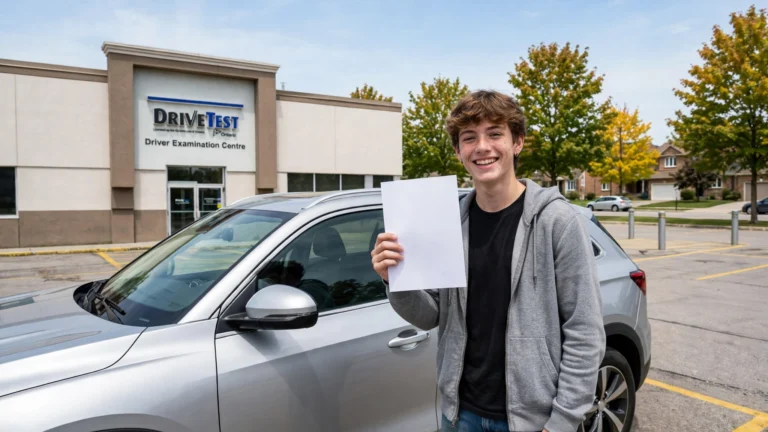
Appointments. Walk-ins are the norm for the knowledge test at many centres, but this varies by location and can change, so check the DriveTest website for the centre you plan to visit before you make the trip.
The vision screening. Short, standard, and part of the same visit. If you wear glasses or contacts, bring them — you want the screening to reflect how you will actually be driving.
Walking in Ready
None of this requires heroics. Arrive early enough that a lineup does not rattle you. Keep your identification in hand before you reach the counter, not buried in a bag. In the room, read each question twice and trust your preparation.
And treat the night before like the night before anything that matters: sleep properly, eat normally, and arrive as the calmest version of yourself.
The test measures what you know about signs and rules — everything else on this page is just choreography, and now you know all the steps.
Quick Answers About Test-Day Mechanics
Do I need an appointment for the G1 knowledge test?
It depends on the centre. Many locations accept walk-ins for the knowledge test, but rules vary and change over time — check the DriveTest website for your specific centre before you go.
Is the G1 test on paper or on a computer?
Most centres run it on computer terminals in a supervised testing room, though some locations still use paper. Your centre decides the format; the content is the same either way.
How long does the test take?
Most people finish in about 20 to 30 minutes. Work at a steady pace, read each question twice, and do not rush — there is no advantage to finishing early.
What happens if I fail the G1 test?
You get your result on the spot, and staff will explain how to book another attempt. Each attempt carries its own fee, which is why arriving well prepared matters.
Can I bring my phone into the testing room?
No — phones and smartwatches must be switched off and put away for the entire session. Being caught cheating means an automatic fail and a lost fee.
Disclaimer: this guide is unofficial practice material for the Ontario G1 knowledge test. It is not affiliated with, endorsed by, or connected to DriveTest or the Government of Ontario.
Test procedures, fees, and requirements can change — always confirm the details that matter with the official DriveTest website before your visit. For practice questions in the same multiple-choice format as the test, try the free G1 practice test.
Want 300 More Practice Questions?
The Premium Question Bank gives you 6 full mock exams with a plain-language explanation for every answer. Instant PDF download, yours to keep.
Get the Question Bank – $9.99Original handbook-mapped questions. Not real DriveTest questions. No pass promises – just serious practice.


One Comment