
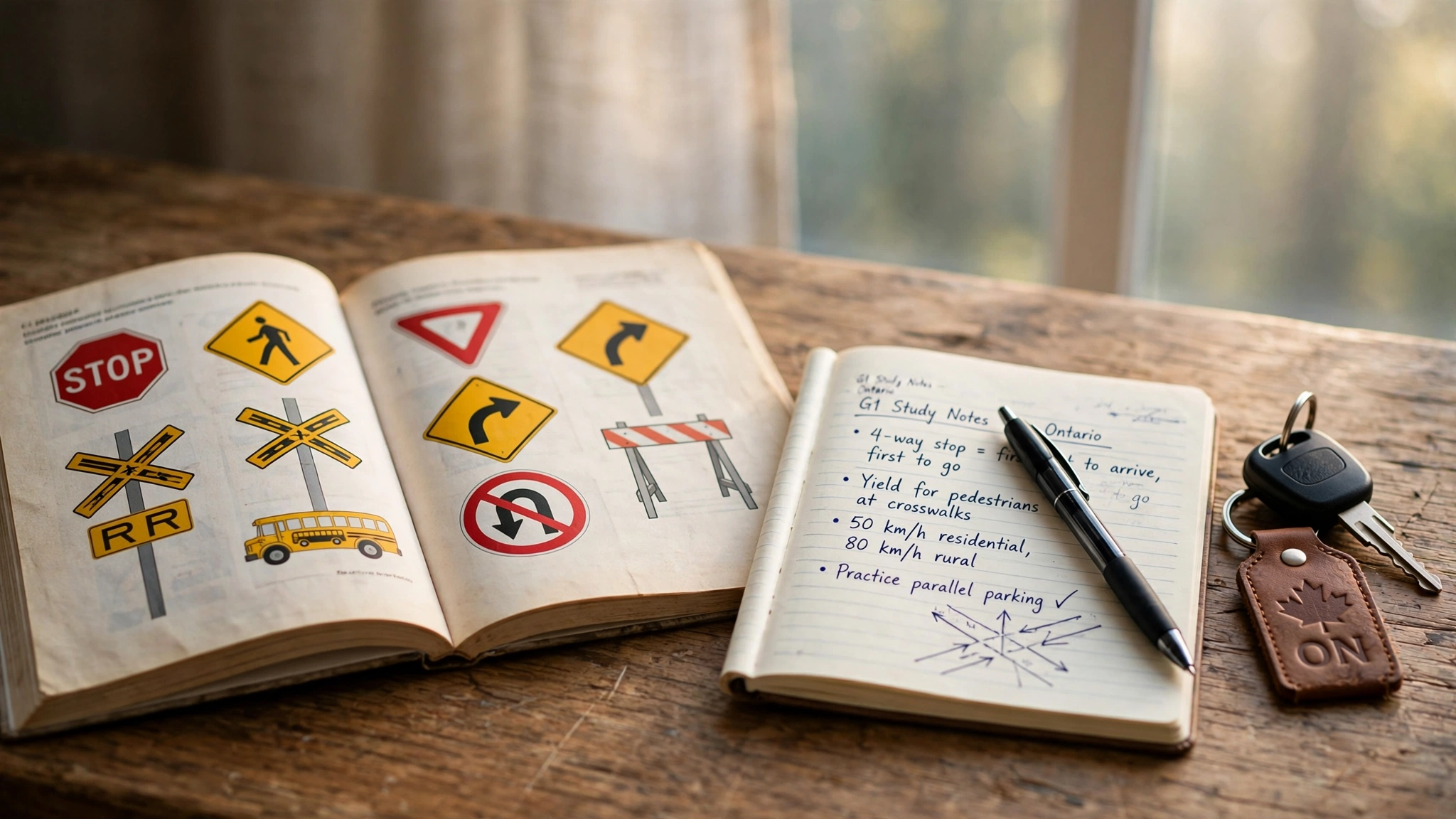
How to Use the Ontario Driver’s Handbook to Study for the G1 Test
Most people open the Official Driver’s Handbook, read it like a novel, and close it having learned almost nothing. The problem is not the book. It is the method.
The handbook is written as a reference, not a study guide. This article turns it into one, with a chapter-by-chapter method that converts reading time into knowledge that survives until test day.
Start With the Genuine Handbook
The Official Driver’s Handbook is published by Ontario’s Ministry of Transportation and is free to read on the Ontario government’s website. Start there, not with a random download.
Outdated or unofficial copies drift from current rules over time. When your study source and the test source are the same document, there is nothing to reconcile later.
If you prefer paper, that works too — just make sure the printed copy is current rather than a years-old edition. Either way, keep a pen nearby. You will be writing, not just reading.
Study the Chapters in This Order
The handbook’s own order serves new drivers learning to drive, not learners preparing for a written test. Rearranging the sequence makes every study hour count more.
- Road Signs first. Read and learn the signs section before anything else. Signs are visual, they are quick to master, and they make up half of your test.
- “Getting Your Driver’s Licence” next. Skim this for the graduated licensing rules and licence classes. A handful of questions come from here, and it is short.
- Rules chapters in handbook order. Work through getting ready to drive, driving along, sharing the road with other road users, driving through intersections, stopping, changing directions and positions, parking along roadways, and freeway driving.
- Night driving, bad weather, and emergencies last. These are smaller slices of the test, but each one can supply a question — finish them, just finish them last.
This sequence puts the heaviest-weighted material first while your motivation is fresh, and leaves the lightest slices for the end. For help deciding how much weight each topic deserves, see what you should study for the G1 test.
Read With a Pen in Your Hand
Passive reading is the handbook’s biggest trap. Your eyes move, the page turns, and nothing stays. Active reading fixes that with almost no extra time.
- Preview before you read. Scan each section’s headings before reading a word. Your brain learns faster when it already knows the map.
- Explain it back. After every page or two, close the book and say the key points aloud in your own words. If you cannot, re-read before moving on.
- Keep one notebook page per chapter. If a chapter does not fit on one page of notes, you copied instead of condensed. Condense until it fits.
- Mark your misses. Every rule you get wrong when quizzing gets a star in the margin. Re-read only the starred pages on review day.
None of this slows you down much. A chapter takes roughly the same hour either way. One version leaves you with notes and memory; the other leaves you with tired eyes.
Turn the Signs Section Into Pictures You Keep
The signs section is a gallery of diagrams, and galleries are learned by looking, not reading. Cover each sign’s name with your hand and guess its meaning before you look.
Group signs by shape and colour as you go. Ontario signs use shape and colour families to carry meaning, so learning the families first makes every individual sign easier to place.
- Learn the families first. Regulatory, warning, and information signs each have a distinctive look. Master the look, then the members.
- Study look-alikes side by side. The signs that resemble each other are the ones tests use to separate guessers from learners. Compare them deliberately.
- Say the meaning aloud every time. Silent recognition is weaker than spoken recall. Name each sign out loud as you quiz yourself.
- Redraw the tricky ones. A rough sketch from memory is a brutally honest test. If you cannot sketch it, you do not know it yet.
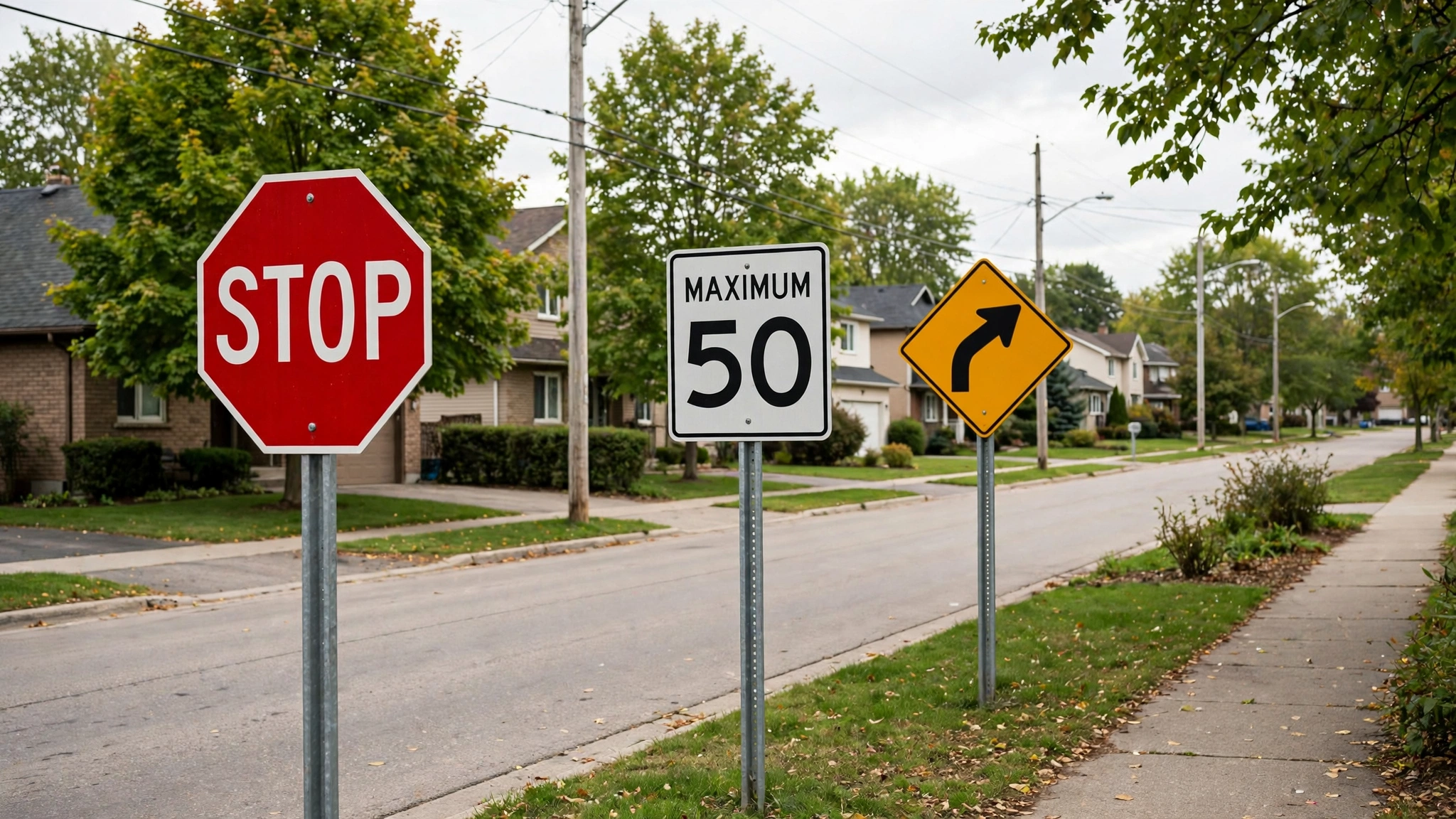
Ten focused sessions on signs, using the cover-and-guess method, will take most learners further than a month of casually flipping through the pages.
Convert Rules Into Scenes You Can See
Rules chapters are dense prose, and prose is forgettable. The trick is to turn each rule into a scene: picture yourself in the exact situation the rule describes.
An abstract rule about yielding becomes concrete the moment you imagine two cars arriving together at an intersection with no signs. Concrete scenes survive until test day; abstract sentences do not.
- Stage every right-of-way rule. Draw or imagine the intersection with yourself in it. Place the other vehicles, then apply the rule.
- Attach distances and speeds to real places. Link following distances and speed rules to roads you actually travel, as a passenger or cyclist.
- Ask “what would the test ask here?” After each rule, phrase the question yourself. Writing the question is half of answering it.
- Collect the exceptions. Rules with “unless” or “except” in them are test favourites. Give each exception its own notebook line.
Rules you have pictured are rules you can apply to situations you have never seen before. That is exactly what the G1’s multiple-choice questions demand — for the full picture of what the test covers, see what the G1 test covers.
Review in Loops, Not Marathons
One pass through the handbook is not studying; it is orientation. Memory forms in review loops, and each loop is shorter than the last.
- Quiz before you advance. Finish a chapter, then test yourself on it before starting the next one. Do not stack untested chapters.
- Re-quiz the weak spots weekly. At the end of each week, revisit only the chapters where you missed questions. Leave the solid ones alone.
- Run the full notebook once. The night before your final review, read through your one-page notes for every chapter in a single sitting.
Each loop takes less time and holds more knowledge. That is the whole point: the handbook shrinks as your understanding grows. For help spacing these loops across real days, see how many days to study for the G1.
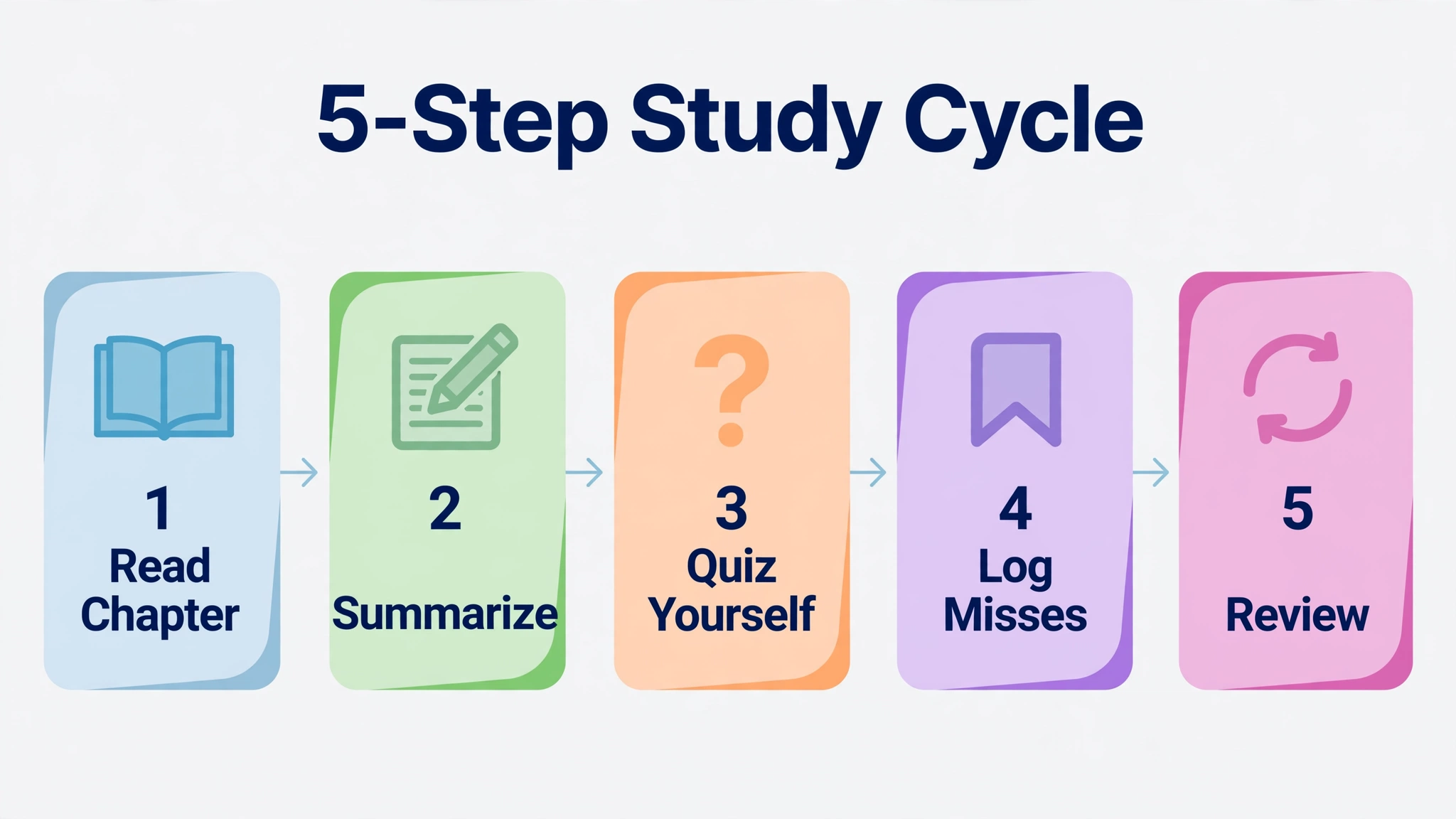
Test Every Chapter Before You Trust It
Reading a chapter well is not the same as knowing it. The only reliable check is answering questions about it with the book closed.
After each chapter, take a short practice quiz on that topic. Misses are not failures — they are a map showing exactly which pages deserve a second look.
Our free G1 practice test splits questions into signs and rules the same way the real test does, so it works as a natural checkpoint after every chapter.
Habits That Quietly Waste Handbook Time
A few common habits make handbook study feel busy while achieving little. Drop them early and your hours start paying off.
- Highlighting everything. If the whole page is yellow, nothing is important. Highlight the exceptions and the numbers, nothing else.
- Re-reading chapters you already know. Comfort reading feels good and teaches nothing new. Your misses decide what gets re-read.
- Skipping the diagrams. Test questions often come straight from the handbook’s illustrations. Study every diagram as carefully as the text.
- Studying in one giant session. Memory consolidates between sessions while you sleep. One marathon cannot replace spaced evenings.
- Reading summaries instead of the book. Third-party summaries drop the small details that tests love to ask about. The handbook is the source; read it.
Frequently Asked Questions
Is the Official Driver’s Handbook Free?
Yes. The Ministry of Transportation publishes it online, and you can read it free on the Ontario government website. You never need to pay for the knowledge it contains.
Do I Need to Read the Whole Handbook?
Focus your deep study where the questions come from: road signs, rules of the road, and the licence chapter. The handbook covers more than the test’s scope, so skim the rest and master the core.
Can I Pass Using Only Practice Tests?
Practice tests are excellent checkers but weak teachers. They reveal what you missed, not why. Read the handbook chapter first, then use practice questions to verify you actually absorbed it.
How Long Does It Take to Study the Handbook Properly?
With the active method above, most learners work through the test-relevant chapters across several focused sessions over one to two weeks — and retain it. Passive cover-to-cover reading takes longer and keeps less.
Should I Take Notes by Hand or on a Screen?
Use whichever you will actually review. Handwriting slows you down just enough to force condensing, which suits the one-page-per-chapter rule. Typed notes are easier to search later. Either works — the method matters more than the medium.
Is the Printed Handbook Different From the Online One?
The content is the same; only the convenience differs. Use whichever version you will actually open. If you choose print, make sure it is a current edition, not a years-old one.
This guide is unofficial practice material for study purposes only. It is not affiliated with DriveTest, the Ontario Ministry of Transportation, or the Government of Ontario, and practice performance does not guarantee any result on the official knowledge test.
Want 300 More Practice Questions?
The Premium Question Bank gives you 6 full mock exams with a plain-language explanation for every answer. Instant PDF download, yours to keep.
Get the Question Bank – $9.99Original handbook-mapped questions. Not real DriveTest questions. No pass promises – just serious practice.





2 Comments