
Ontario Regulatory Signs: What Do They Mean?
Some road signs suggest. Regulatory signs command. A warning sign tells you a curve is coming; a regulatory sign tells you to stop, slow down, or not turn at all. Ignoring one is a traffic offence, not a suggestion.
On the G1 test, several of the road-sign questions draw from this family. This guide breaks regulatory signs into groups by shape and meaning, flags the pairs that test-takers mix up most, and ends with a quick self-test so you can check what stuck.
What Makes a Sign “Regulatory”
Ontario groups road signs into families. Regulatory signs are the family that gives orders: stop, yield, speed limits, turn bans, parking rules, and lane rules.
The practical difference is simple. Disobey a warning sign and you were careless. Disobey a regulatory sign and you broke the law. That is why the G1 test probes these signs closely — it wants drivers who treat orders as orders.
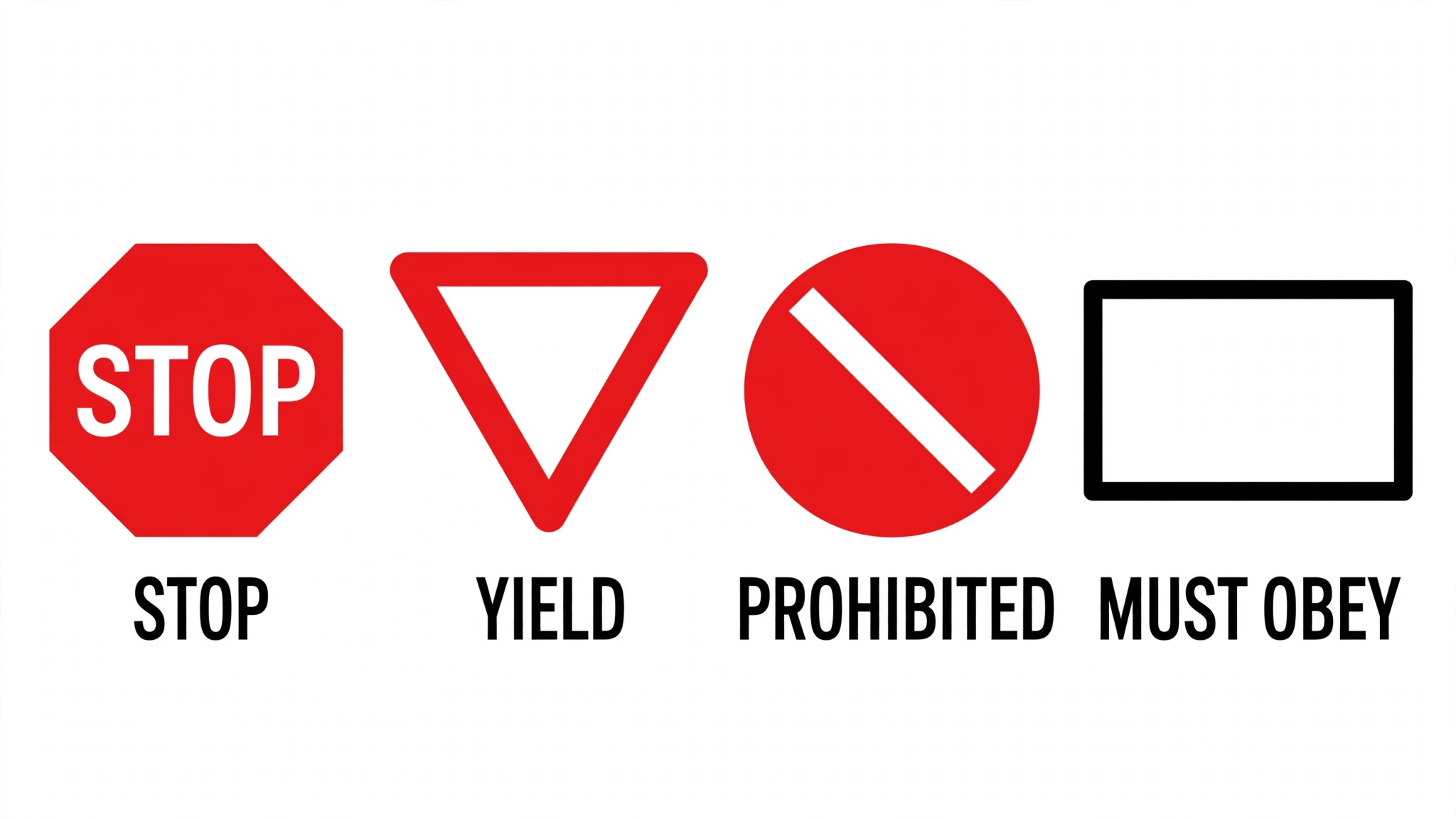
Before reading a single word on a sign, read its shape. Each shape belongs to one family:
- Red octagon: stop. Nothing else uses this shape.
- Inverted red-and-white triangle: yield.
- Red circle with a diagonal slash: something is prohibited.
- White rectangle with black or red markings: a rule you must follow.
- Red circle with a white horizontal bar: do not enter.
Warning signs, by contrast, only advise you about hazards ahead. Our guide to Ontario warning signs covers the yellow-diamond family separately, so you can study each family on its own terms.
Stop and Yield: Who Goes First
These two signs control right of way at intersections, and the G1 test rarely skips them. Learn the exact action each one demands.
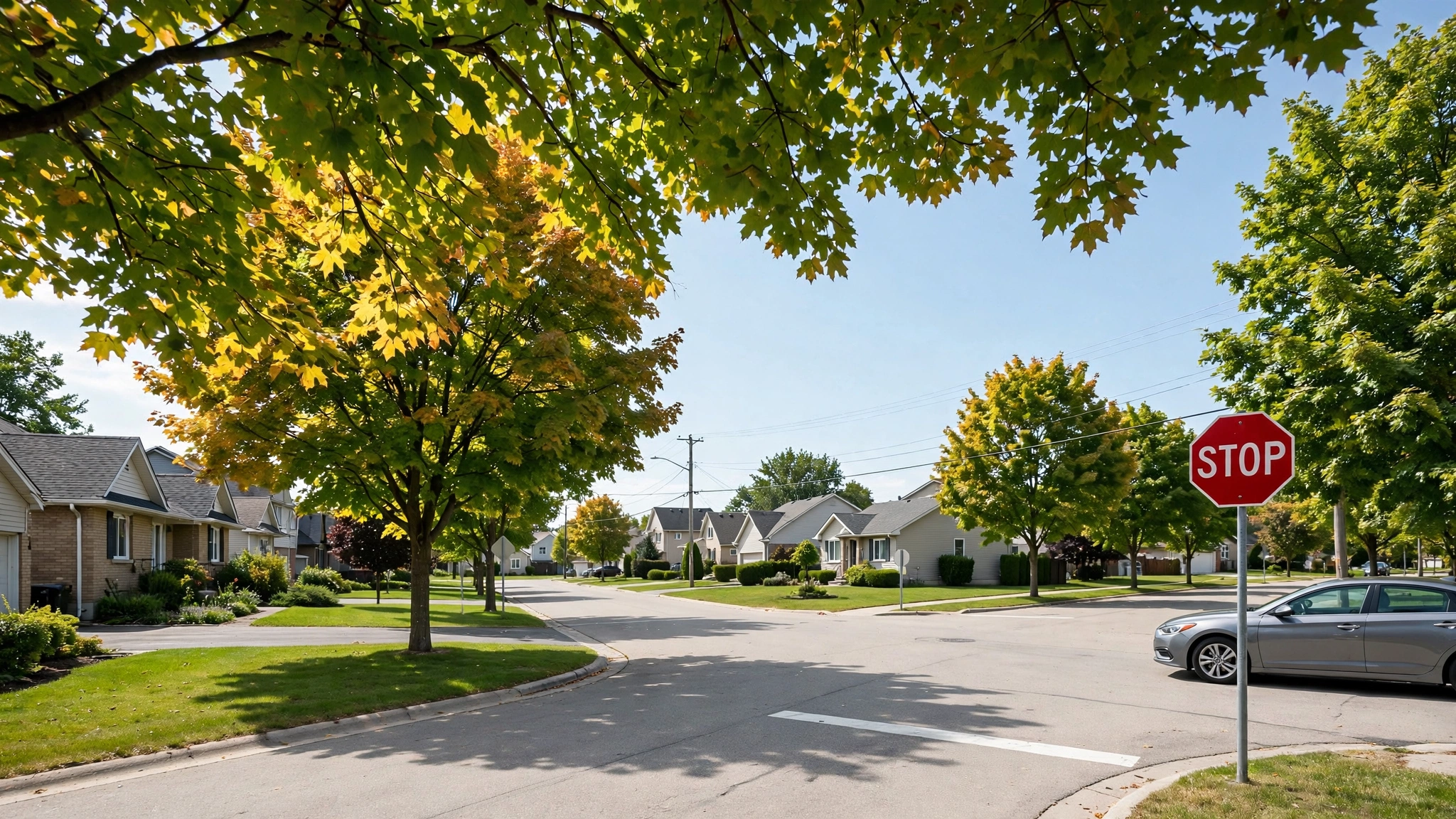
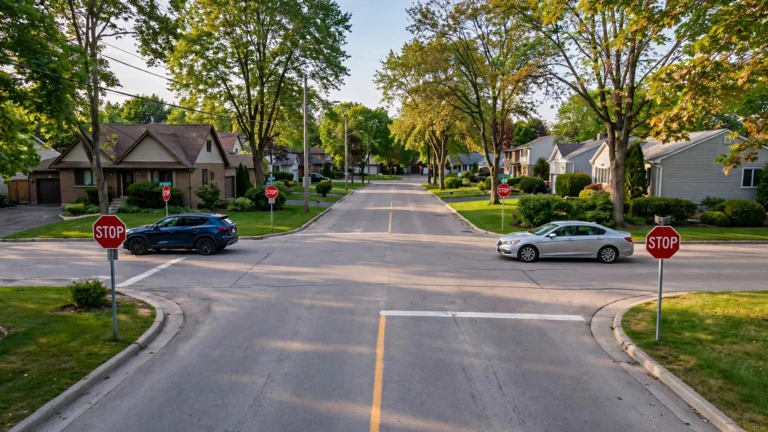
A stop sign means a complete stop, every time. Stop at the white stop line if there is one. If there is no line, stop before the crosswalk. If there is no crosswalk either, stop at the edge of the intersection. Then look both ways and go only when the way is clear.
At an intersection where every direction has a stop sign, the vehicle that stops first goes first. When two vehicles stop at the same moment, the one on the right has the right of way.
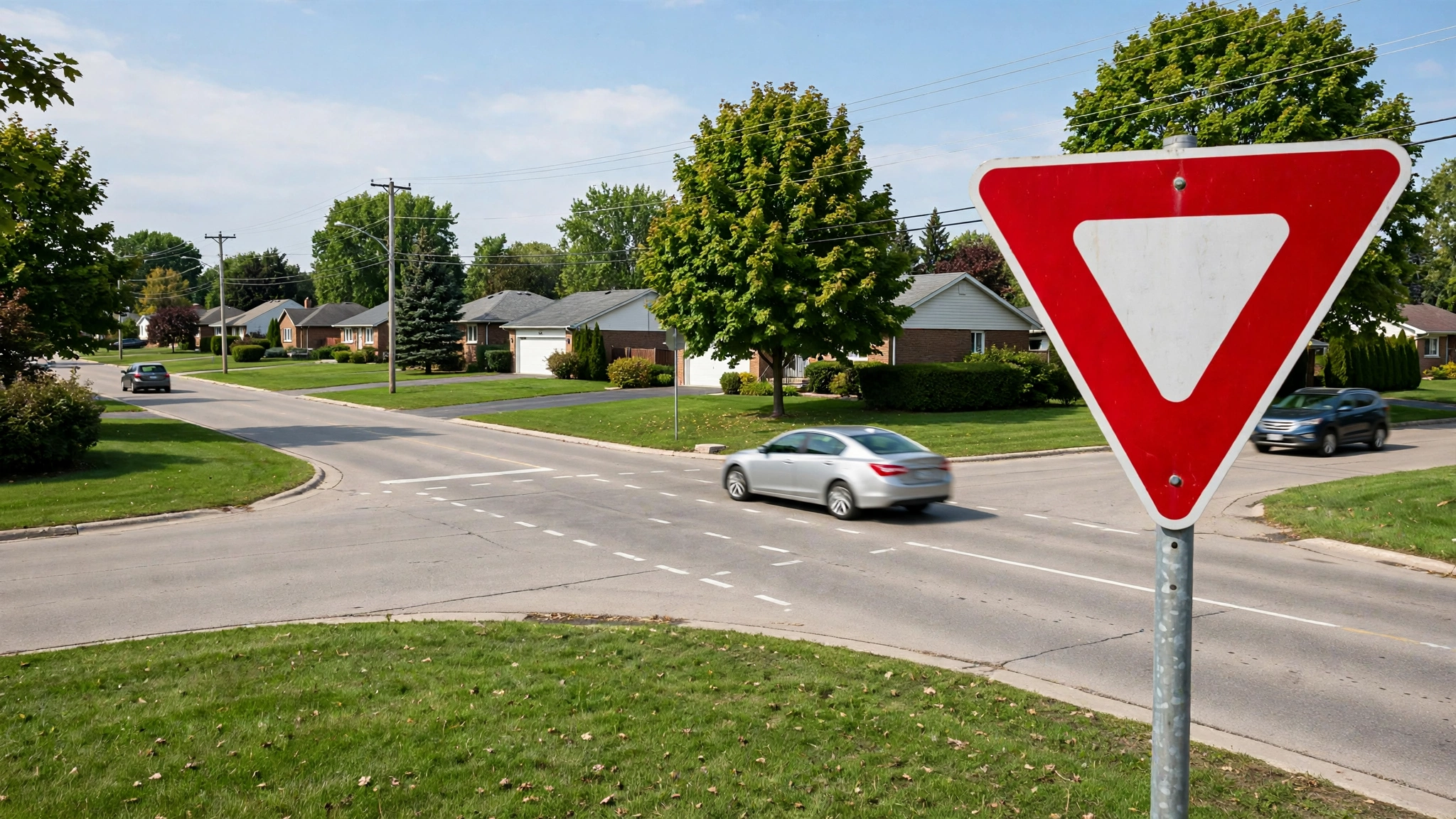
A yield sign is softer but not optional. Slow down, be ready to stop, and give the right of way to traffic and pedestrians already in or approaching the intersection. If the way is genuinely clear, you may keep rolling — a full stop is not required.
Speed Limit Signs and the Word “Maximum”
A speed limit sign shows the maximum, not the recommended speed. In good conditions you may drive up to it, never over it. In rain, snow, or heavy traffic, the safe speed sits below it.
Where no limit is posted, Ontario has defaults straight from the Driver’s Handbook: 50 km/h in cities, towns, and villages, and 80 km/h everywhere else.
A posted sign always overrides the default. Watch for lower limits in school zones and construction zones, where the whole point is protecting children and road workers.
Some highways also post minimum speeds. Where a minimum appears, treat it the same way: it is a regulation, not advice. And even without a posted minimum, driving far below the flow of traffic creates its own hazard.
Turn Bans and the Little Clock Underneath
A red circle with a slash over a turning arrow bans that turn: no left turn, no right turn, no U-turn. The arrow symbol does the talking, so learn to read each arrow at a glance.
Sometimes a small plate under the sign shows hours, such as 7 AM to 4 PM. The ban applies only during those hours. Outside them, the turn becomes legal again.
This trips people up in both directions. Some drivers ignore the ban during restricted hours; others refuse a perfectly legal turn at midnight. Read the plate before you decide.
Two related rules pair naturally with these signs. After a complete stop, you may turn right on a red light unless a sign forbids it. You may turn left on a red only from a one-way street onto another one-way street, again after stopping and when the way is clear.
Direction Signs: One Way, Do Not Enter, Wrong Way, Keep Right
These signs manage which way traffic flows. Misread one and you can end up facing oncoming traffic, so the test treats them seriously.
- One way: a black arrow on a white rectangle. Travel only in the arrow’s direction.
- Do not enter: a red circle with a white horizontal bar. The road or lane beyond is closed to you.
- Wrong way: a red sign with white letters. You are the problem — turn around or pull over safely and reorient yourself.
- Keep right: pass to the right of the sign. You will see it at traffic islands and other obstructions in the roadway.
Do not enter and one way signs travel in pairs. If you spot one, expect the other nearby — and never turn down a street that shows you the red circle.
No Stopping Versus No Parking: The Comparison That Earns Marks
This pair causes more wrong answers than any other parking question. The rules form a ladder from strictest to loosest:
| Sign | What it allows |
|---|---|
| No stopping | Nothing. You cannot halt even for a moment, except to avoid a collision or to obey a signal or officer. |
| No parking | You may stop briefly to pick up or drop off passengers, but you cannot leave the vehicle or park it. |
Arrows under the sign show where the rule applies. An arrow pointing left marks where the zone starts, one pointing right marks where it ends, and a double-headed arrow means the whole stretch between signs is covered.
Time plates work exactly as they do with turn bans. A no-parking sign reading 8 AM to 6 PM describes a normal, legal parking spot in the evening.
Lane Signs: Diamonds, Passing Rules, and Slower Traffic
A white diamond on a black sign marks a reserved lane. Only the vehicles named on the sign — buses, high-occupancy vehicles carrying at least the posted number of occupants, or bicycles — may use it during the posted times.
A do-not-pass sign means exactly what it says: stay behind the vehicle ahead until the restriction ends. Passing is normally allowed where the centre line is broken; this sign removes that option for the stretch ahead.
Slower traffic keep right signs appear on multi-lane highways. If you are not actively passing, move right and let faster traffic by. Where the sign is posted, keeping right is an order rather than a courtesy.
You will also meet signs directing traffic around obstructions, such as keep-to-the-right markers at construction zones. Treat every lane-direction sign as mandatory — that is what the regulatory family means.
Five Mix-Ups That Cost Test-Takers Marks
- Do not enter vs. wrong way. Do not enter faces you before you commit; wrong way tells you that you already committed. One prevents the mistake, the other reports it.
- No parking vs. no stopping. No parking bans leaving your car; no stopping bans halting at all. Re-read the comparison table above before test day.
- Maximum vs. advisory speeds. A white maximum sign is law. A yellow speed plate under a warning sign is advice for the curve ahead. The G1 test shows you both — check the colour.
- Yield vs. stop. Yield lets you roll through when the way is clear; a stop sign never does. If the question says “must come to a complete stop,” only the octagon qualifies.
- Turn bans with and without time plates. A bare no-left-turn sign bans the turn at all times. The same sign with hours bans it only then. The little plate changes the answer.
A 10-Minute Drill That Locks In Regulatory Signs
Reading about signs is not the same as recognizing them at speed. This drill takes ten minutes and targets exactly what the test measures:
- Sort by shape. List the five shapes from the decoder above and name each family without looking back.
- Say the action aloud. For each sign, state exactly what a driver must do: “complete stop,” “give way,” “no stopping at all.” Actions stick better than definitions.
- Test the pairs. Cover the meanings and quiz yourself on do-not-enter versus wrong-way, no-parking versus no-stopping, and maximum versus advisory until the mix-ups disappear.
- Space it out. Repeat the drill tomorrow and again in three days. The memory techniques for road signs in our memorization guide explain why spaced repetition beats cramming.
Quick-Fire Self-Test: Eight Questions
Answer from memory, then check yourself against the answers woven into each question:
- Which shape is used only for the stop sign? — the red octagon.
- With no signs posted, what is the maximum speed in a town? — 50 km/h.
- A no-stopping zone is in force. May you halt for ten seconds to drop off a passenger? — no; stopping is fully prohibited.
- A no-left-turn sign shows 7 AM to 9 AM. Is the turn legal at noon? — yes; the ban applies only during the posted hours.
- What does a red circle with a white horizontal bar mean? — do not enter.
- At a yield sign with no traffic coming, must you stop fully? — no; slow down, check, and proceed if the way is clear.
- What does a white diamond on a black sign indicate? — a reserved lane for the vehicles named on the sign.
- Where do you stop for a stop sign when there is a crosswalk but no stop line? — before the crosswalk.
Frequently Asked Questions
Are Regulatory Signs Legally Enforceable?
Yes. Regulatory signs carry the force of law. Running a stop sign, exceeding a posted maximum, or parking where prohibited can bring a ticket and demerit points. Warning signs advise; regulatory signs command.
How Can I Tell a Regulatory Sign From a Warning Sign?
Check the shape and colour. Regulatory signs are usually white rectangles, red circles, the red octagon, or the inverted triangle. Warning signs are yellow diamonds. Our complete guide to Ontario road signs walks through every family side by side.
What Does a White Rectangular Sign Mean?
It states a regulation you must follow. Speed limits, lane rules, parking rules, and similar orders all live on white rectangles, sometimes with a smaller plate underneath adding hours or conditions.
Do Regulatory Signs Show Up on the G1 Test?
Yes. Expect several questions on them in the sign section, especially stop signs, speed limits, and the no-parking versus no-stopping pair. Try them under exam conditions on our free Ontario G1 practice test.
This guide is unofficial study material for the Ontario G1 knowledge test. It is not affiliated with DriveTest, the Ministry of Transportation, or the Government of Ontario. Road rules change over time, so always confirm current requirements with official sources before your test.
Want 300 More Practice Questions?
The Premium Question Bank gives you 6 full mock exams with a plain-language explanation for every answer. Instant PDF download, yours to keep.
Original handbook-mapped questions. Not real DriveTest questions. No pass promises – just serious practice.



One Comment