

What Does the G1 Test Cover in Ontario?
Most people start studying for the Ontario G1 knowledge test the same way: they open the Driver’s Handbook, see how thick it is, and feel their motivation drain out through their shoes. The handbook is a lot.
But here is the thing that makes studying dramatically easier — the test itself is not a random sample of everything in that book.
It draws from a specific map of topics, and once you know the map, you can stop reading the handbook like a novel and start studying it like a syllabus. This guide is that map.
It walks through everything the G1 knowledge test covers in Ontario, section by section, so you can see exactly where your study hours should go.
The Test’s Two Halves, at a Glance
The G1 knowledge test is 40 multiple-choice questions split into two equal sections of 20: road signs, and rules of the road.
Each section is passed or failed on its own — you need at least 16 correct answers in each section, so a strong signs score cannot carry a weak rules score.
If you want the full breakdown of those numbers and what they mean for your study plan, there is a separate guide to the test’s format in numbers.
Everything below fits inside those two halves. Nothing on the test comes from outside them — so if a topic is not a sign or a rule, it is not on the test, and you can safely stop worrying about it.
First Half: the Language of Road Signs
Twenty of the forty questions test whether you can read the signs of the road the way a driver must: instantly, without translating.
Ontario’s signs fall into four families, and the test treats them as four separate vocabularies worth learning on their own terms.
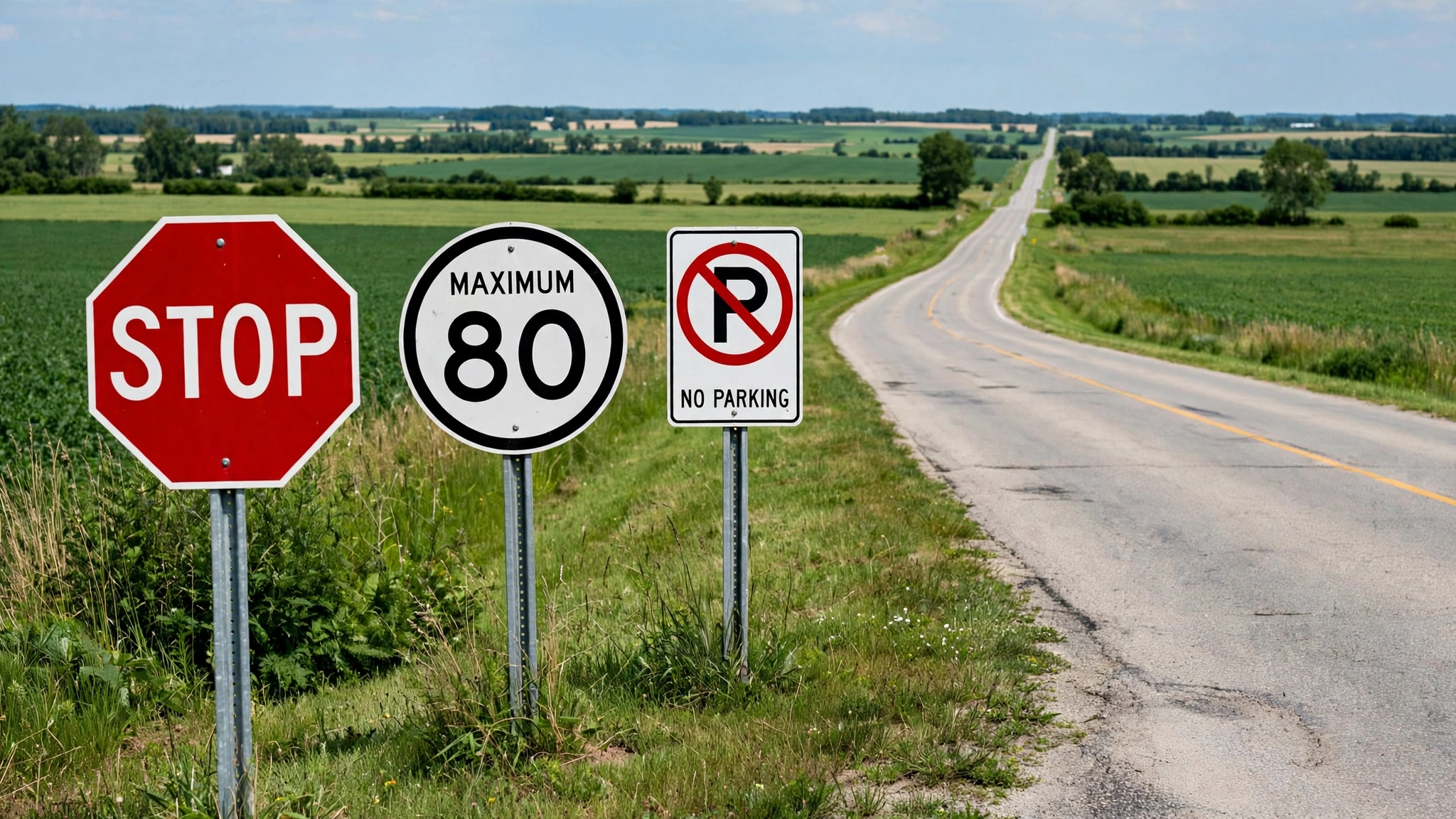
Regulatory signs are the orders of the road. They tell you what you must do or must not do, and ignoring one is a traffic offence, not a suggestion.
The test loves these: stop signs, yield signs, speed limit signs, do-not-enter signs, one-way signs, no-parking and no-stopping signs, and turn-control signs like no left turn.
When a question shows a regulatory sign, it is really asking whether you know the law behind it — a stop sign question is a question about what “stop” legally requires (a full stop, behind the line or crosswalk, before proceeding when safe).
Warning signs are the road’s way of tapping you on the shoulder.
These are the yellow diamond signs: curves and sharp turns ahead, winding road, slippery when wet, pedestrian and school crossings, deer or moose crossings, hidden intersections, narrow bridges, and railway crossings ahead.
Test questions on warning signs usually describe a driving situation and ask which sign you would expect to see — or show the sign and ask what hazard it warns about.
Learn the shapes and colours first (yellow diamond = warning), then the individual symbols.
Information and direction signs are the quietest family and the one people under-study.
These green, blue, and white signs tell you where things are and what services are available: route markers, distance signs, hospital and gas station signs, parking signs, and tourist information.
They are a smaller share of the questions, but they are easy marks if you have seen them all once.
Temporary condition signs — the orange ones — cover construction zones, detours, lane closures, and workers on the road.
Ontario treats construction zones seriously, and the test reflects that: questions here often combine the sign with the rule (for example, that speed limits in signed construction zones must be obeyed and fines are higher).
Traffic signals sit inside this half too: steady and flashing red, yellow, and green lights, green arrows, and pedestrian signals including the flashing hand.
The trickiest signal questions are the edge cases — what a flashing yellow means versus a flashing red, and what to do when a green light and a pedestrian signal disagree about your turn.
Second Half: the Rules That Govern the Road
The rules section is where the test stops asking “what does this mean?” and starts asking “what do you do?” It is the larger topic area in practice, because it covers nearly everything about operating a vehicle on Ontario roads. The questions cluster into a handful of themes.
Right-of-way. This is the beating heart of the rules section: who goes first, and when.
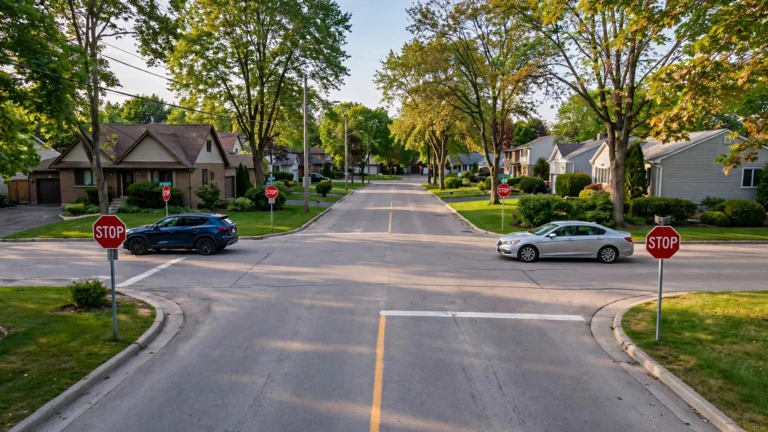
Four-way stops, uncontrolled intersections, T-intersections, roundabouts, turning left across oncoming traffic, yielding to pedestrians in crosswalks, and yielding to transit buses pulling out.
If there is one cluster to master completely, it is this one — right-of-way questions appear in many forms, and getting them wrong in real life is how collisions happen.
Speed and space. Know the posted limits, but also the statutory defaults that apply when no sign is posted: 50 km/h on roads in built-up areas and 80 km/h on rural roads, per Ontario’s Highway Traffic Act.
Just as important is adjusting speed to conditions — rain, snow, fog, and darkness all demand slower driving, and the test will ask about it.
Following distance belongs here too: the two-second rule in good conditions, more when the road is wet or icy, and much more behind large trucks that block your view.
Lane use, passing, and turning.
- Lane discipline: which lane to be in and when, and how to change lanes safely (mirror, signal, blind spot).
- Passing rules: when passing is allowed and when it is forbidden — hills, curves, intersections, railway crossings, school zones.
- Safe turns: the mechanics of turning safely, including turning into the correct lane and signalling well in advance.
Stopping, standing, and parking.
Where you may and may not stop, how far from intersections, crosswalks, fire hydrants, and railway tracks you must park, parking on hills (wheels turned toward the curb downhill, away from the curb uphill), and parallel parking rules.
Parking questions are detail-heavy — distances and directions — so they reward a careful single read of the handbook section rather than skimming.
Sharing the road.
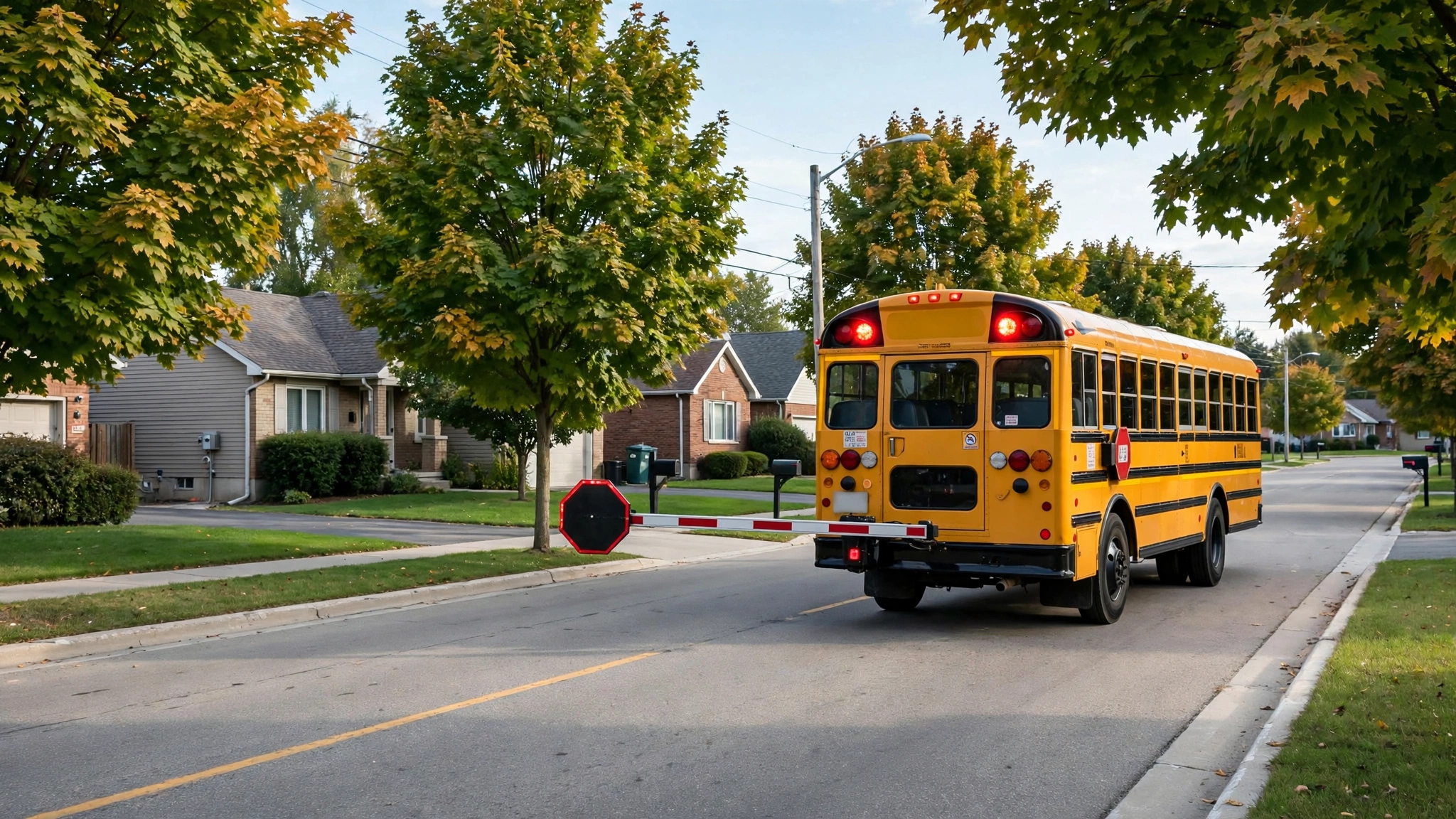
Pedestrians (including children and people with disabilities), cyclists (one-metre passing rule, bike lanes, checking before right turns), motorcyclists, large trucks with their blind spots and long stopping distances, school buses, and emergency vehicles.
The school bus rule is a perennial test question: when a school bus has its red lights flashing, traffic in both directions must stop — the only exception is on a road divided by a median, where oncoming traffic may proceed.
Emergency vehicles are the companion question: pull to the right and stop when an emergency vehicle approaches with lights or sirens, and never follow closer than the legal distance behind one.
After a collision. The handbook’s duties are straightforward and testable: stop, stay at the scene, call for help if anyone is hurt, exchange information, and report to police when required.
Hit-and-run questions show up precisely because the answer is always the same — you never leave.
Driving impaired, distracted, or tired. Ontario’s zero-tolerance rules for young and novice drivers (zero alcohol and zero drugs in your system), the dangers of distracted driving, and the effects of fatigue.
The G1 licence conditions themselves live here too: you must be accompanied by a fully licensed driver, you cannot drive on 400-series highways or at night during certain hours, and every passenger must wear a seatbelt.
These conditions are not trivia — they are the legal terms of the licence you are applying for.
The Questions That Punch Above Their Weight
Every topic above can appear on the test, but a few small topics generate a surprising share of questions — and of wrong answers. Give these extra attention.
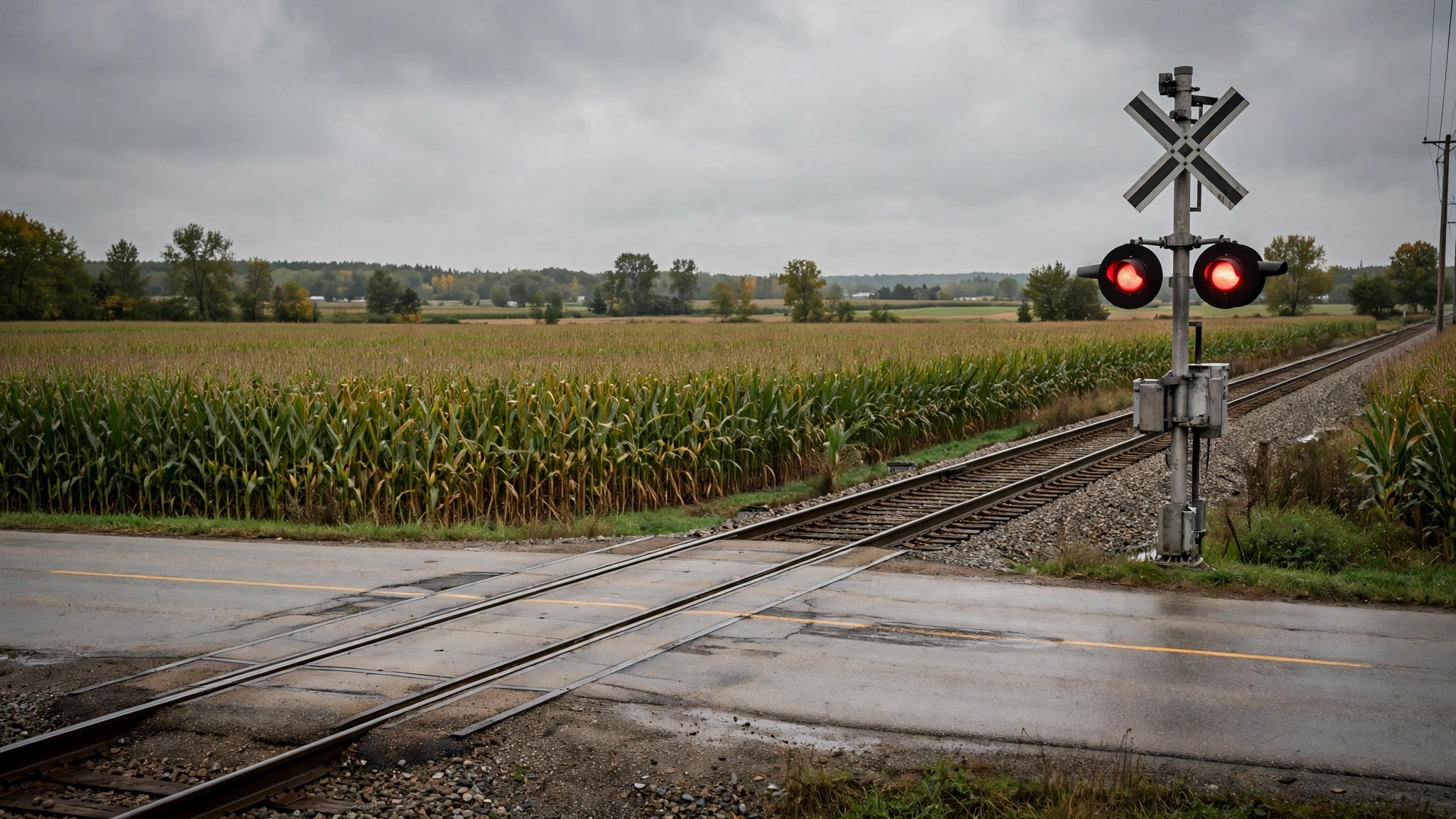
Railway crossings look like a footnote in the handbook and behave like a headline on the test.
Know the crossbuck, the flashing-light signals, and the rules: never stop on the tracks, never shift gears while crossing, stop at least a set distance back when required to stop (buses and some other vehicles must always stop), and never try to beat a train.
A handful of careful minutes with this topic buys several confident answers.
School zones and community safety zones combine signs with rules: reduced limits when flashing, no passing, extra caution around children.
Roundabouts generate questions because the rules are specific — yield on entry, signal your exit, never stop inside.
Funeral processions, horse-drawn vehicles, and farm equipment appear occasionally; they are rare on the road but fair game on the test, so at least know they exist in the handbook.
The pattern to notice: the test rewards you most for the topics you would otherwise skim. The big, obvious subjects (stop signs, red lights) are the ones everyone gets right.
The pass line is often decided in the margins — railway crossings, parking distances, and school bus rules.
What the Knowledge Test Does NOT Cover
Clearing up what is not on the test is almost as useful as knowing what is, because it stops you from studying the wrong things.
The knowledge test does not test your ability to physically drive.
Parallel parking as a manoeuvre, three-point turns, hill starts, and lane changes behind the wheel are road-test material — they belong to the G2 and G road tests, not the G1 written test.
The G1 test may ask you the rules about parking, but it will never ask you to demonstrate it.
The vision test is a separate requirement handled at the DriveTest centre; it is not one of the 40 questions.
Vehicle mechanics beyond the basics — engine repair, tire changes, fluid types — are not covered either, though you should know your dashboard warning lights and basic vehicle checks.
First aid, insurance shopping, and the exact dollar amounts of fees and fines are not test material; the test cares about behaviours and rules, not price lists.
And one persistent myth to retire: the test does not include trick questions about obscure laws nobody follows. Every question traces back to the handbook.
If you can explain each handbook topic in your own words, there is nothing on the test that can surprise you.
How to Turn This Map Into a Study Plan
Knowing the syllabus is only half the job; the other half is working through it in the right order. Here is a sequence that respects how the test is built.
1. Learn the sign families first. Signs are the most visual, most memorable material, and they are half the test.
Go family by family — regulatory, warning, information, temporary — and test yourself with flashcards or free G1 practice questions until you can name any sign on sight.
2. Master right-of-way before anything else in the rules half. It is the highest-value cluster: intersections, four-way stops, roundabouts, left turns, pedestrian priority.
Draw the scenarios on paper if it helps — many people find right-of-way clicks faster as diagrams than as paragraphs.
3. Sweep the detail-heavy topics in one focused pass. Parking distances, railway crossing rules, school bus rules, speed defaults, following distances, G1 licence conditions. Read each once, carefully, and make a one-page cheat sheet. These are the questions people miss by skimming.
4. Practice in the test’s own shape. The exam is two sections of 20 with a 16-per-section pass line, so practice that way: score each section separately and keep studying until both halves are consistently above the line, not just your total.
A walkthrough of what the test looks like on the day helps you rehearse the experience, not just the content.
5. Study in the language you will test in. The G1 test is offered in more than 20 languages at most DriveTest centres, and studying in the language you are most comfortable with is a genuine advantage.
If that language is French, our French G1 practice test lets you rehearse the same material in French before test day.
Straight Answers to Syllabus Questions
Do I Need to Memorize Every Single Sign in the Handbook?
Effectively, yes for the common ones — but “memorize” is the wrong word. Learn the families first (shape and colour tell you the category), and most individual signs become obvious.
The regulatory and warning families carry the most questions, so start there and treat information signs as a final sweep.
Are the Test Questions Worded the Same as the Handbook?
No. The test asks about the handbook’s topics in its own wording, and many questions describe a driving situation rather than quoting a rule.
That is why understanding beats memorization: if you know why the rule exists, you can answer the question however it is phrased.
Which Section Do People Find Harder?
Most test-takers find the signs section more straightforward — it is recognition, and recognition improves fast with practice.
The rules section is where judgment questions live (right-of-way scenarios, “what should you do when…” situations), and it is the section that most often falls below the pass line. Budget your study time accordingly.
Is the Syllabus the Same at Every DriveTest Centre?
Yes. The test format and the topics it draws from are the same province-wide.
The specific questions vary from sitting to sitting, but they all come from the same map described above — which is exactly why studying the syllabus, rather than any fixed set of questions, is the strategy that holds up.
Disclaimer: this article is unofficial study material for informational purposes only. This site is not affiliated with, endorsed by, or connected to DriveTest, the Ministry of Transportation of Ontario, or the Government of Ontario.
Practice questions on this site are sample questions written for study purposes — they are not the questions you will see on test day, and nothing here can guarantee a pass.
Want 300 More Practice Questions?
The Premium Question Bank gives you 6 full mock exams with a plain-language explanation for every answer. Instant PDF download, yours to keep.
Get the Question Bank – $9.99Original handbook-mapped questions. Not real DriveTest questions. No pass promises – just serious practice.



8 Comments