Ontario Intersection Rules for New Drivers
Most G1 test failures on the rules half of the exam come down to a single moment: the driver misreads an intersection. They treat a two-way stop like an all-way stop, or they stop where there is no stop line, or they turn left across traffic they should have waited for.
Intersections are where the handbook’s rules collide with real decisions. This guide teaches you to read any intersection the same way the test expects, so the right answer feels automatic.
Read the Intersection Before You Follow the Rules
Every intersection in Ontario falls into one of two families: controlled or uncontrolled. The rules you follow depend entirely on which family you are in, so identifying it is always step one.
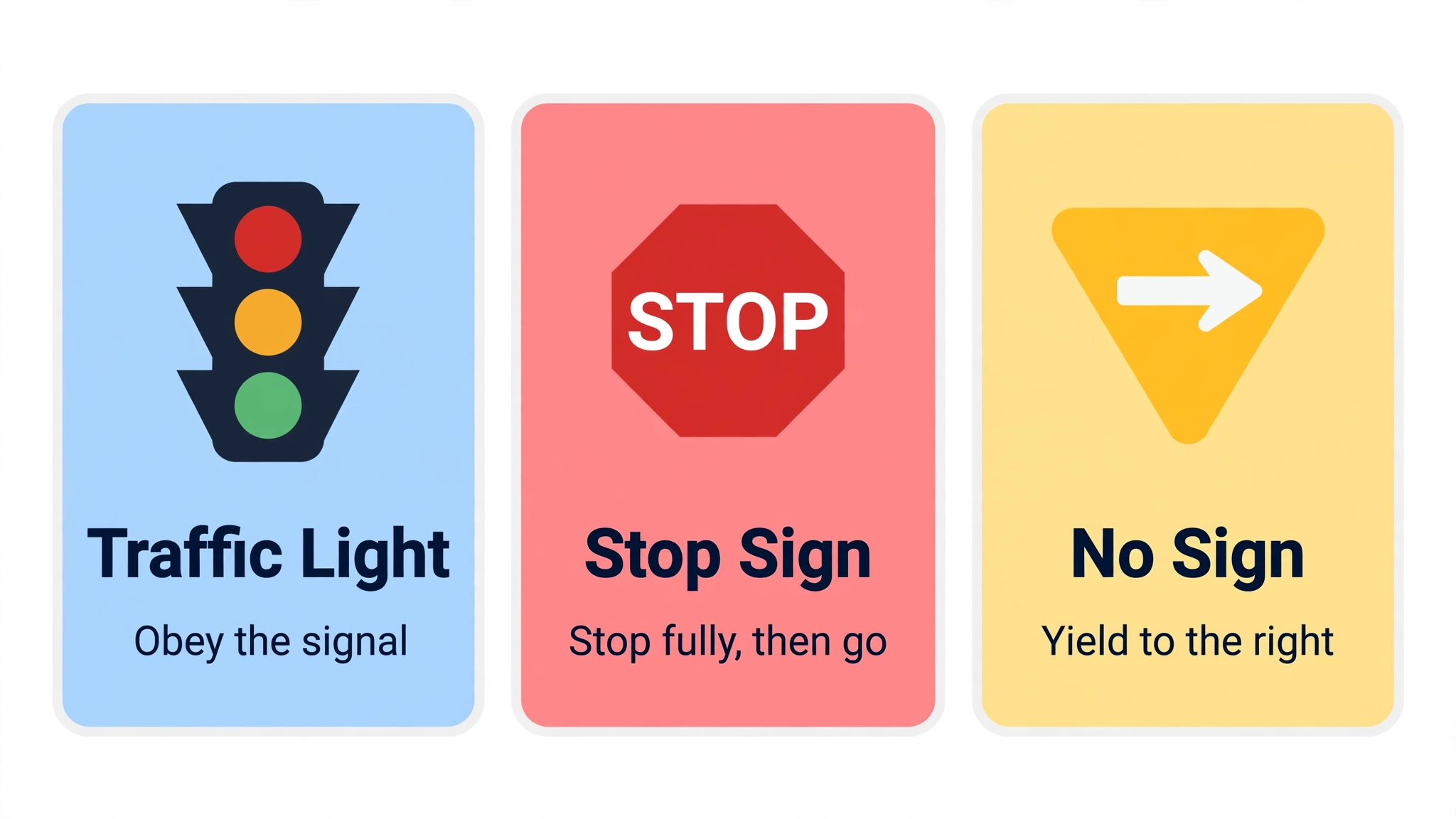
A controlled intersection has a device or person telling drivers what to do. That can be a traffic signal, a stop sign, a yield sign, or a police officer directing traffic.
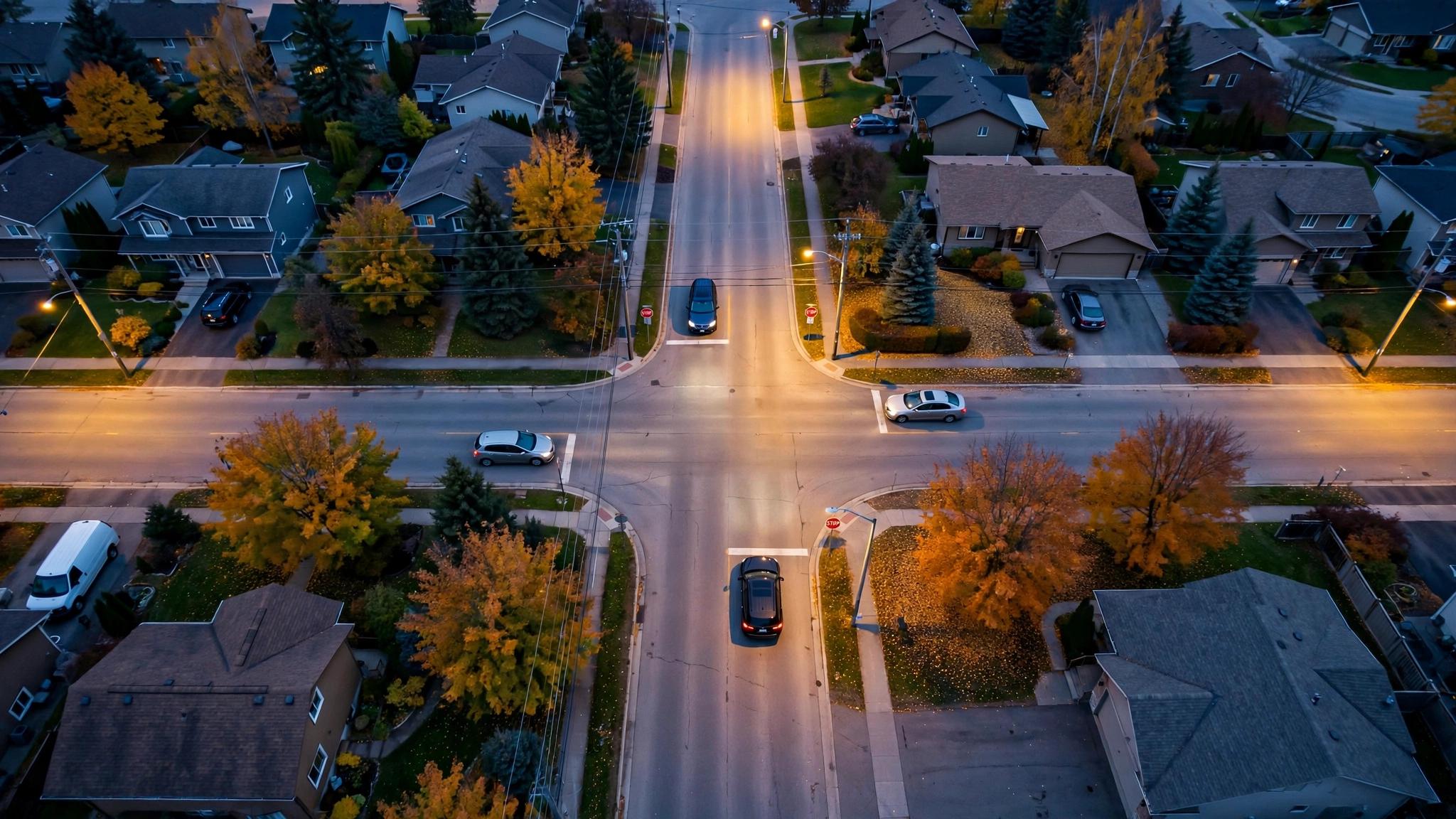
An uncontrolled intersection has none of these. No lights, no signs, no officer. These show up in quiet residential areas and rural roads, and the test loves them because so many drivers have never thought about the rules that apply.
The G1 test will often describe an intersection without naming its type. Your job is to spot the control from the description before you pick an answer.
Controlled Intersections With Traffic Signals
Traffic signals are the most tightly controlled intersections, and their rules are the most precise. Each light state has exactly one correct response.
A solid green means you may go, but only if the way is clear. You still yield to pedestrians in the crosswalk and to vehicles already in the intersection.
A solid amber (yellow) means stop, unless you are so close that stopping safely is not possible. It is not a signal to speed up.
A solid red means stop and wait. You may turn right on red after a complete stop, once you have yielded to traffic and pedestrians, unless a sign says otherwise.
A flashing red light works exactly like a stop sign: stop fully, yield, then go when it is safe. A flashing amber means proceed with caution, yielding to traffic already in the intersection.
An advanced green (a green arrow) lets you turn in the arrow’s direction while oncoming traffic still faces red. It feels safe, and it is, but you must still watch for pedestrians crossing on your green.
If the signals are dark because of a power failure, treat the intersection as an all-way stop. Every driver stops, and the first to arrive goes first.
Tip: On the test, “flashing red” and “stop sign” are interchangeable. If a question asks what to do at a flashing red light, the answer is always the full stop-sign procedure: stop, yield, then proceed.
Controlled Intersections With Stop Signs
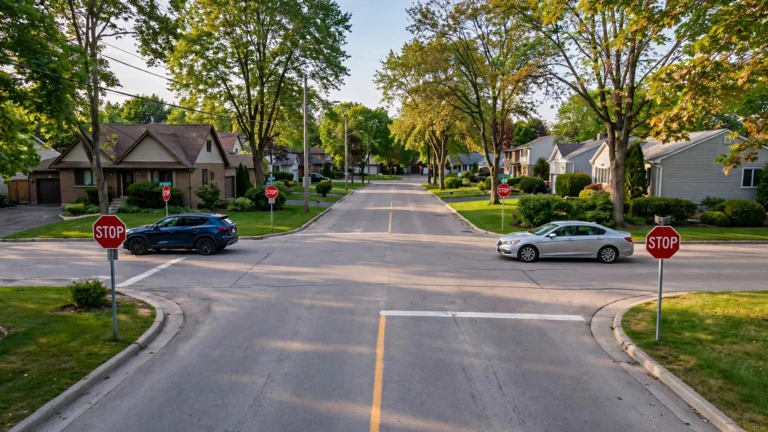
Stop signs come in three flavours, and the test checks whether you know the difference. A two-way stop controls only the side street. Traffic on the through road does not stop.
A three-way stop controls three approaches, usually at a T-intersection. A four-way (all-way) stop controls every approach, and every driver must stop.
At an all-way stop, the first vehicle to arrive and stop goes first. If two vehicles arrive at the same time, the one on the right goes first.
The stop must be complete. Rolling through a stop sign, even slowly, is the same as running it, both on the test and on the road.
After stopping, you yield to any traffic and pedestrians that arrived before you or are already in the intersection. Only then do you take your turn.
At a two-way stop, you also yield to all traffic on the through road, even traffic that is still some distance away. Through traffic has the absolute right-of-way.
Our guide to stop and yield signs walks through what each sign looks like and what the test expects you to do at each one.
Caution: The classic test trap is a two-way stop described as if it were an all-way stop. If the question says “stop signs face only your direction,” through traffic never stops, and you yield to everything before moving.
Where Exactly to Stop
Knowing you must stop is only half the answer. The test also asks where, and it accepts exactly one spot.
- Stop at the stop line if one is painted on the road. Your front bumper should not cross it.
- If there is no stop line, stop before the crosswalk. Never block the crosswalk, even partially.
- If there is neither, stop at the edge of the intersecting roadway, where you can see clearly in both directions.
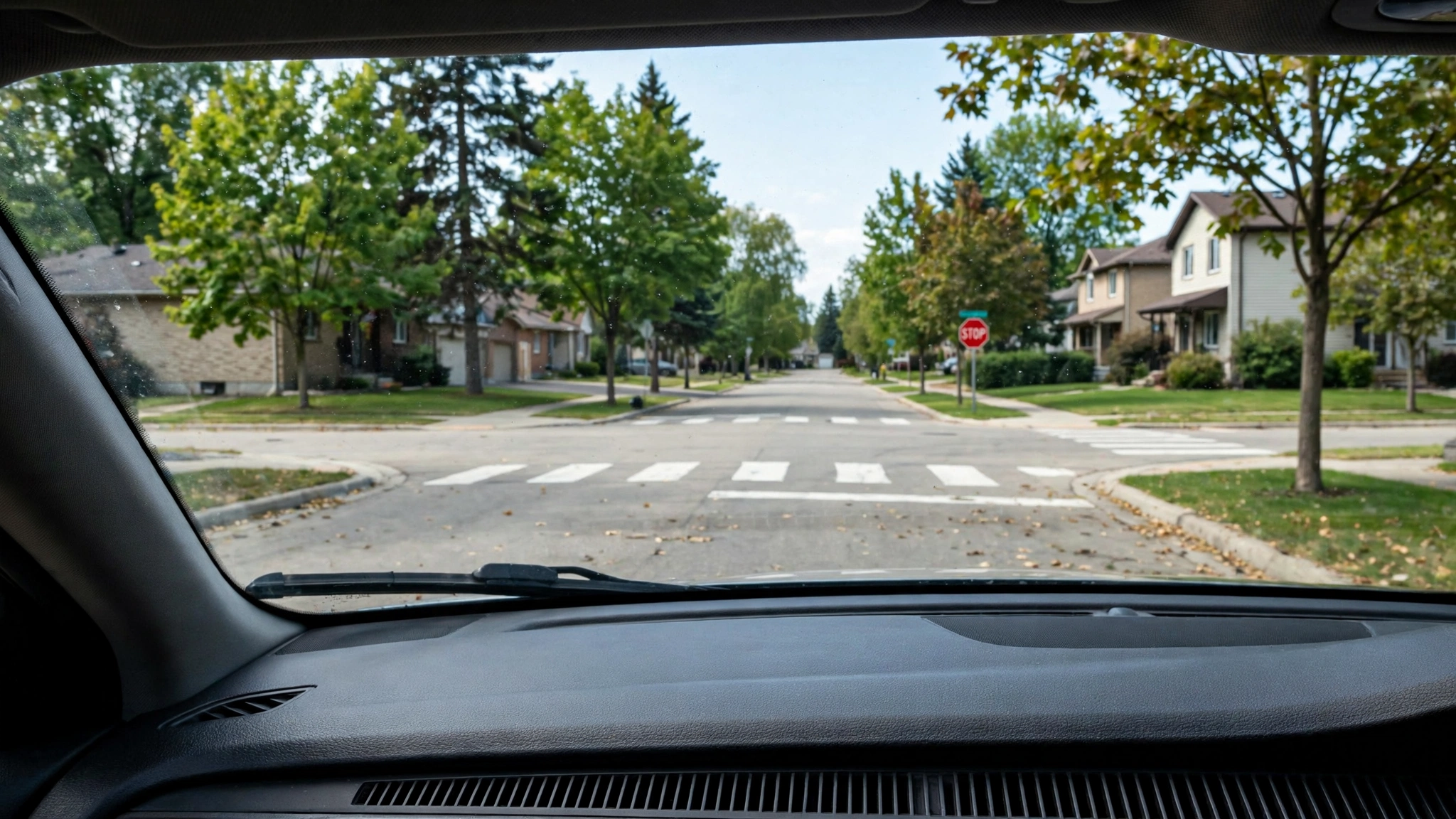
Parked cars, hedges, or buildings sometimes block your view after you stop in the legal spot. In that case, creep forward slowly until you can see, then stop again and check before proceeding.
This two-stage stop is completely legal and exactly what examiners want to see. Stopping once in the legal position and then edging forward for visibility shows you know both rules.
At traffic lights, the same positions apply: stop behind the stop line or crosswalk. On a red light, never pull past the line while waiting.
Uncontrolled Intersections: Yield to the Right
Uncontrolled intersections have no signs, no signals, and no officer. They are common in residential neighbourhoods and on rural roads, and they follow one clear rule.
Yield to any vehicle that arrives at the intersection before you. If you arrive at the same time as another vehicle, the vehicle on the right goes first.
Slow down as you approach so you can scan for traffic. You do not need to stop if the way is clearly empty, but you must be ready to.
Pedestrians crossing at an uncontrolled intersection still have the right-of-way. So do cyclists travelling straight through; treat them exactly like any other vehicle.
The test often pairs uncontrolled intersections with a second vehicle arriving from a specific direction. Work out who is on whose right before you answer.
Key fact: “Yield to the right” applies at both uncontrolled intersections and all-way stops when vehicles arrive simultaneously. One phrase, two situations, and the test uses both.
If you want more practice on who goes first in these situations, our who goes first at intersections guide walks through eight realistic scenarios step by step.
Turning at Intersections Without Getting It Wrong
Turns at intersections follow their own logic, and the test separates right turns from left turns for a reason.
For a right turn, signal well before the intersection, move into the right lane, and turn into the corresponding right lane of the new road. Keep the turn tight.
For a left turn, signal, move toward the centre of the road without crossing the centre line, and yield to oncoming traffic and pedestrians. Turn into the corresponding left lane of the new road.
The most tested left-turn rule is simple: oncoming traffic going straight has the right-of-way over you. Wait for a clear gap, or wait for the light to change if the intersection allows it.
Never swing wide on a turn. Wide turns push you into lanes where other drivers do not expect you, and the test treats lane discipline at turns as a core skill.
When turning, also watch for cyclists beside you. A cyclist going straight has the right-of-way over a vehicle turning across their path.
Large trucks need extra room to turn and may swing wide. Give them space and never try to squeeze between a turning truck and the curb.
The One Rule About Blocked Intersections
You have a green light. Traffic ahead is bumper to bumper. Do you enter the intersection? The answer is no.
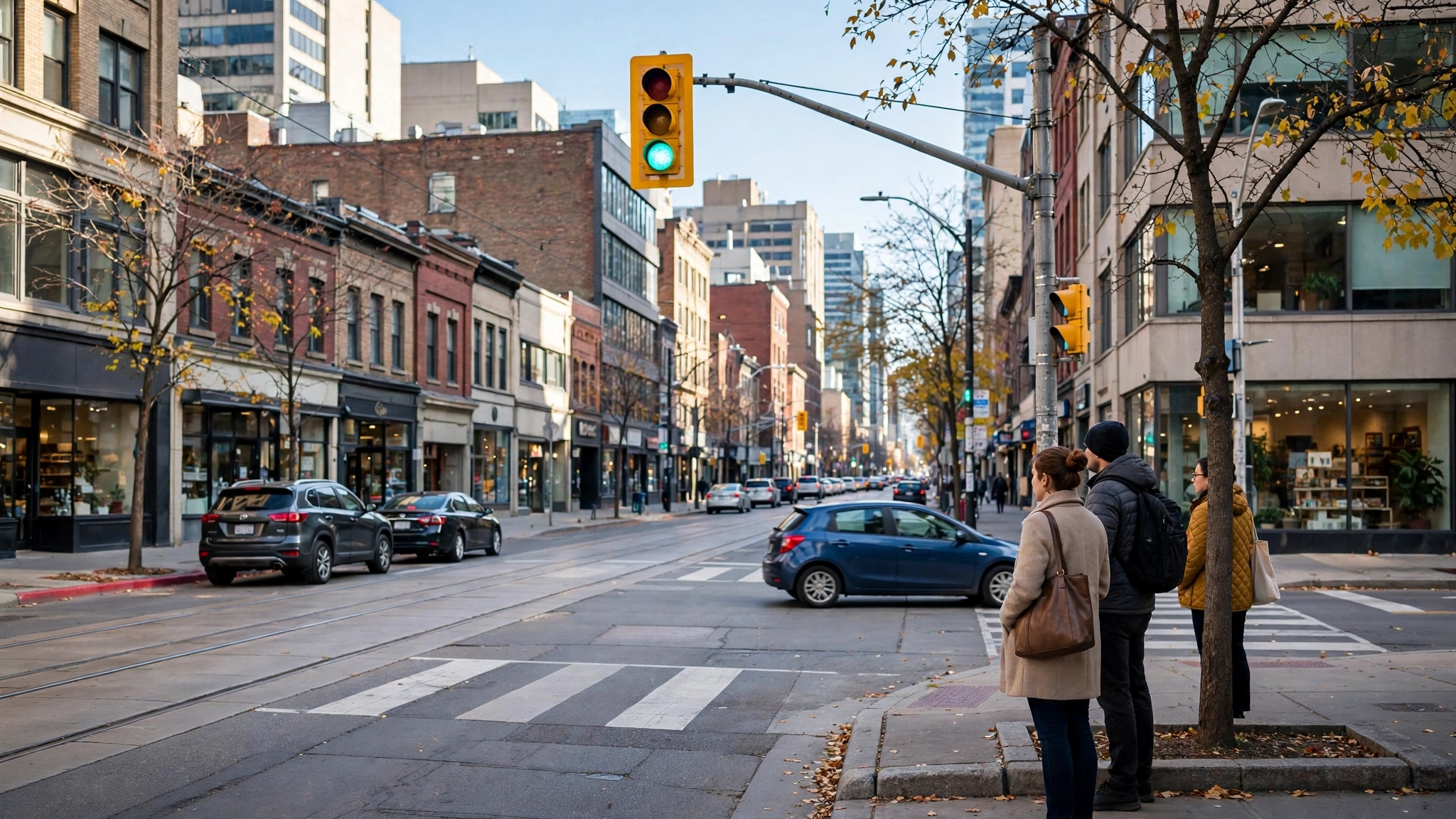
Never enter an intersection unless you can clear it completely. If traffic is backed up on the far side, wait behind the stop line until there is room.
Drivers who enter anyway end up stranded in the middle when the light changes, blocking cross traffic. The test treats this as a serious error, and so do the drivers stuck behind you.
This rule applies at every intersection, controlled or not. A green light gives you permission to go, not an obligation.
Caution: “The light is green, so I can go” is a trap answer. If the far side is blocked, the correct answer is always to wait, even on green.
Approach Speed: Slow Down Before the Intersection
Intersections demand lower speeds than open road. Cover the brake as you approach so you are ready for a light change, a pedestrian stepping out, or a driver doing something unexpected.
Your stopping distance at different speeds matters most right here. At higher speeds you need far more road to stop, which is why racing a yellow light so often ends badly.
On wet or icy roads, start slowing down even earlier. The intersection itself is often the slickest part of the road, since oil and polished pavement collect where cars stop and start.
How the G1 Test Questions You on Intersections
Intersection questions on the G1 test follow a few repeatable patterns. Walk through these three and you will recognise the shape of most of them.
Scenario 1: You arrive at a four-way stop at the same time as a car to your left. Who goes first? You do, because the other car is on your left and you are on its right. “Yield to the right” decides it.
Scenario 2: You are turning left at a green light with oncoming traffic approaching. When do you turn? After the oncoming traffic passes or stops, and after checking for pedestrians. Oncoming straight-through traffic always has priority over your left turn.
Scenario 3: You reach a stop sign where the cross street has no signs. A car is approaching on the cross street. What do you do? Stop fully, then yield to the cross-street traffic before proceeding. At a two-way stop, through traffic never yields to you.
Notice what all three have in common: the answer comes from identifying the intersection type first, then applying that type’s single rule.
Quick Answers to Common Intersection Questions
Do I have to stop at a yield sign? Not always. You must slow down, be ready to stop, and yield to traffic and pedestrians. Stop if the way is not clear.
Can I turn left on a red light? Only from a one-way street onto another one-way street, after a full stop and yielding, and only if no sign prohibits it. In every other case, wait for green.
What if another driver waves me through? A wave is not a rule. Go only when the actual right-of-way rules say it is your turn, and make sure the way is truly clear.
Do the same rules apply at night? Yes, and they matter more. Scan twice at night, since headlights and shadows make it harder to judge other vehicles’ speed and distance.
Disclaimer: This article is unofficial practice material for the Ontario G1 knowledge test. It is not affiliated with, endorsed by, or connected to DriveTest, the Ministry of Transportation of Ontario, or the Ontario government. Road rules can change, so always check the current Ontario Driver’s Handbook for the official wording.
Ready to see how these rules show up as real questions? Try our free Ontario G1 practice test and find out which intersection rules you have down cold and which ones need another look.
Want 300 More Practice Questions?
The Premium Question Bank gives you 6 full mock exams with a plain-language explanation for every answer. Instant PDF download, yours to keep.
Original handbook-mapped questions. Not real DriveTest questions. No pass promises – just serious practice.