How to Study G1 Rules of the Road
The G1 knowledge test has two halves, and most learners quietly let one of them drift. They drill road signs because signs are easy to picture, then walk into the test centre with only a vague sense of the rules half. That imbalance costs more marks than people expect.
Rules of the road are the “what should you do here?” questions — the twenty items that ask you to act like a driver, not name a symbol.
Studying them is a different skill from memorizing signs, and it rewards a different approach. This is your plan for that half of the test.
What the Rules Section Really Measures
The test has 40 questions split into two sections of 20: road signs and rules of the road. You need at least 16 correct in each section. A strong signs score cannot carry a weak rules score, so the rules half deserves its own study time.
If you have not read it yet, our breakdown of how the G1 passing rule works shows exactly why both sections matter equally on test day.
Rules questions are written as small driving stories. You get a situation — an intersection, a parked bus, a car merging ahead — and four things a driver could do. Only one matches the rule.
That means the test is really asking whether you can apply rules, not whether you can recite them.
This is the key shift. Reading a rule once and thinking “got it” feels like learning, but it only builds recognition. The test asks for application: which action, in which order, in this specific scene. Your studying should match that demand from day one.
Study Situations, Not Sentences
A rules question almost always starts with a scene. So build scenes while you study.
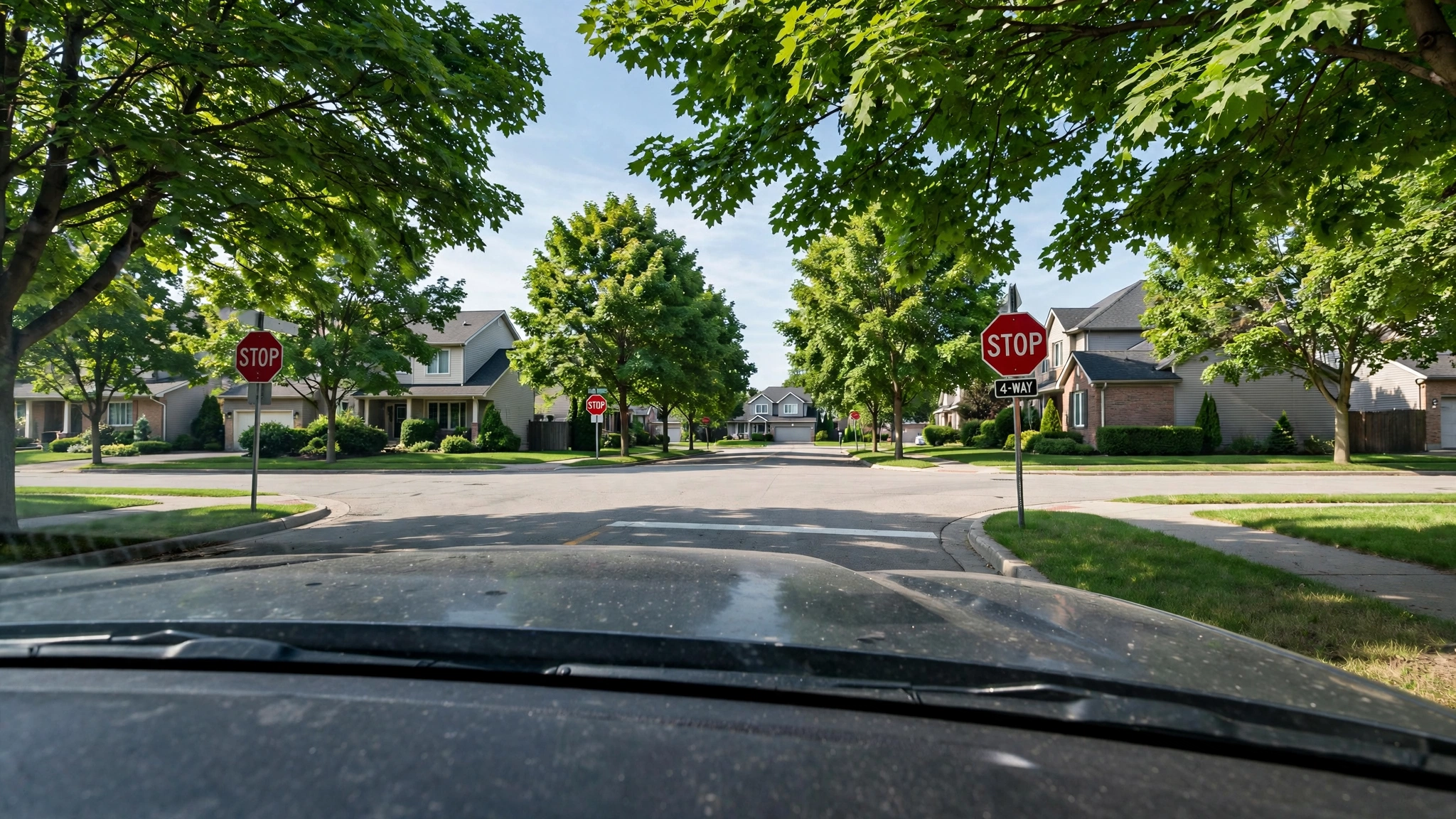
When you read a rule about right-of-way, picture the exact intersection: who arrived first, who is turning, who is going straight. Put yourself in the driver’s seat before you look at any answer.
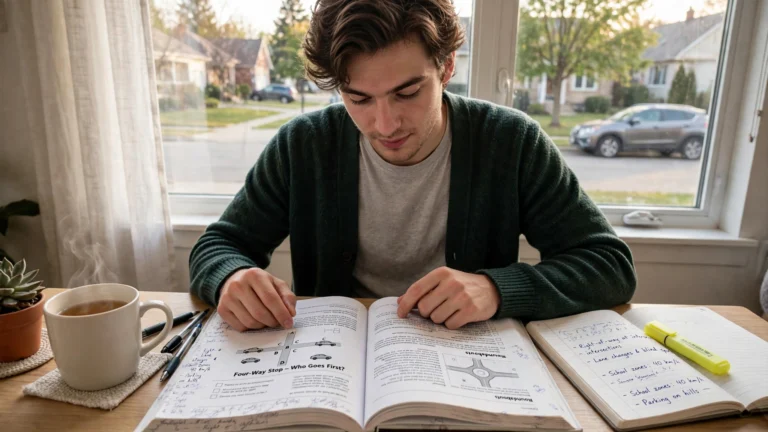
The teach-back trick works brilliantly here. After reading a rule, close the book and explain it out loud as if a friend asked you at a red light. If you stumble, you found the gap.
Learners who can explain a rule aloud answer it correctly far more often than learners who merely recognized the words.
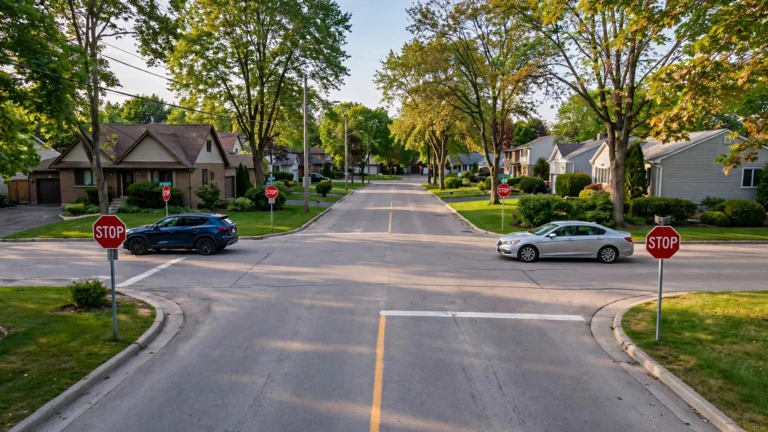
Draw the tricky ones. A four-way stop with three cars arriving at once is worth a thirty-second sketch in a notebook. Arrows, labels, and a one-line note of who goes first turn an abstract paragraph into something your memory can grab on test day.
Group your studying around situations, too. Instead of re-reading a handbook chapter front to back, set a timer for 20 minutes and only study “what happens at intersections.”
Short situation blocks beat long general reading because your brain files rules next to the scenes they belong to.

The Six Rule Families Worth Mastering
Most rules questions fall into six families. Learn each family as a package rather than memorizing rules one by one, and whole groups of questions start feeling familiar.
- Right-of-way. Who goes first at uncontrolled intersections, four-way stops, and when turning across traffic. This is the biggest family and the most tested.
- Passing and lane changes. When passing is allowed, where it is not, and the full signal-check-move sequence for changing lanes.
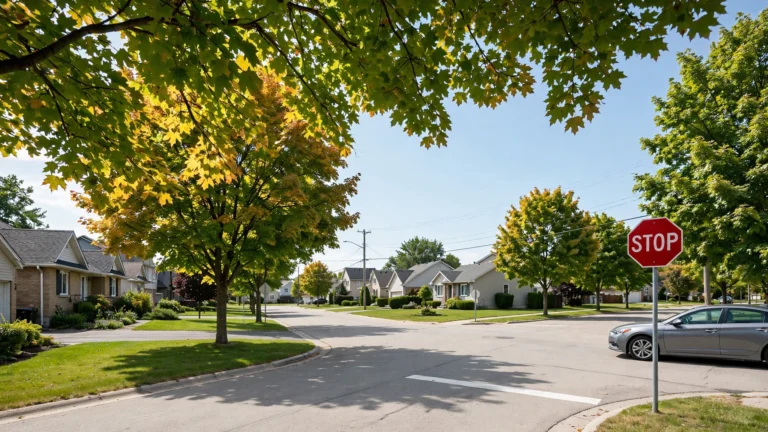
- Intersections. Stopping positions, turning paths, pedestrian priority, and what “yield” actually requires you to do.
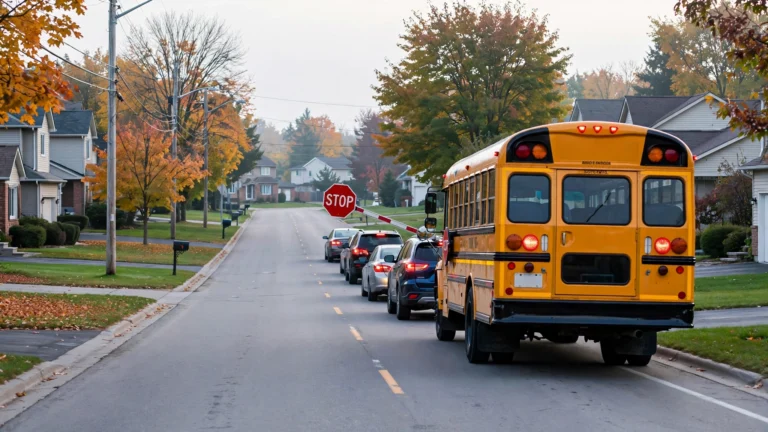
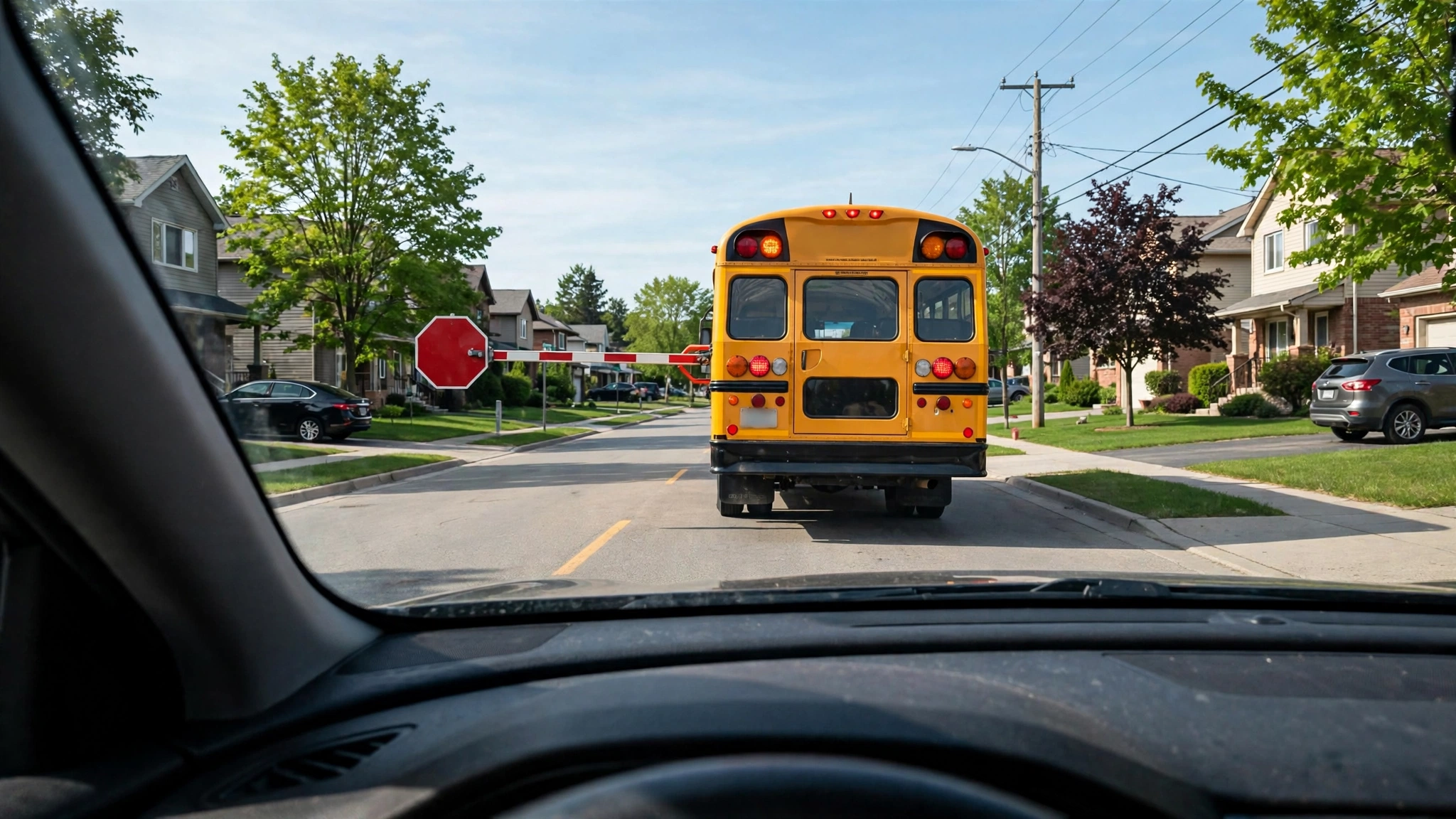
- School buses and emergency vehicles. When you must stop for a bus with flashing lights, and how to make room for emergency vehicles.
- Speed limits. How limits work in built-up areas versus elsewhere, and when reduced limits apply, like around schools and construction zones.
- Parking, stopping, and sharing the road. Where you may stop, how far to park from crossings and hydrants, and how to share lanes with cyclists and large vehicles.
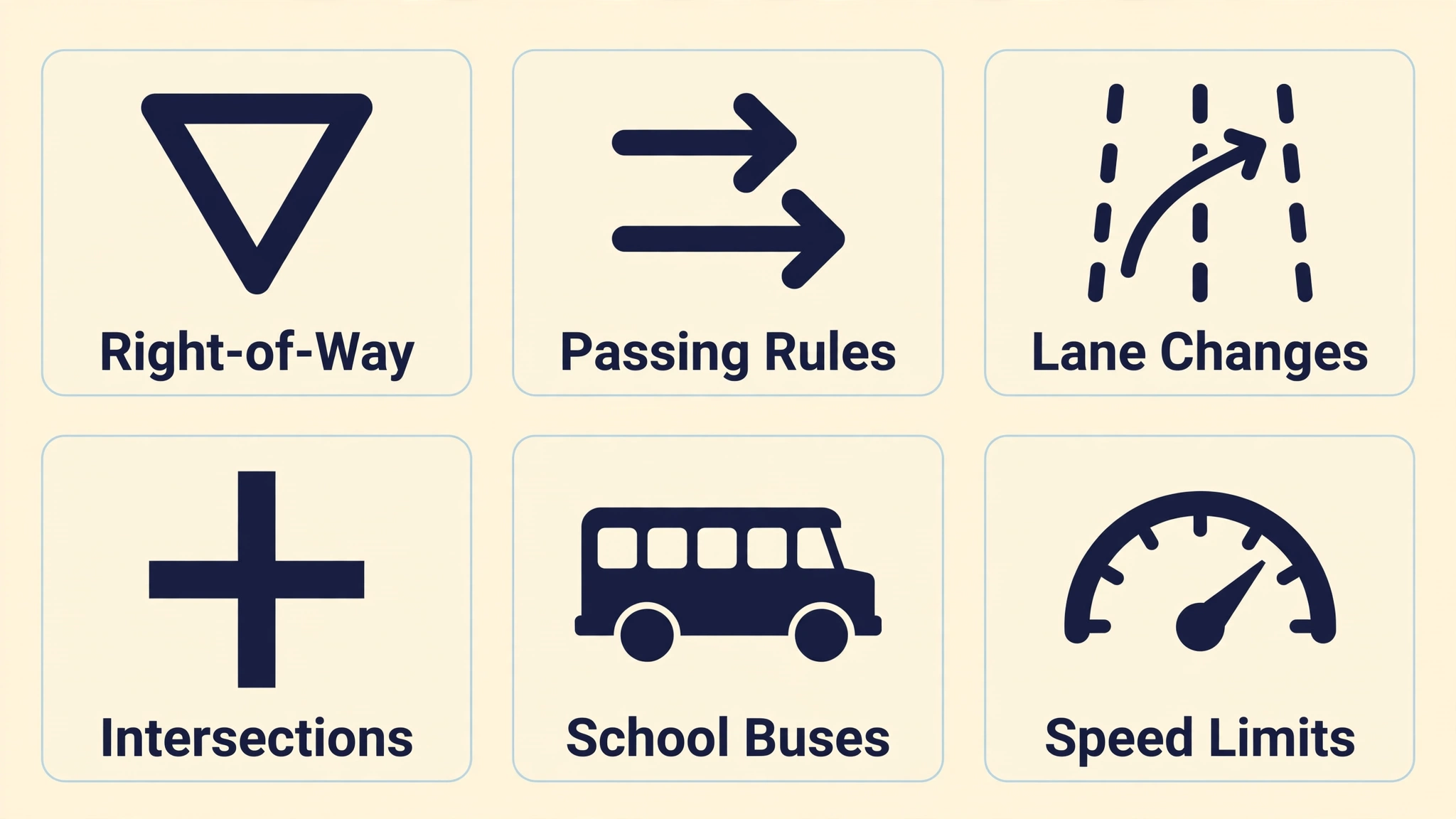
Notice how each family is a set of situations, not a list of sentences. If you can handle five typical right-of-way scenes, you can handle the questions — even worded ones you have never seen before.
Over the coming weeks we will publish a deep dive for each family in this rules cluster. For now, treat the list above as your map: it shows where every rules question you meet belongs.
Turn Reading Into Rehearsal
Reading is the start, not the study. After each rule family, close the material and rehearse.
The simplest rehearsal is self-quizzing: cover the answer, say what the driver should do, then check. It feels slower than re-reading, but the remembering is exactly what the test requires.
Our guide on how to get the most from the handbook pairs well with this section — use its chapter order to find the rules, then rehearse them the way this post describes.
Mix new and old every session. Start with five minutes reviewing yesterday’s rules, then move to today’s family.
That spacing is what moves rules from “I studied that” to “I just know it.” Cramming a family once and never returning to it is the main reason rules knowledge fades before test day.
Talk through the “why,” not just the “what.” Why does a driver turning left yield to oncoming traffic? Because crossing someone’s path creates the conflict. Rules with reasons stick; rules without reasons blur together.
Drill the Lookalikes Until They Split
Rules questions love pairs that sound almost the same. “Stop” versus “yield.” Passing on the left versus passing on the right. A flashing red light versus a steady red light. These lookalikes are responsible for a huge share of wrong answers.
The fix is side-by-side study. Take one lookalike pair and write both rules on the same page, with a one-sentence scene for each. Seeing the difference in one place is what finally splits them in memory — studying them on different days never does.
Make a “confusion list” and keep it short. Any rule you miss twice goes on the list. Review only that list on the last day before the test. By then it should be short, and fixing it is the highest-value hour of your whole preparation.
Watch for absolute words in answer choices. Options with “always” or “never” are often wrong, but not always — the trick is to check the rule, not the wording. Train yourself to test each choice against the situation in the question stem.
Practice the Way the Test Asks
Once a rule family feels solid, test yourself the way the test will ask: mixed questions, one at a time, no hints. Single-family drills build knowledge; mixed practice builds the quick sorting your brain does on test day.
Time yourself loosely. The real test has no strict time pressure, but practising at a steady pace stops the slow re-reading habit.
Read the situation once, decide, move on. If you are unsure, flag it mentally and review after the set — just like a real test-taker reviewing at the end.
Read every question stem twice before choosing. Many wrong answers come from missing one word: “left” instead of “right,” “approaching” instead of “following.” The extra three seconds of reading is the cheapest mark-protection you have.
Use the free G1 practice test on our homepage to run full 40-question sets once your rules studying is underway. Full sets teach you to switch between signs and rules thinking, which is its own skill.
A Two-Week Rules Study Plan
You do not need months. Two focused weeks are enough for the rules section if each session has a job. Here is a plan that fits around a normal schedule.
- Days 1–2: Right-of-way. The biggest family. Sketch four-way stops and uncontrolled intersections until who-goes-first feels obvious.
- Days 3–4: Intersections and turning. Stopping positions, turn paths, pedestrian rules. Pair with right-of-way for mixed drills.
- Days 5–6: Passing and lane changes. When each is allowed and the exact signalling sequence. Side-by-side the lookalikes.
- Day 7: First mixed review. Fifty questions across the three families you have covered. Build your confusion list.
- Days 8–9: School buses, emergency vehicles, speed limits. The stop-for-bus rule and reduced-limit situations deserve sketches too.
- Days 10–11: Parking, stopping, sharing the road. Distances and prohibitions — short sessions, since this family is mostly facts.
- Days 12–13: Full mixed sets. Two full runs. Review only your confusion list between them.
- Day 14: Light review. Confusion list only, then stop. Fresh beats frantic the night before a test.
Short on time? The one-week version keeps the same order and drops days 10–11 into days 8–9. Never skip the mixed-review days — they are where the learning actually consolidates.
If signs are also on your list, alternate the two: rules one day, signs the next. Our companion guide on memorizing road signs uses the same family-by-family logic for the signs half.
Mistakes That Cost Rules Marks
The same errors show up again and again. Knowing them in advance is worth real points.
- Studying only the night before. Rules need two or three spaced passes. One long session creates familiarity, not knowledge.
- Re-reading instead of self-testing. If your study session has no questions in it, it is review, not learning.
- Ignoring the “boring” families. Parking and speed-limit questions feel minor, so learners skip them — then lose easy marks.
- Memorizing wording, not meaning. The test rewords everything. If you only remember the handbook’s exact sentence, a reworded question can beat you.
- Skipping the handbook entirely. Practice questions teach patterns; the handbook teaches the actual rules. Use both.
The pattern is simple: passive study feels productive and scores poorly. Every session should end with you answering questions you have not seen before.
Rules Questions, Answered
Is the Rules Section Harder Than the Signs Section?
Most learners find it harder, yes — but only because they study it less. Signs can be memorized visually; rules need the situation practice this post describes. Give the rules half equal time and the difficulty gap mostly disappears.
How Many Rules Questions Can I Miss and Still Pass?
You can miss up to 4 of the 20 rules questions, since 16 correct passes the section. But remember the sections are scored separately: 20 out of 20 on signs will not save a 15 on rules.
Should I Study Rules Before Signs?
Either order works. What matters is not mixing them too early — finish one family at a time, then combine. Many learners alternate: rules on weekdays, signs on weekends, mixed sets in the final days.
Are the Practice Questions the Same as the Real Ones?
No. The real test questions are not published anywhere, and any site claiming to have the exact questions is misleading you. Good practice questions test the same rules in the same style, which is what actually prepares you.
How Do I Know I Am Ready for the Rules Half?
Take two full mixed practice sets on different days. If you score 16 or better on the rules questions both times and your confusion list is short, you are ready. Consistency across days beats one lucky score.
This article is unofficial study material for the Ontario G1 knowledge test and is not affiliated with DriveTest or the Government of Ontario.
Rules described here are study guidance only — always follow the current Ontario Driver’s Handbook and posted signage when driving.
Want 300 More Practice Questions?
The Premium Question Bank gives you 6 full mock exams with a plain-language explanation for every answer. Instant PDF download, yours to keep.
Get the Question Bank – $9.99Original handbook-mapped questions. Not real DriveTest questions. No pass promises – just serious practice.