

How Many Questions Are on the M1 Test in Ontario?
The Ontario M1 knowledge test has 64 multiple-choice questions. That single number answers the headline question — but the way those 64 questions are divided into sections is what actually decides whether you pass or walk away empty-handed.
This guide breaks down the widely reported format: how many questions sit in each part, what each part covers, and the per-section pass mark — so you can turn the test’s own structure into your study plan.
The Three Sections at a Glance
Every version of the M1 knowledge test that practice sources describe follows the same skeleton: three sections, 64 questions total, multiple choice with one correct answer each. The exact paper is set by the Ministry of Transportation, but this is the format every major practice source agrees on.
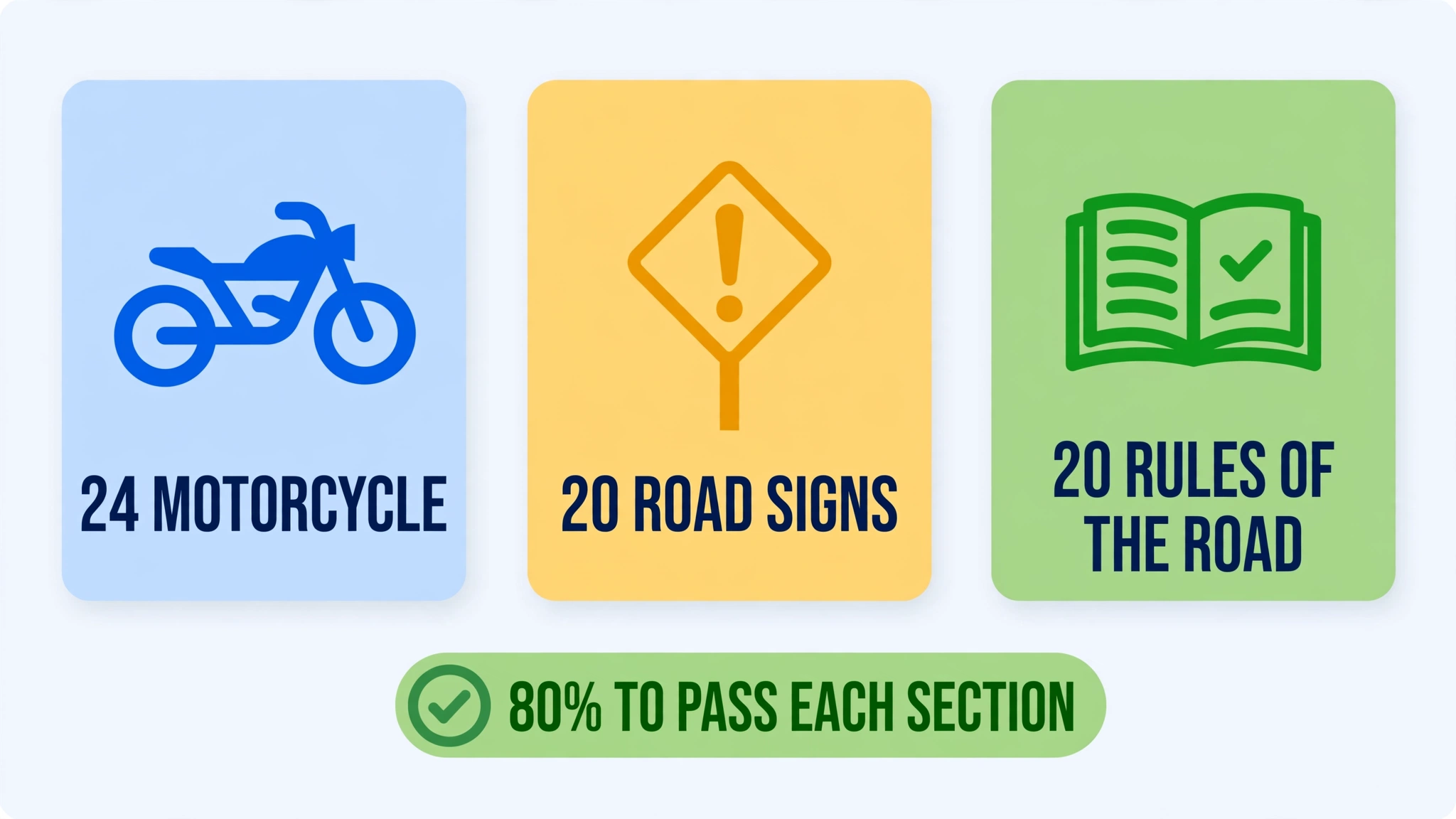
Key fact: 64 questions = 24 motorcycle-specific + 20 road signs + 20 rules of the road. The pass mark is 80% in each section, not 80% overall.
The order of the sections can vary on the day, and the questions are drawn at random, so no two test papers are identical. What stays constant is the structure — and that structure is your study map.
Section 1: The Motorcycle Questions (24 Questions)
This is the largest section, and it is what makes the M1 different from a car test. Twenty-four questions cover motorcycle-specific knowledge drawn from the Official MTO Motorcycle Handbook.
Expect questions on:
- Controls and handling — throttle, clutch, front and rear brakes, and how the bike responds to each input.
- Lane position — the dominant position in a lane and when to move within it.
- Braking and stopping — stopping distances, braking in curves, and what to do if a wheel locks.
- Steering at speed — how countersteering works and why it matters.
- Group riding — staggered formation and when to switch to single file.
- Surfaces and hazards — gravel, wet pavement, railway crossings, and road debris.
- Protective gear and equipment — helmets, eye protection, and keeping the bike roadworthy.
If you already drive a car, this section is the hard part. Signs and rules overlap with what you know — the motorcycle material is all new. Most riders who fail the M1 fail here, which is exactly why this section deserves the biggest share of your study time.

A smart way to attack this section is to take our free M1 motorcycle practice test and watch which topics you miss. Misses cluster fast — and those clusters tell you which handbook chapters to re-read.
Section 2: Road Signs (20 Questions)
Twenty questions test whether you can read the road. Regulatory signs, warning signs, temporary condition signs, and information and direction signs all appear here.
If you hold a G1 or G2 already, much of this is review. If the M1 is your first licence of any kind, treat this as a memorization project: learn the sign shapes and colours first, because shape alone answers a surprising number of questions before you even read the symbol.
Section 3: Rules of the Road (20 Questions)
The final twenty cover the traffic laws every road user follows: right-of-way, speed limits, following distance, alcohol and drug rules, sharing the road with other vehicles, and parking.
Motorcycle riders get special attention here too. Questions can ask how the general rules apply from a rider’s point of view — for example, where a motorcycle should position itself at an intersection, or how following distance changes when you are the smaller vehicle on the road.
The 80 Percent Rule Applies to Every Section
Here is the detail that trips people up: the pass mark is not 80 percent overall. It is 80 percent in each section, separately. You could answer nearly every sign and rules question correctly and still fail if the motorcycle section drops below the line.
Caution: failing one section fails the entire test. A perfect signs score cannot rescue a weak motorcycle section — balance your preparation across all three.
The pass marks that practice sources widely report are 16 out of 20 for road signs, 16 out of 20 for rules of the road, and 19 out of 24 for the motorcycle section. Those are the targets to drill toward on every practice run.
It also means your study time should follow the section sizes. Twenty-four of the 64 questions come from the motorcycle section — nearly two in every five marks — yet many riders spend most of their hours on sign questions they already know from driving a car.
How the M1 Compares to the G1
The G1 knowledge test — the car equivalent — has 40 questions in two sections: 20 road signs and 20 rules of the road, with 16 out of 20 needed in each. The M1 keeps both of those sections and adds the 24-question motorcycle section on top.
That comparison is useful for one reason: if you passed the G1, roughly two-thirds of the M1 (the signs and rules sections) should feel familiar. The remaining third is a subject you have never been tested on. Riders who treat the M1 as “just a G1 with bikes” are the ones the motorcycle section surprises.
A Study Plan Built on the Format
Knowing the structure lets you study like a strategist instead of reading the handbook cover to cover and hoping for the best.
- Diagnose first. Take a full-length practice test before you open the handbook. Your score by section shows exactly where marks are leaking.
- Attack the motorcycle section first. It is the biggest section and the least familiar material. Give it at least half of your study time.
- Drill signs in short bursts. Flashcard-style repetition beats long reading sessions for sign shapes and meanings.
- Read rules for understanding, not memory. Rules questions reward reasoning — if you understand why a rule exists, you can answer variations of it.
- Finish with full timed runs. Our 200-question M1 question bank is built for exactly this: long practice sessions that expose the topics you keep missing.
Tip: study your weakest section first, not your favourite one. An hour spent lifting a 12-out-of-24 motorcycle score to 19 is worth far more than polishing a 19-out-of-20 signs score to a perfect 20.
What Happens If You Fail a Section
Failing one section fails the whole test — but the attempt is not wasted. Practice sources report that if you retake the test within a year, you only need to re-sit the section or sections you failed. A retest fee applies, so confirm the current amount on the official DriveTest site before you book.
The practical lesson is simple: walk out of a failed attempt knowing exactly which section beat you, and spend your study time there before you go back.
The good news is that a failed section usually costs you days, not months. Practice sources report that you can book a retake as soon as another slot is available — often the next day — so the real price of failing is a few days of focused study on your weakest section.
Tip: many riders fail the M1 on the motorcycle section alone. If that is you, do not re-study everything — hammer the motorcycle handbook chapters and re-test with motorcycle-heavy practice sets until 19 out of 24 feels easy.
Test Day at a Glance
You write the M1 knowledge test in person at a DriveTest centre — it is not available online. Bring identification that proves your legal name, date of birth, and signature, and expect a vision test before you sit down at the computer.
You must be at least 16 years old to take it. Arrive rested, read every question twice, and trust the preparation your practice-test section scores already showed you.
Frequently Asked Questions
How many questions are on the Ontario M1 test?
Sixty-four multiple-choice questions, split into three sections: 24 motorcycle-specific questions, 20 road sign questions, and 20 rules-of-the-road questions.
How many questions do I need to get right to pass?
You need at least 80% in each section separately. The widely reported targets are 16 out of 20 for signs, 16 out of 20 for rules, and 19 out of 24 for the motorcycle section.
Is the motorcycle section really the hardest?
For car drivers, yes. The signs and rules sections overlap with G1 knowledge, but the motorcycle section covers entirely new material — controls, lane position, braking, group riding, and riding hazards.
What happens if I fail only one section?
You fail the whole test. Practice sources report that if you retake it within a year, you only need to re-sit the failed section or sections, with a retest fee.
Is the M1 test harder than the G1?
The two tests share the signs and rules sections. The M1 adds a third section of 24 motorcycle-specific questions, which is new material for most test takers — that is where the extra difficulty lives.
Study note: this site is an independent practice resource. Our questions are original study material written from the public handbooks — they are not official, real, or leaked test questions, and we are not affiliated with the Ontario Ministry of Transportation or DriveTest.
Practice scores show how ready you feel, not how the official test will grade you. Use them to find your weak sections, then verify the rules in the current handbooks before test day.
Riding for Your M1? Drill 200 More Questions.
The M1 Question Bank gives you 200 original questions across motorcycle operation, road signs, and traffic rules – every answer explained. Instant PDF download, yours to keep.
Get the M1 Question Bank – $9.99Original handbook-mapped questions. Not real DriveTest questions. No pass promises – just serious practice.


2 Comments