

How Many Questions Are on the G1 Test?
The Number That Matters Most
Forty. That is the number to hold in your head when you walk into a DriveTest centre: the Ontario G1 knowledge test is 40 multiple-choice questions, split into two sections of 20.
Half of the test is about road signs, and half is about the rules of the road. To pass, you need at least 16 correct answers in each section — not just 32 overall.
That last detail is where the simple question “how many questions are on the G1 test?” starts to matter in a practical way. The count is not just trivia; it shapes how the test is scored and how you should prepare.
Here is everything the number 40 implies, broken down piece by piece.
The Short Version
If you want the facts at a glance, here they are:
- Total questions: 40
- Sections: 2 — road signs and rules of the road
- Questions per section: 20 each
- Pass mark per section: 16 out of 20
- Minimum correct answers overall: 32, with at least 16 in each section
- Format: multiple choice
- Where: DriveTest centres across Ontario (the same format at every centre)
The rest of this guide explains what those numbers mean in practice, including the pass rule that surprises more test-takers than anything else on the sheet.
Why the Test Is Built as 20 + 20
Ontario could have written one long 40-question test with a single pass line. Instead, it divided the exam into two balanced halves, because driving demands two different kinds of knowledge.
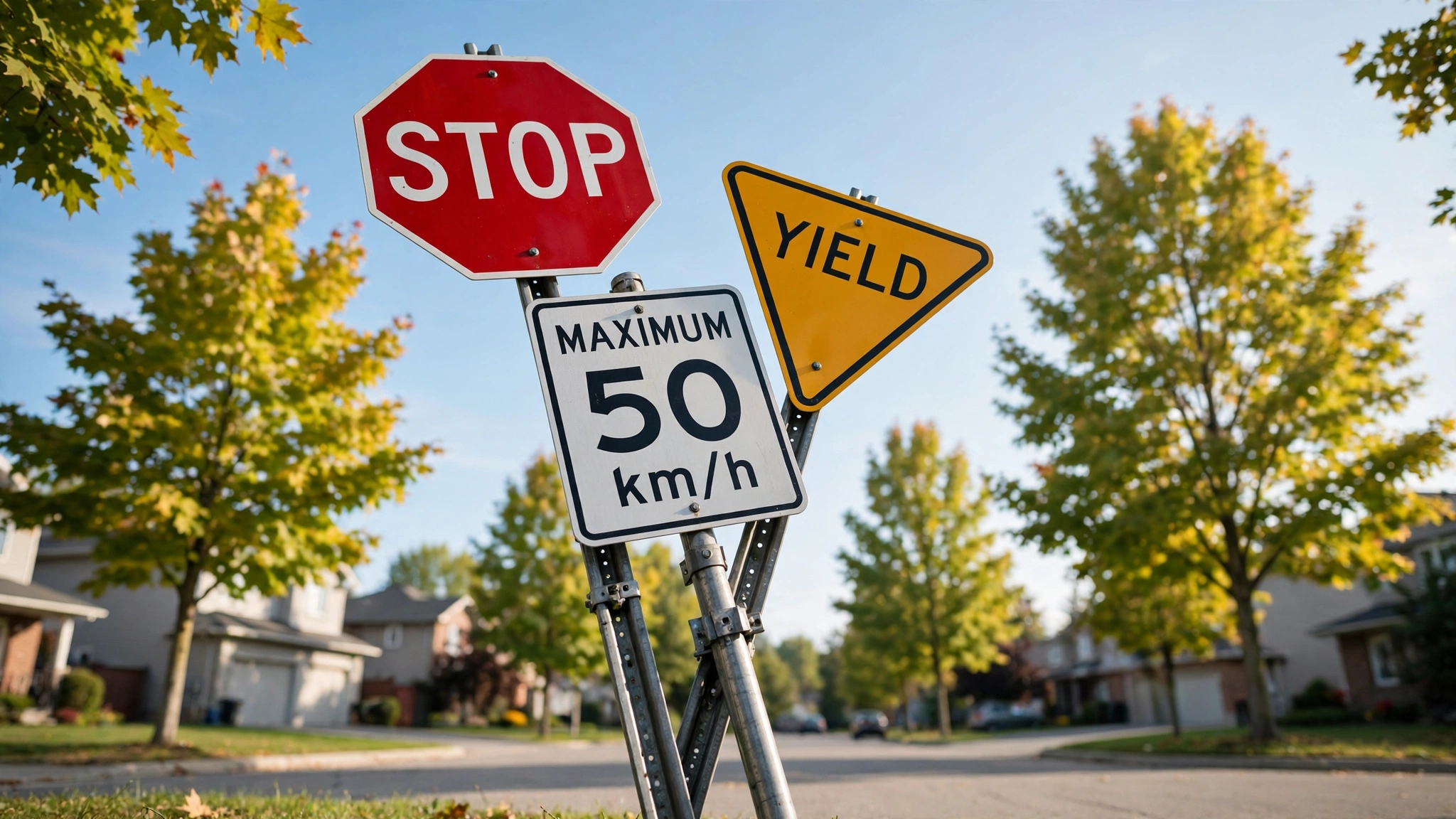
Recognizing a sign is a visual skill: you see a yellow diamond with a curve arrow, or a red circle with a slash, and you need to know instantly what it is telling you.
Knowing the rules of the road is a judgment skill: given a four-way stop, a school bus with flashing lights, or a tailgating situation, you need to know what you should do.
A new driver can be excellent at one and shaky at the other. Someone might identify every sign perfectly yet have no idea who goes first when two cars arrive at an uncontrolled intersection at the same time.
The two-section design exists so that both skills get tested properly — which is exactly why the pass rule treats each section on its own terms.
The Two Pass Lines, Explained with Examples
Here is the rule that catches people off guard: each section of the test is passed or failed independently. There is no averaging, and a strong performance in one section cannot rescue a weak one in the other.
Walk through a few score combinations and the rule becomes obvious:
- 18 on signs, 14 on rules — fail. The rules section is below 16, even though the total (32) would have been enough under a simple percentage rule.
- 16 on signs, 16 on rules — pass. Both sections clear the line. This is the lowest passing score: 32 correct answers, distributed correctly.
- 20 on signs, 16 on rules — pass. A perfect signs score plus the minimum rules score still clears both lines.
- 15 on signs, 20 on rules — fail. A perfect rules score does not compensate for a signs score of 15.
The practical takeaway: the magic number is 16, and it applies twice. Thirty-two correct answers spread the wrong way (say, 19 and 13) is still a fail.
When you take practice tests online, watch your per-section scores, not just your total — the section that is below 16 is the one that will fail you on test day.
What “Multiple Choice” Looks Like on the Day
Every one of the 40 questions is multiple choice: one question, a small set of answer options, and you pick the answer you think is right.
At most DriveTest centres you will answer on a computer touchscreen, with the two sections presented one after the other. A small number of centres still use paper booklets, but the format of the questions is the same either way.
The test is offered in more than 20 languages at most centres (English and French paper versions everywhere else), so if a language other than English is more comfortable for you, ask what is available at your centre.
Our own French G1 practice test exists for exactly that reason: many Ontario drivers study and practice in French before test day.
There is no penalty for a wrong answer — a question you get wrong simply does not count toward your total. If you are unsure, narrowing the options and choosing the best fit is always better than leaving anything blank.
You generally get to review your answers before submitting, so if you finish early, use the extra minutes to re-read the questions you hesitated on rather than rushing out.
Where the Wrong Answers Usually Land
The two sections of 20 are equal in weight, but they are not equal in difficulty for most people. The road signs section is largely recognition: if you have spent time learning what the signs mean, the questions feel direct.
The rules-of-the-road section is where the questions ask you to apply knowledge — following distances, who yields to whom, what to do when an emergency vehicle approaches from behind, how to handle a school bus with its red lights flashing.
That is why study guides consistently advise against a lopsided strategy. Memorizing signs for a week and skimming the rules the night before is the classic way to score 19 and 13 — one point above one pass line and three below the other.
The numbers reward balance: a modest, steady effort on both sections beats a deep dive into just one.
Using the Numbers to Plan Your Study
Once you know the test is 20 plus 20, you can structure your preparation around that shape instead of studying blindly.
Split your study time in half. Roughly fifty percent on signs, fifty percent on rules.
If the Ontario Driver’s Handbook is your main study source, alternate chapters from each area rather than reading the sign chapters front to back and then discovering the rules chapters late.
Practice in sets of 20. Full practice tests mirror the real exam — for example, you can sit a full walkthrough of the test format on this site before test day — but between full runs, shorter 20-question drills on a single section are useful.
Score each drill out of 20, the same way the test does, and treat 16 as your floor.
Build a buffer above the pass line. Passing needs 16 per section; aim to be answering 18 or more correctly per section in practice before you book your centre visit.
That buffer absorbs test-day nerves, which have a way of costing people the question or two they could not afford to lose.
Chase your weaker section, not your stronger one. If your practice results show 19 on signs and 14 on rules, the signs section does not need more of your time. Every extra hour goes to rules until both sections are comfortably above 16.

Quick Answers to Common Question-Count Questions
Is It 40 Questions at Every DriveTest Centre?
Yes. The test format is the same province-wide: 40 multiple-choice questions, 20 on road signs and 20 on rules of the road, with the 16-per-section pass rule.
The questions themselves vary from one test sitting to the next, but the structure does not change.
What Happens If I Score 15 in One Section?
You do not pass, even if the other section is perfect. You can write the test again — a small retake fee applies each time you sit it.
Because the two pass lines are independent, most people who retake do better the second time simply by focusing their study on the section that fell short.
Do the 40 Questions Include the Vision Test?
No. The vision test is a separate step you complete at the centre alongside the knowledge test; it is not one of the 40 questions.
Think of the knowledge test and the vision test as two distinct requirements that happen to be handled in the same visit.
Is There a Time Limit?
You will not be watching the clock. Most test-takers finish comfortably within 20 to 30 minutes, and centres give you enough time to read each question carefully.
If anything, rushing is the bigger risk — a careful re-read of the trickier questions is a better use of your minutes than an early exit.
Does Everyone Get the Same 40 Questions?
No. The questions are drawn from the topics in the Ontario Driver’s Handbook, and different test-takers see different combinations.
That is why memorizing a fixed set of practice questions is a weak strategy; understanding the handbook material behind them is what carries over from one sitting to the next.

The Bottom Line
The G1 knowledge test is 40 questions, two sections of 20, and two independent pass lines at 16 each. Remember those three numbers — 40, 20, 16 — and the shape of the test stops being a mystery.
Study both sections equally, practice in the same 20-question chunks the test uses, and walk in with both pass lines comfortably cleared in your practice runs. The numbers are on your side as long as you respect what each one is asking of you.
Disclaimer: this article is unofficial study material for informational purposes only. This site is not affiliated with, endorsed by, or connected to DriveTest, the Ministry of Transportation of Ontario, or the Government of Ontario.
Practice questions on this site are sample questions written for study purposes — they are not the questions you will see on test day, and nothing here can guarantee a pass.
Want 300 More Practice Questions?
The Premium Question Bank gives you 6 full mock exams with a plain-language explanation for every answer. Instant PDF download, yours to keep.
Get the Question Bank – $9.99Original handbook-mapped questions. Not real DriveTest questions. No pass promises – just serious practice.




14 Comments