What Questions Are on the Ontario M1 Motorcycle Licence Test?
The Ontario M1 knowledge test does not ask random trivia. Every question comes from a published map — the MTO Motorcycle Handbook itself lists the topics the test may draw on.
If you know that map, you know exactly where to focus your study time.
This guide walks through that topic list one area at a time and shows what each one looks like as a test question, so you can study like an M1 rider, not a general driver.
How the M1 Test Divides Its Questions
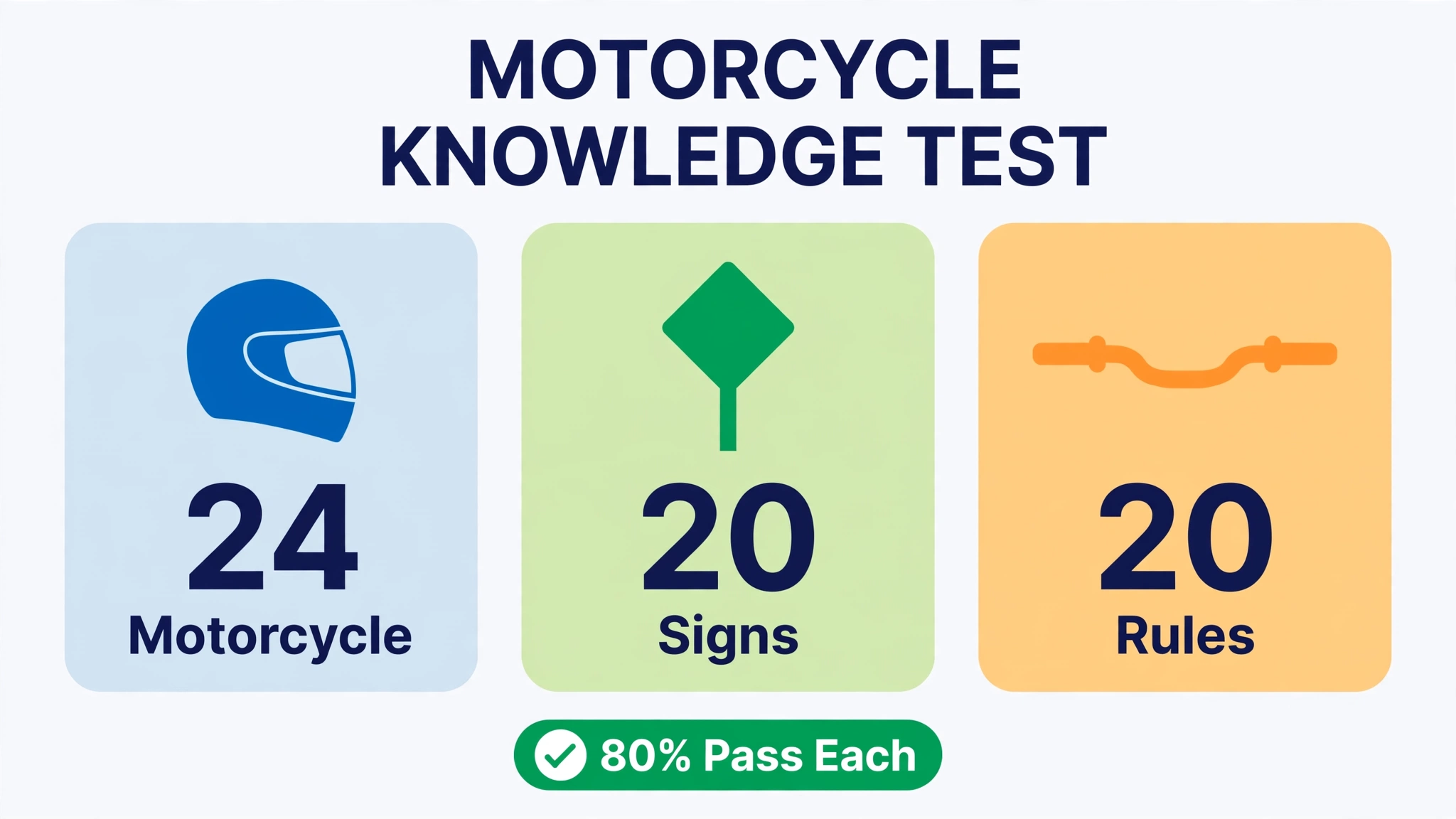
The M1 knowledge test is widely reported to contain 64 multiple-choice questions split into three sections: 24 motorcycle-specific questions, 20 road sign questions, and 20 road rule questions.
You need at least 80 percent in each section to pass — a strong signs score cannot rescue a weak motorcycle section.
We mapped this structure in full in our breakdown of how the M1 test’s question count works, so this guide focuses on something different: the actual subject matter inside the motorcycle section, topic by topic.
Motorcycle Controls: The Questions Everyone Should Expect
Controls are the single most-tested motorcycle topic. The handbook names six primary controls you must know cold: handlebars, throttle, front brake lever, rear brake lever, clutch lever, and shift lever.
The Six Primary Controls
A classic question format asks which item is not a primary control. The trap answer is usually the speedometer — it is a secondary control (an instrument), not one of the six. Memorize the list as three hand controls plus three more.
- Throttle: the right handgrip — twist toward you to speed up, away from you to slow down. It should spring fully back to idle when you let go.
- Front brake lever: right handlebar, in front of the throttle. Squeeze it toward the grip.
- Clutch lever: left handlebar — squeeze to disengage before every gear change.
- Rear brake: a foot lever near the right footrest, pressed with your foot.
- Shift lever: near the left footrest — lift or press with your foot, only while the clutch is disengaged.
Because control positions can differ between bikes, the handbook stresses familiarizing yourself with every control before riding an unfamiliar motorcycle — and test questions love that exact scenario.
Braking and Mirror Questions
Braking questions show up in nearly every practice set. The handbook teaches that the front brake provides about three-quarters of your stopping power, yet you must use both brakes together to stop effectively.
Grabbing the brakes too hard can lock the tires and cause a skid.
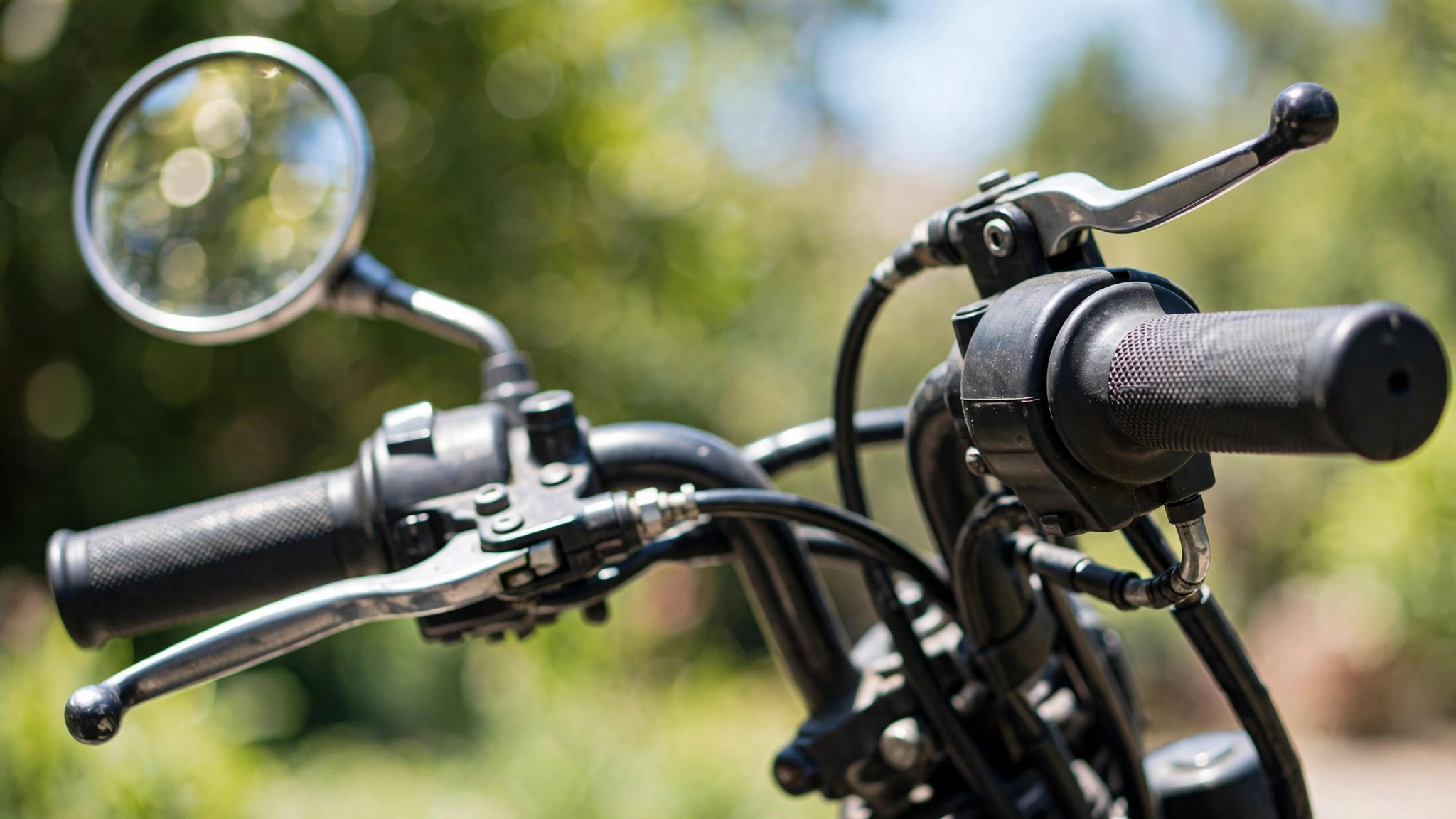
Mirror questions are another favourite. The handbook warns that convex mirrors make other vehicles look farther away than they really are — and reminds you that a mirror check is never a substitute for looking over your shoulder.
Lane Position and Steering Questions
Proper lane position is one of the handbook’s named test topics, and the handbook even gives you a free sample question: when motorcyclists ride together, the safest formation is the staggered formation.
That single question tells you exactly how this topic is tested.
In a staggered formation, the leader rides on the left side of the lane while the second rider stays about a one-second distance behind on the right side.
The pattern continues — left, right, left — with two-second gaps to the rider two spots ahead.
On curves, in turns, or when entering and leaving a freeway, the group switches to single file.
Steering questions focus on how a motorcycle turns and how you hold your position. Keep in mind the two-second rule, which the handbook presents as the minimum following distance for riders.
Equipment and Helmet Questions
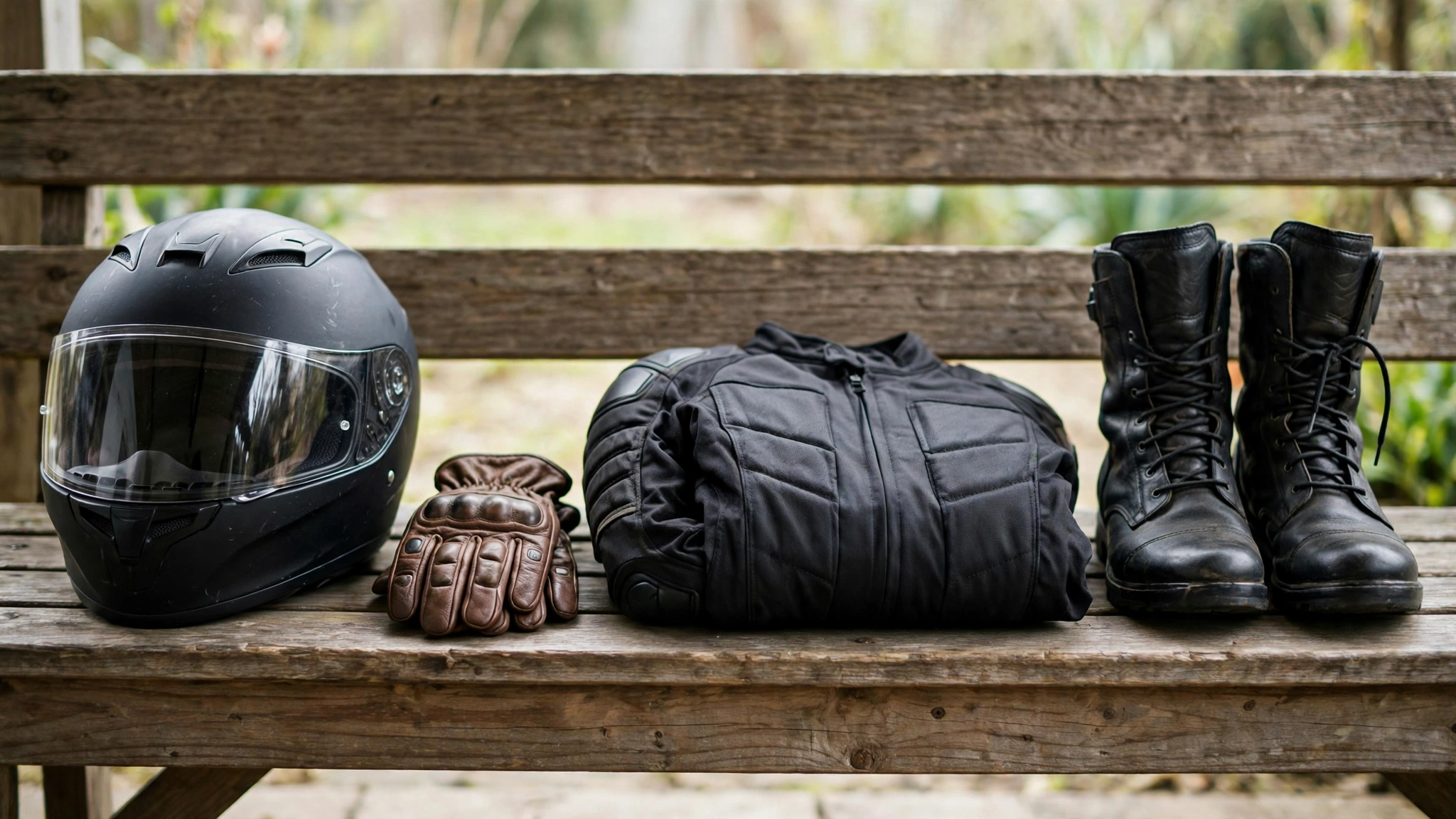
Motorcycle equipment requirements and safety helmets are two separate entries on the handbook’s test-topic list, which means they are tested as distinct subjects.
For the road test checklist, the handbook specifies an approved motorcycle helmet that complies with Regulation 610 — a detail that frequently migrates into knowledge-test questions.
Lighting and visibility questions belong here too. Motorcycles must show a white headlight at the front and a red light at the rear at all times of day and night.
Study the handbook’s equipment chapter for the full list of required equipment.
Passengers, Cargo, and Load Questions
Carrying passengers or cargo is its own handbook test topic, and the questions probe how extra weight changes the bike. The core idea: a loaded motorcycle responds more slowly, needs more room to stop, and handles differently in turns.
Load placement matters too. The handbook directs riders to place loads over or in front of the rear axle — anything mounted behind the rear wheel can upset turning and braking, and can even cause a wobble.
Tie every load down securely, and distribute heavy items as evenly as possible.
Dangerous Surfaces and Weather Questions
Handling dangerous surfaces is a dedicated test topic because a hazard that is a minor bump in a car can be a crash on a bike. Questions typically describe a surface or weather condition and ask for the correct response.
- Wet roads: shift gears, accelerate, turn, and brake as smoothly as possible — abrupt inputs cause skids.
- Gravel, sand, and debris: questions ask where loose material collects in a lane and how to cross it safely.
- Cold weather: the handbook states plainly that cold weather lowers tire pressure, so check it regularly — a favourite true-or-false style question.
- Poor visibility: rain, fog, and spray demand extra following distance and smooth control inputs.
Downshifting and Gear Questions
Downshifting of gears gets its own line in the handbook’s test-topic list, which surprises many car drivers.
The questions test whether you understand the sequence: squeeze the clutch, shift down, ease the clutch back out — and downshift before you stop, not after.
One subtle question pattern involves engine braking. When you slow down by gearing down or rolling off the throttle, the engine acts as a brake — but your brake light does not come on.
The handbook instructs you to apply the brakes as a signal to others whenever you are slowing down.
Maintenance and Pre-Ride Check Questions
Proper maintenance of the motorcycle is the final topic on the handbook’s list, and the pre-ride check is its most question-rich section.
The handbook wants you to check tires, controls, brakes, chassis, cables, lights, fuel and oil, and stands before every ride.
Expect questions like these:
- What should you check on your tires? Pressure (checked cold with a gauge), tread wear, and damage such as cuts, nails, or bulges.
- How do you test the brakes? Try the front and rear brakes one at a time — each must hold the motorcycle when fully applied. This check is especially important on a bike you have never ridden.
- What happens if the drive chain breaks? You instantly lose power to the rear wheel while the engine speeds up — a symptom the handbook describes precisely.
- Why does the engine fail to start? A common culprit the handbook flags: the engine kill switch was left in the “off” position.
Road Signs and Road Rules: The Overlap With the G1
Two of the test’s three sections — road signs and rules of the road — come straight from the same driver’s handbook that car learners study for the G1.
If you already hold a G licence or have studied for the G1, roughly two-thirds of the test format will feel familiar.
Do not skip this review, though. Sign recognition questions use the same image-based format as the G1, and rule questions cover right-of-way, speed limits, and safe following.
Our free G1 practice test is a solid warm-up for these two sections before you focus on the motorcycle-specific material.
Turning This Map Into a Study Plan
- Read the two handbooks. The MTO Motorcycle Handbook plus the “Safe and responsible driving” and “Traffic signs and lights” chapters of the Driver’s Handbook cover everything the test may ask.
- Learn the six primary controls by name and location. This is the highest-yield single page of the handbook.
- Drill the motorcycle section first. Run our M1 motorcycle practice test and note which handbook topics you miss — controls, lane position, or maintenance.
- Expand with the full bank. Work through the 200-question M1 question bank to meet every topic in question form, with explanations for each answer.
- Revisit the misses. Any topic you got wrong goes back to the handbook chapter before test day.
This site is an independent practice resource and is not affiliated with the Ontario Ministry of Transportation or DriveTest.
Our questions are original study material mapped to the public handbooks — they are not official, real, or leaked exam questions, and no practice resource can guarantee a pass.
Frequently Asked Questions About M1 Test Questions
Are the Motorcycle Questions Harder Than the Signs and Rules Questions?
Most riders say yes. Signs and rules overlap with the G1 material many learners already know, while the motorcycle section covers controls, handling, and maintenance that are new to car drivers.
Riders who want the full difficulty picture can read how hard riders find the M1 test for a section-by-section difficulty breakdown.
Does the M1 Test Ask About Specific Motorcycle Parts?
Yes. The handbook’s test-topic list includes knowledge of motorcycle controls, steering control, and proper maintenance.
That means questions name parts like the throttle, clutch lever, shift lever, brake levers, mirrors, tires, and the drive chain directly.
Do I Need to Memorize the Staggered Formation?
You should understand it, because the handbook’s own sample knowledge-test question asks about it: the safest way for a group of motorcyclists to ride together is in a staggered formation.
Switch to single file on curves, in turns, and at freeway entries and exits.
Are There Questions About Riding in the Rain or Cold?
Yes — handling dangerous surfaces is a named test topic. Expect questions on smooth control inputs on wet roads, where debris collects, and facts like cold weather lowering tire pressure.
How Many Questions Must I Get Right in the Motorcycle Section?
The format is widely reported as 24 motorcycle-specific questions with an 80 percent pass mark per section — which works out to at least 19 correct in that section, alongside 16 of 20 in each of the signs and rules sections.