How Hard Is the M1 Test in Ontario?
So, how hard is the M1 test in Ontario? The honest answer: it depends on what you bring into the test room.
For an experienced car driver, two of the three sections feel like review — and the third feels like a subject you have never studied.
This guide gives you a straight difficulty breakdown by section, shows who finds the test easiest and who finds it hardest, and lays out a section-by-section study plan — so you walk in knowing exactly where your effort belongs.
The Short Answer: It Depends on What You Already Know
The M1 is not uniformly hard.
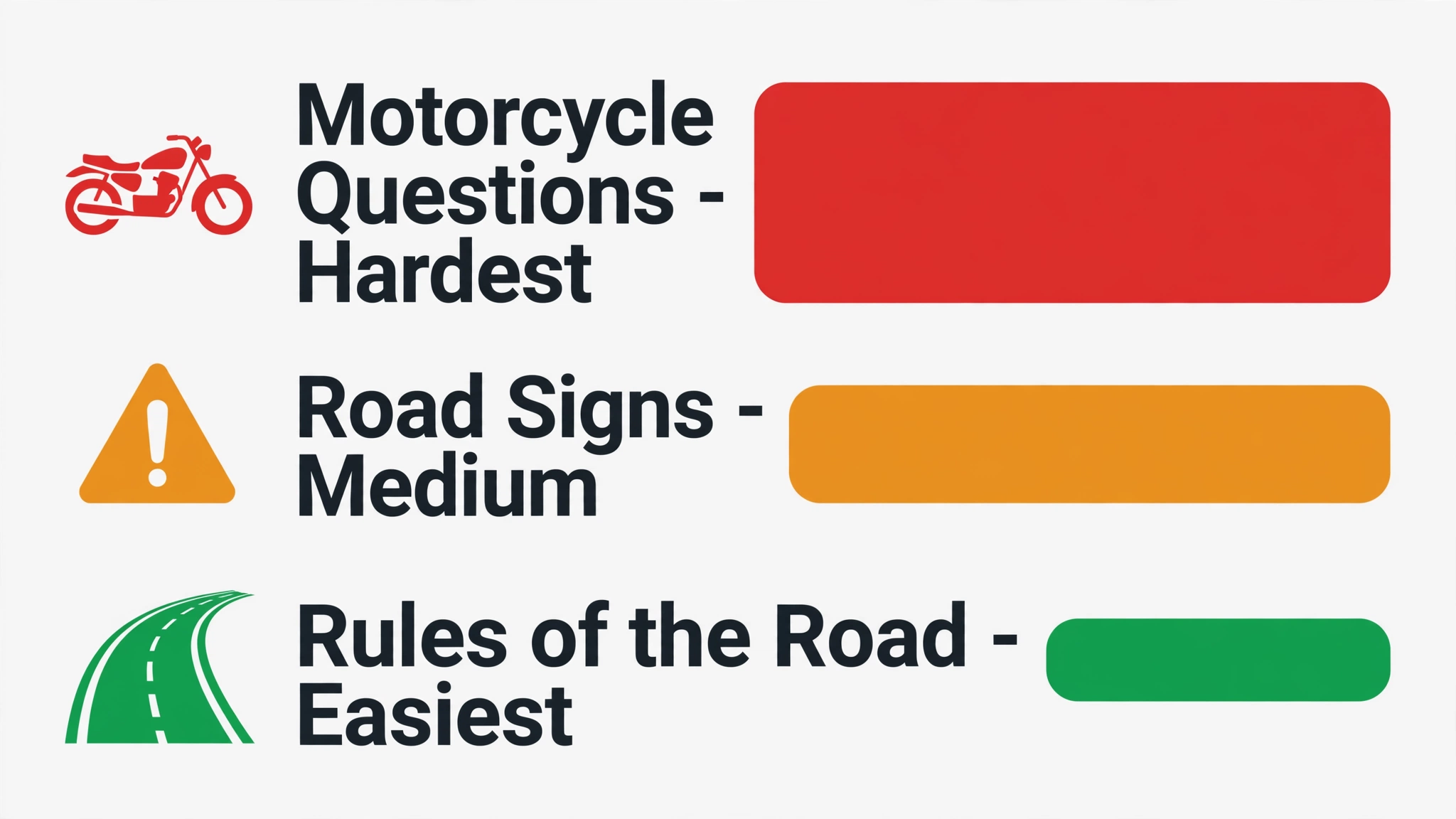
The format that practice sources widely report is 64 multiple-choice questions in three sections — 24 motorcycle-specific, 20 road signs, 20 rules of the road — with 80 percent required in each section separately, not just overall.
That split is the whole difficulty story. The motorcycle section is the one that surprises people.
The other two sections overlap heavily with what licensed car drivers already know, which is why most M1 candidates find them manageable with light review.
Key fact: the 80 percent rule applies to each section separately. One weak section fails the entire test, so “difficulty” really means “which section could pull you under the line.”
If you want the numbers behind the format in detail, our guide to how many questions are on the M1 test breaks down the sections, the per-section pass marks, and how the format differs from the G1.
Why the Motorcycle Section Is the Hard Part
Twenty-four questions cover material most test takers have never been examined on: controls, lane position, braking, steering at speed, group riding, riding surfaces, and protective equipment.
The topics come from the Official MTO Motorcycle Handbook, and for car drivers, nearly all of it is new vocabulary.
What makes it genuinely hard is not the question style — it is the same multiple choice as the rest of the test. It is the unfamiliarity.
You cannot reason your way to an answer about countersteering or staggered formation from car-driving instincts, because cars do not do either.
The sub-topics that trip people up most tend to be:
- Controls and handling — what each control does and how the bike responds: throttle, clutch, front and rear brakes.
- Lane position — the dominant position in a lane, when to shift within it, and why a rider’s lane is not a car’s lane.
- Steering at speed — how countersteering works and why it matters for turns.
- Group riding — staggered formation, when to switch to single file, and the handbook’s sample questions on it.
- Surfaces and hazards — gravel, wet pavement, railway crossings, oil patches, and how each one changes what you do.
- Braking — stopping distances, braking in curves, and what to do if a wheel locks.
- Equipment and gear — helmet and eye-protection rules, and keeping the motorcycle roadworthy.
Some questions ask for handbook facts you simply have to know.
Others are reasoning questions — “what would you do in this situation” — where the right answer only becomes obvious once you think like a rider instead of a driver.
This is also the biggest section: 24 of the 64 questions, with a widely reported pass mark of 19 out of 24. It deserves the biggest share of your study time by a wide margin.
The Signs Section: Medium Difficulty, Pure Memorization
Twenty questions test whether you can read the road: regulatory signs, warning signs, temporary condition signs, and information and direction signs. For anyone holding a G1, G2, or G licence, much of this is review from the car test.
If the M1 is your very first licence of any kind, this section is a memorization project rather than a hard one.
Signs reward short, repeated study bursts far more than long reading sessions — and learning shapes and colours first answers a surprising number of questions before you even read the symbol.

Tip: learn sign shapes and colours before individual signs. An octagon is always a stop, a triangle usually warns — shape alone answers a large share of sign questions.
The signs section trips up first-time licence holders more than experienced drivers, but even then it is rarely the section that fails people.
It is the section most candidates can lift to a comfortable score with a week of flashcard-style drilling.
The Rules Section: Usually the Easiest
Twenty questions on the traffic laws every road user follows: right-of-way, speed limits, following distance, alcohol and drug rules, parking, and sharing the road. If you already drive, you have been applying most of these rules for years.
The questions reward understanding over memorization. If you know why a rule exists — why following distance grows in bad weather, why intersections get the right-of-way rules they do — you can answer variations you have never seen before.
Motorcycle riders do get special attention here.
Some questions ask how the general rules apply from a rider’s point of view: where a motorcycle should position itself at an intersection, or how being the smaller vehicle on the road changes your following distance and visibility thinking.
Who Finds the M1 Easy — and Who Does Not
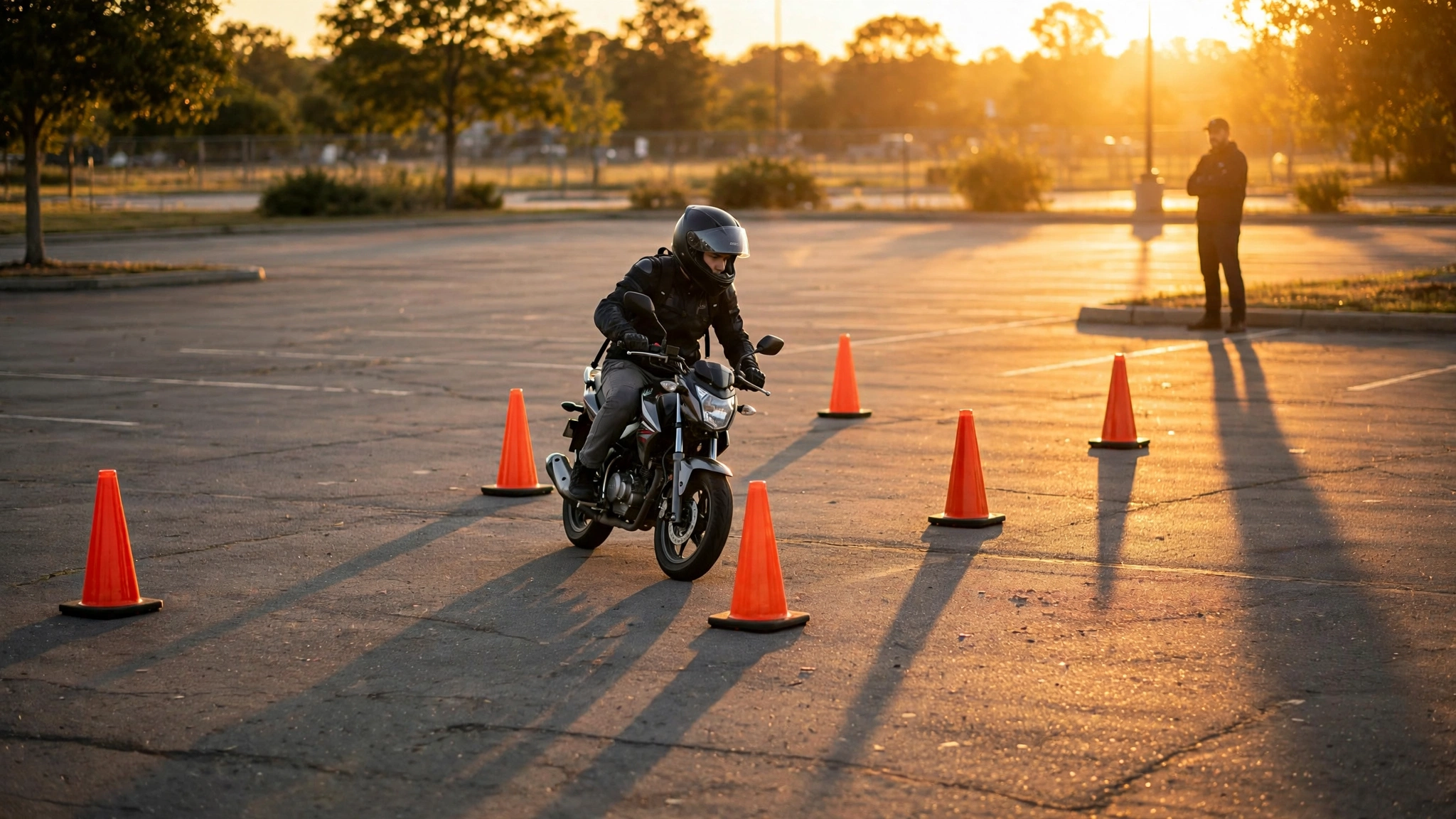
Your starting point decides your difficulty more than the test itself does. Here is how it breaks down for the three most common candidates:
- Experienced car drivers. The easiest path: roughly two-thirds of the test is material you have already passed a test on. Your battle is the 24 motorcycle questions — study those chapters and drill that section.
- First-time licence holders. The steepest climb, because all three sections are new. But the test is not trick-based — it is a fair multiple-choice exam over published handbook material. It takes more study hours, not more talent.
- Rusty or returning riders. You may know the motorcycle material from years of riding, but signs and rules fade with time. A quick refresh of the signs section usually closes the gap.
Notice what is missing from that list: nobody’s path requires anything exotic.
Every question on the test comes from material you can study — the Official MTO Motorcycle Handbook and the standard driver’s handbook — so difficulty is a function of preparation, not aptitude.
The Real Reason People Fail: One Weak Section
Here is the mechanism behind most failures: failing one section fails the whole test, even if the other two were strong. And the section that pulls people under is almost always the motorcycle one.
Think about the arithmetic. The signs and rules sections each need 16 out of 20 — forgiving targets for anyone who has driven.
The motorcycle section needs 19 out of 24 on material that is new to most candidates. That is where the margin disappears.
Caution: a perfect signs score cannot rescue a weak motorcycle section.
If you are scoring 19 out of 20 on signs and 14 out of 24 on the motorcycle questions, the test is telling you exactly where your next ten study hours go.
The fix is mechanical, not mysterious. Take a full-length M1 motorcycle practice test, look at your score by section, and study the section that is below the line — not the ones that are already comfortable.
A Section-by-Section Study Plan
Difficulty is not evenly distributed, so your study time should not be either. Work the plan in this order:
- Diagnose first. Take a full practice test before you open a handbook. Your score by section shows exactly where marks are leaking — and the motorcycle section is the usual suspect.
- Give the motorcycle section half your time. It is the largest section, the least familiar material, and the hardest pass mark to reach. Read the motorcycle handbook chapters until the vocabulary feels ordinary.
- Drill signs in short bursts. Ten minutes of sign review three times a day beats a two-hour cram session. Shapes and colours first, individual signs second.
- Study rules for understanding. Do not memorize rules as sentences — understand the reasoning behind them. Rules questions reward logic, so one understood principle answers many question variations.
- Finish with full timed runs. Our 200-question M1 question bank is built for exactly this: long practice sessions that surface the topics you keep missing.
- Re-check the weak section last. The night before the test, do one final section-by-section check. Your weakest section gets the last hour of review, not your strongest.
Tip: study your weakest section first in every session, not your favourite. An hour lifting a 14-out-of-24 motorcycle score toward 19 is worth far more than polishing a 19-out-of-20 signs score to a perfect 20.
Test-Day Nerves Are Not the Same as Difficulty
Part of what people call “hard” is just the test environment. You write the M1 knowledge test in person at a DriveTest centre — it is not available online.
Bring identification proving your legal name, date of birth, and signature, and expect a vision test before you sit at the computer. You must be at least 16 years old.
The test itself is straightforward multiple choice with one correct answer per question. Practice sources do not report trick wording or trap answers — the challenge is knowing the material, not decoding the questions.
Read every question twice, eliminate the answers you know are wrong, and trust the section scores your practice runs already showed you. If your practice section scores are consistently above the pass marks, the difficulty question is already answered.
Frequently Asked Questions
Is the M1 Test Harder Than the G1 Test?
They share the signs and rules sections, so for car drivers those parts feel the same.
The M1 adds a third section of 24 motorcycle-specific questions on entirely new material — that extra section is where all of the added difficulty lives.
What Is the Hardest Part of the M1 Test?
The 24-question motorcycle section. It covers controls, lane position, braking, steering, group riding, surfaces, and equipment — topics most candidates have never been tested on, with a widely reported pass mark of 19 out of 24.
Can You Fail the M1 If You Only Fail One Section?
Yes. The 80 percent pass mark applies to each section separately, so failing one section fails the entire test. Practice sources report that a retake within a year only requires re-sitting the failed section or sections, with a retest fee.
How Should I Study for the Motorcycle Section?
Read the Official MTO Motorcycle Handbook chapters on controls, lane position, braking, steering, group riding, and surfaces.
Then drill the material with a M1 motorcycle practice test until your section score is consistently above 19 out of 24. Give this section at least half of your total study time.
Is 80 Percent the Pass Mark for the Whole Test or Each Section?
Each section separately. The widely reported targets are 16 out of 20 for road signs, 16 out of 20 for rules of the road, and 19 out of 24 for the motorcycle section.
A strong overall score with one section under its mark is still a fail.
Study note: this site is an independent practice resource. Our questions are original study material written from the public handbooks.
They are not official, real, or leaked test questions, and we are not affiliated with the Ontario Ministry of Transportation or DriveTest.
Practice scores show how ready you feel, not how the official test will grade you. Use them to find your weak sections, then verify the rules in the current handbooks before test day.
Riding for Your M1? Drill 200 More Questions.
The M1 Question Bank gives you 200 original questions across motorcycle operation, road signs, and traffic rules – every answer explained. Instant PDF download, yours to keep.
Get the M1 Question Bank – $9.99Original handbook-mapped questions. Not real DriveTest questions. No pass promises – just serious practice.