M1 vs M2 vs M: Ontario Motorcycle Licence Levels Explained
Ontario does not hand you a full motorcycle licence in a single step. It builds riders in three stages — M1, M2, and M — each with its own tests, its own rules, and its own timeline.
Mixing up the three is the most common planning mistake new riders make. This guide lays out what each level allows, how you move between the levels, and how long the whole ladder really takes — so you can plan your riding season instead of guessing.
The Three Levels at a Glance
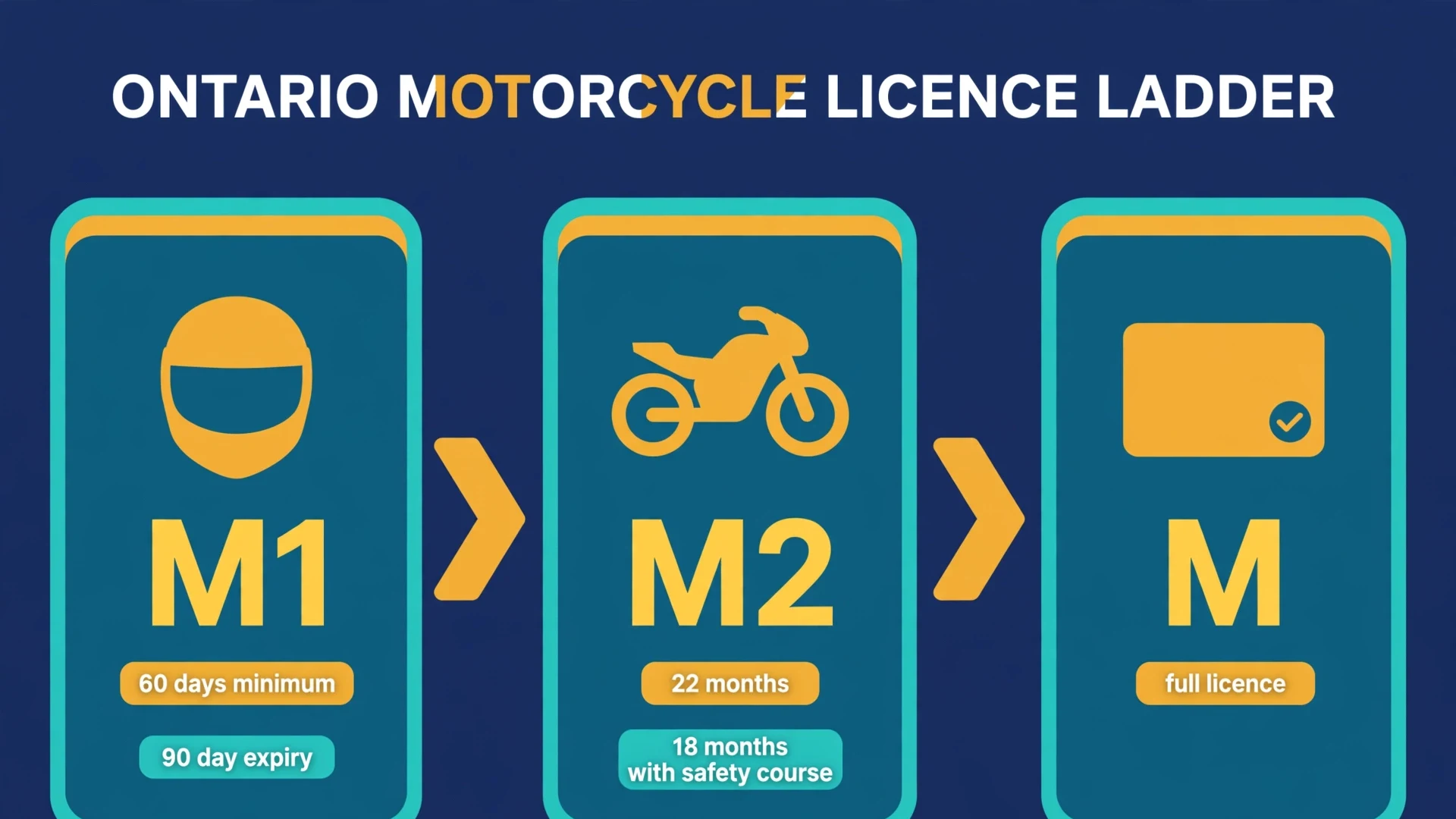
Think of M1, M2, and M as learner, intermediate, and full. Every new rider enters at M1, and two road tests — one after each of the first two levels — are the gates between stages.
The system is built on one idea: skills first, freedom later. Level One keeps new riders in low-risk situations while they learn the machine. Level Two adds real riding experience over many months. The full M arrives only after a final road test proves the rider is ready.
- M1 — Level One, the learner stage. Earned with a vision test and written knowledge tests. Lasts a minimum of 60 days and expires after 90. Riding comes with four strict conditions.
- M2 — Level Two, the intermediate stage. Earned by passing the Level One road test. Lasts a minimum of 22 months, or 18 with a ministry-approved safety course. Most restrictions lift; zero alcohol and helmet rules stay.
- M — the full motorcycle licence. Earned by passing the Level Two road test. No novice conditions and no forced timeline.
Key fact: the whole ladder runs on three numbers — 60 days minimum at M1, 90 days before the M1 expires, and 22 months minimum at M2 (18 with an approved safety course).
Level One: The M1 Licence
To enter Level One you must be at least 16 years old. At a DriveTest centre you pass a vision test and two written tests: one on traffic signs, one on motorcycles and the rules of the road.
Passing gives you an M1 licence valid for only 90 days. You must hold it for at least 60 of those days before attempting the Level One road test.
You must pass that test before the 90 days run out, or you start the graduated process over.
Riding on an M1 comes with four strict conditions:
- Zero blood alcohol. No drinking at all before riding — your blood-alcohol level must be zero.
- Daylight hours only. From half an hour before sunrise to half an hour after sunset.
- Slower roads. No roads posted over 80 km/h, with narrow exceptions for Highways 11, 17, 61, 69, 71, 101, 102, 144, and 655, where some riders have no other route.
- No passengers. At this level, you ride alone.
The 90-day clock is the tightest constraint in the entire system. Book the Level One road test early in the window — an expired M1 means new tests, new fees, and a brand-new 90-day clock.
Caution: an M1 that expires before you pass the Level One road test cannot be extended. You retake the vision and knowledge tests, and the 90-day countdown starts again from zero.
Before test day, check your readiness with an M1 motorcycle practice test so the written material is solid and the road test is the only thing left on your mind.
The First Gate: The Level One Road Test
The Level One road test checks basic riding skills. The handbook describes cone exercises — weaving through sets of cones placed a metre apart — alongside the fundamentals: starting, stopping, turning, and keeping the bike under control at low speed.
Here is the detail most riders miss: the vehicle you bring to this test decides what your M2 licence allows.
- Test on a standard motorcycle — get an unrestricted M2.
- Test on a limited-speed motorcycle or moped — get an M2 with an L condition.
- Test on a three-wheeled motorcycle — get an M2 with an M condition.
That choice deserves a deliberate decision, not a convenient one. Borrowing a scooter for test day because it feels easier can quietly lock your licence to small bikes — the L and M conditions are explained in full below.
A ministry-approved motorcycle safety course offers another route through this gate: recognized courses include a road test of their own.
The 60-day M1 minimum still applies, and the course certificate is valid for only six months — take it to a DriveTest centre after the 60 days and before the six months pass, or you test again.
Level Two: The M2 Licence
Passing the Level One road test earns the M2, and this is where most riders spend most of their time. Level Two lasts a minimum of 22 months from the day the M2 is issued — or 18 months with a ministry-approved safety course.
Life at Level Two looks much more like real riding:
- You may ride at night.
- You may ride on any road, including highways.
- You may carry passengers — except on a moped.
Two conditions carry over from Level One: your blood-alcohol level must stay at zero, and you must wear an approved helmet. Neither is negotiable at this level.
An M2 is valid for up to five years. Before it expires, you must either pass the Level Two road test for a full M licence or reapply for Level Two. The clock is generous — but it still runs.
Tip: any L or M condition earned at the Level One road test stays with you through all of Level Two. Decide which bike you test on with the end of the ladder in mind, not just test day.
The L and M Conditions, Explained
The letters printed after your licence class are restrictions, not upgrades. Here is what each one means and how riders end up with it.
L condition — limited-speed motorcycles and mopeds. Added when you pass a road test on a limited-speed motorcycle or a moped. It restricts you to those vehicles on public roads other than controlled-access highways and certain other listed highways.
M condition — three-wheeled motorcycles only. Added when you pass a road test on a motor tricycle or a motorcycle with a sidecar. It restricts you to three-wheeled motorcycles on any public road in Ontario.
No condition — the full M2. Pass the test on a standard two-wheeled motorcycle and you may ride a motorcycle or motor tricycle on any public road. You may also ride a moped or limited-speed motorcycle wherever those are permitted.
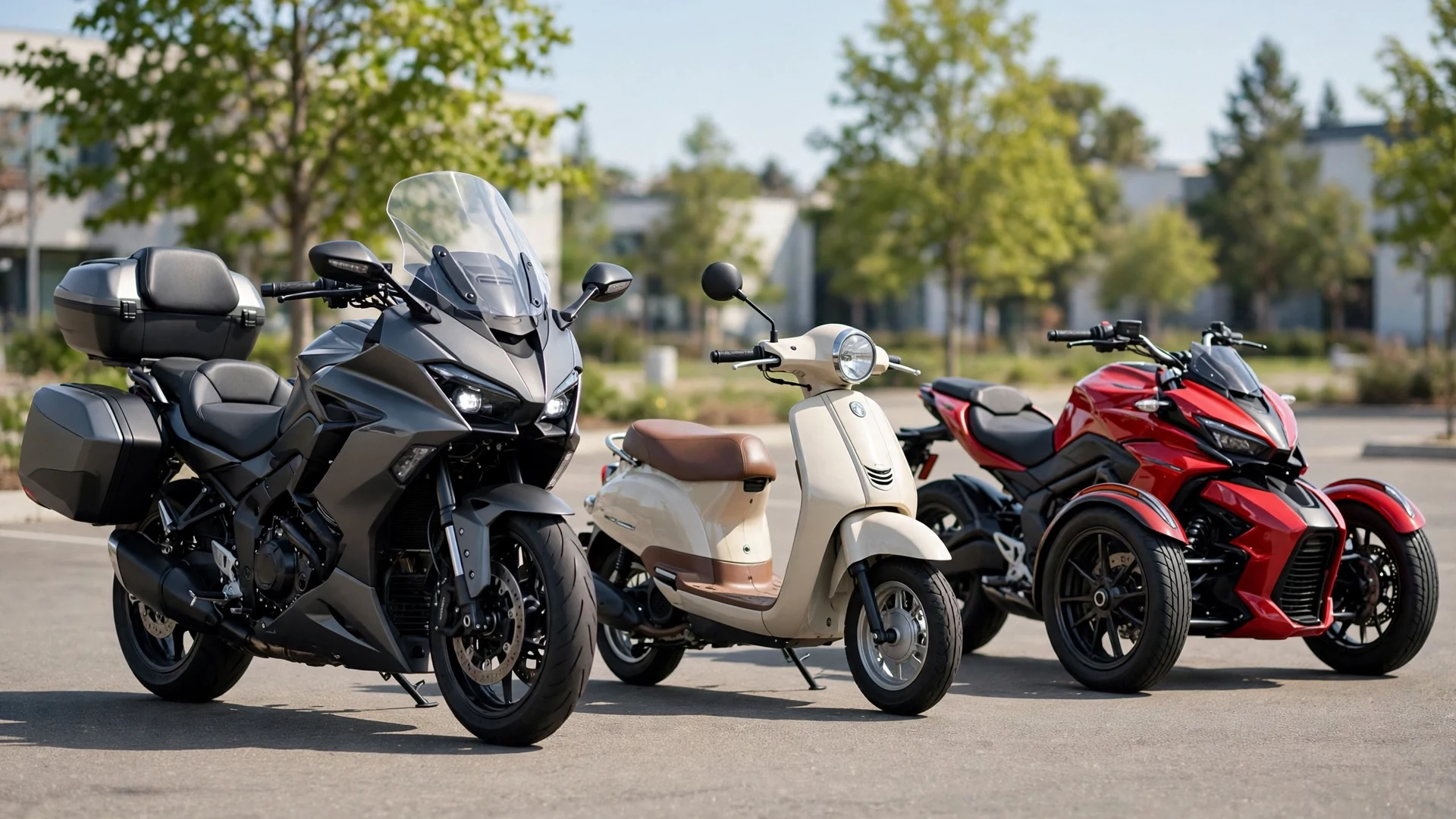
None of these is a lesser licence — they are different licences for different vehicles. A rider who only ever wants a moped is well served by the L path.
The costly mistake is drifting into a condition by accident and discovering later that your licence does not cover the bike you actually want.
Conditions can be removed by passing the appropriate road test on the right vehicle. Getting it right the first time simply saves a second round of test fees and waiting.
The Safety Course Shortcut
The Ministry encourages every new rider to take a ministry-approved motorcycle safety course — and the incentive is concrete. Recognized courses, run by colleges and rider-training organizations, teach real riding skills and include a road test in the program.
Passing one buys two things:
- Four months off Level Two. The 22-month minimum drops to 18 months — the single biggest time saving anywhere in the ladder.
- A possible insurance break. Graduates may qualify for reduced premiums, which matters because insuring a new rider is famously expensive.
The course can be taken during Level One or Level Two.
Taken at Level One, its included road test can satisfy the Level One road test requirement — with the timing rules from above: the 60-day M1 minimum still applies, and the certificate must reach a DriveTest centre within six months.
Courses charge a fee that varies by provider and require full riding gear, so budget for both. For riders who want to finish the ladder faster and ride better doing it, it is the best money in the process.
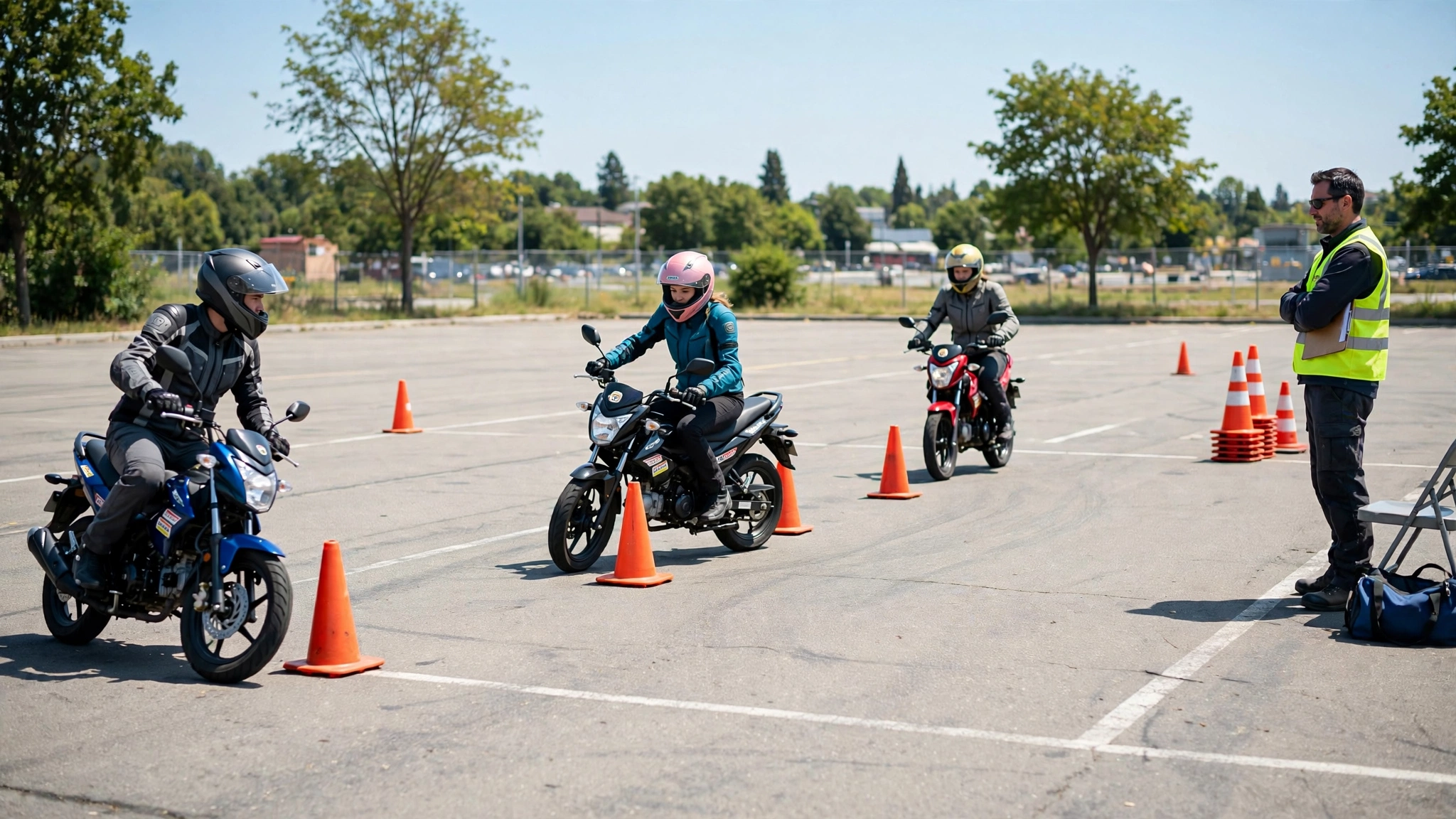
Tip: book a safety course early in your M1 window. The course itself takes a weekend or two — your real constraints are the 60-day M1 minimum on one side and the six-month certificate validity on the other.
How Long the Whole Ladder Takes
The minimums stack up like this:
- M1 to M2: 60 days minimum, capped by the 90-day M1 expiry.
- M2 to M: 22 months minimum — or 18 with an approved safety course.
- End to end: roughly two years from the first knowledge test to a full M, or about 20 months with the course shortcut.
Those are minimums, not averages. Real riders stretch the ladder across riding seasons — an M1 earned late in the year may wait out winter before the road test, and many riders use most of their five M2 years building experience before the final test.
The planning insight is where the pressure actually sits. The M1 window is short and unforgiving: 90 days with a 60-day floor leaves a narrow booking window, while the M2 period is long and forgiving.
Front-load your effort — pass the knowledge test, book the road test immediately, and reach Level Two before the clock becomes the problem.
Key fact: the fastest legal path runs M1 knowledge test, then the Level One road test at day 60, then M2, then a safety course, then the Level Two road test at month 18 — a full M in about 20 months.
Where Do You Start? Everyone Starts at M1
There is no skipping. Whatever your age or driving history, the motorcycle ladder begins with the M1 knowledge test. A full G car licence does not exempt you — the motorcycle classes are a separate system with their own tests.
If you are sorting out which licence class covers which vehicle — cars, motorcycles, mopeds, trikes — the Ontario licence class finder lays the classes out side by side so you apply for the right one the first time.
And when the knowledge test is your next step, the 200-question M1 question bank covers the same handbook ground the test draws from — signs, rules, and the motorcycle-specific material behind the hardest section.
Frequently Asked Questions
Can I Skip M1 and Go Straight to M2?
No. Every rider enters graduated licensing at Level One. You hold the M1 for at least 60 days and pass the Level One road test before an M2 is issued — there is no direct-to-M2 route.
What Happens If My M1 Expires Before I Pass the Road Test?
You restart the process: a new vision test, new knowledge tests, new fees, and a fresh 90-day M1. The handbook’s own advice is to book the Level One road test early in the window.
Does a Safety Course Let Me Skip the Road Tests?
Not exactly. An approved course includes a road test that can satisfy the Level One requirement, and it cuts Level Two from 22 months to 18 — but the 60-day M1 minimum still applies, and you still pass a Level Two road test for the full M.
What Is the Difference Between an M2 and a Full M Licence?
The M2 is still a novice licence: zero blood alcohol, helmet required, and a five-year expiry that forces the Level Two road test. The full M drops the novice framework — it is the unrestricted motorcycle licence.
If I Take My Road Test on a Scooter, What Licence Do I Get?
An M2 with an L condition, restricting you to limited-speed motorcycles and mopeds on certain roads. To ride a full motorcycle later, you retest on one and the condition comes off.
How Fast Can I Go From M1 to a Full M?
The legal minimums stack to about two years — 60 days at M1 plus 22 months at M2 — or about 20 months with an approved safety course cutting Level Two to 18 months. Most riders take longer, and there is nothing wrong with that.
This page is an unofficial study guide. It is not affiliated with, endorsed by, or connected to the Ontario Ministry of Transportation (MTO) or DriveTest. Motorcycle licensing rules change over time — confirm current requirements in the Official MTO Motorcycle Handbook before you apply or book a test.
Want 300 More M1 Practice Questions?
The Premium M1 Question Bank gives you 6 full mock exams with a plain-language explanation for every answer. Instant PDF download, yours to keep.
Original handbook-mapped questions. Not real DriveTest questions. No pass promises – just serious practice.