
Ontario Licence Class Finder: Which Licence Do You Need?
Interactive Tool
Assumptions: class definitions verified against the official MTO driver licensing source on October 14, 2026. “Designed seating” means the seating the bus was built for, and weights refer to gross or registered gross weight. If the MTO changes a threshold, results may differ.
Ontario’s licence chart looks like alphabet soup at first glance: a run of letters from A to M, graduated levels, and an endorsement that is not even a class. Most drivers only ever need one of them, yet plenty of people study for the wrong test because the chart is never explained in plain language.
The finder above gives you the answer in seconds. This guide explains the reasoning behind it: the three thresholds that decide almost every case, how the graduated G and M paths work, the mix-ups that trip people up (including the famous Class E versus Class F confusion), and exactly what to do next once you know your class.
How the Ontario Licence Chart Is Organized
Think of the chart in three groups. Class G is the everyday car licence and Class M is the motorcycle equivalent. Both have graduated versions — G1 and G2 for cars, M1 and M2 for motorcycles — that phase in full driving privileges step by step. These two streams cover almost every private driver in the province.
Then come the classified licences: A, B, C, D, E and F. These are for commercial and special-purpose vehicles — buses, ambulances, heavy trucks and tractor-trailers. They sit above Class G in the chart, which is why Ontario requires a full Class G before you can even apply for one of them. If you are brand new to driving, your journey starts in the G or M stream no matter what you eventually want to drive.
Key fact: a full Class G is required before applying for Class A, B, C, D, E or F. Novice drivers holding G1, G2, M1 or M2 may not hold a classified licence.
The Three Thresholds That Decide Everything
Almost every “which class do I need” question comes down to three numbers: the vehicle’s weight, the trailer’s weight, and the number of designed seats. Learn these three lines and you can read the whole chart without memorizing it.
The 11,000 kg Line: Straight Trucks
A straight truck over 11,000 kg registered gross weight needs a Class D. At or under that line, the same truck is a Class G vehicle. This is the most common surprise: a fairly large delivery truck can still be Class G if it is registered at or under 11,000 kg.
If you drive trucks for work, this line is worth double-checking against the vehicle’s registration, because the registered gross weight is what counts — not how big the truck looks in the parking lot.
The 4,600 kg Line: Trailers and Combinations
Once the trailer or trailers you are towing exceed 4,600 kg in total gross weight, you are in Class A territory — the tractor-trailer licence. Below that line, a heavy combination is typically Class D, while a light combination under 11,000 kg total stays Class G.
This is why the finder asks about trailer weight separately. It is the single detail that flips a combination from D to A, and guessing it wrong means preparing for the wrong knowledge test.
The 24-Seat Line: Buses
For buses, seating capacity does the sorting. More than 24 designed seats means Class B for a school bus or Class C for a regular bus. Twenty-four seats or fewer drops you to Class E for a school bus or Class F for a regular bus or ambulance.
Note the word “designed”: what matters is the seating the bus was built for, not how many passengers happen to be on board on any given day. The bus’s design plate or registration tells the story.
Class G: Where Almost Everyone Starts
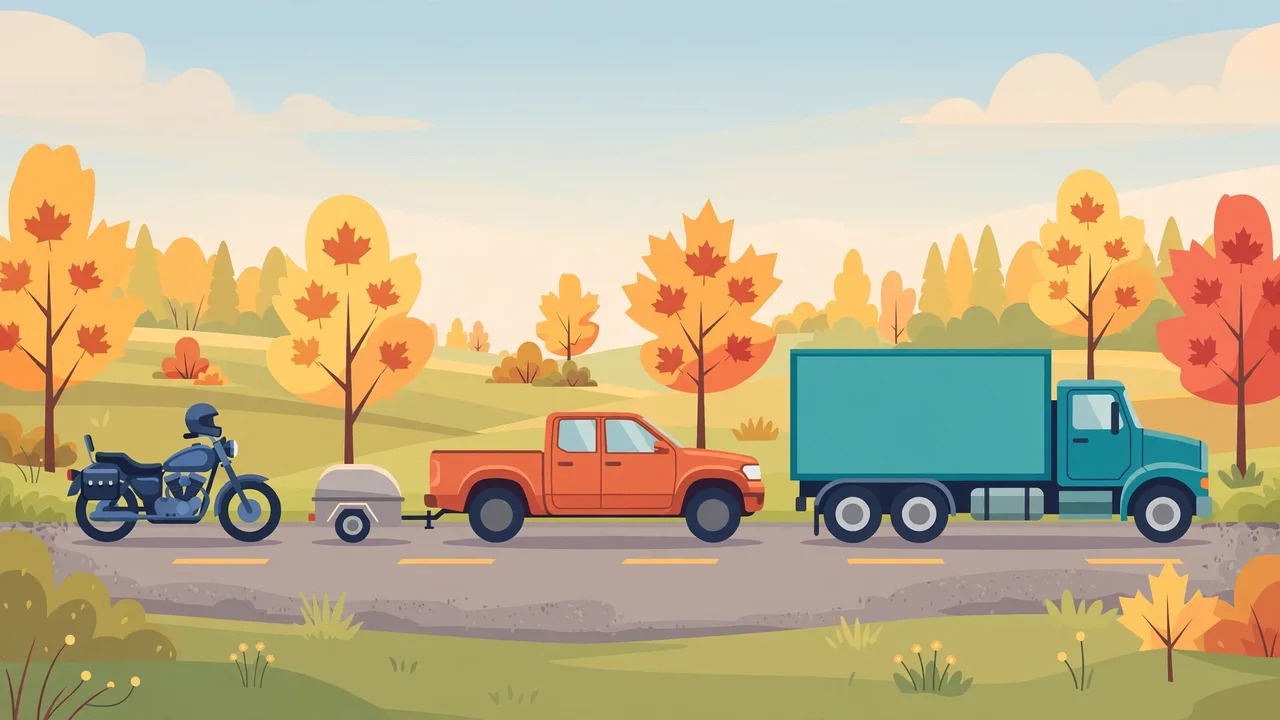
Class G is the licence behind the wheel of every car, SUV, van and small truck in Ontario. It also covers combinations up to 11,000 kg total, provided the towed vehicle stays at or under 4,600 kg — so towing a typical boat, camper or utility trailer is still Class G.
The graduated path runs G1, then G2, then full G. You can map out that journey with our G licence timeline planner, and when you are ready to study, our free G1 practice tests mirror the real test’s two-section format. After each practice run, the G1 score calculator checks you against the real 16-out-of-20 pass rule.
Because full Class G is the gateway to every classified licence, even future truck and bus drivers pass through here first. Treat the G1 knowledge test as the foundation everything else is built on, not as a formality to rush through.
Class M: The Motorcycle Stream
Motorcycles run on a parallel graduated system: M1, then M2, then full M. Like the G stream, it begins with a knowledge test covering motorcycle-specific rules, road signs and safe riding practices. Passing it gets you an M1, which lets you start riding under strict conditions while you build experience.
If you are heading down this path, our Ontario M1 motorcycle practice test gives you the full practice experience with explanations for every answer. It is the fastest way to find out whether you are genuinely test-ready or just feeling ready.
Key fact: Class M is its own stream. A full Class G does not let you ride a motorcycle, and a full Class M does not let you drive a car — each stream needs its own licence and its own tests.
The Mix-Ups That Catch Everyone
Four confusions account for most wrong answers on this topic. Here they are, settled once and for all:
- E versus F: both cover vehicles with 24 seats or fewer — but Class E is only for school purposes buses, while Class F is for ambulances and regular buses. A 20-seat shuttle used as a school bus is Class E; the same bus running an airport route is Class F.
- C versus B: same 24-plus seating, different purpose. Class B is school purposes buses, Class C is regular buses. The word “school” is the whole difference.
- When D is needed: people either over-apply or under-apply Class D. You need it for a straight truck over 11,000 kg or a heavy combination whose trailer stays at or under 4,600 kg. You do not need it for the family SUV towing a camper.
- Z is not a class: the Z air brake endorsement is added to a licence, never held on its own. If your bus or truck has air brakes, you need Z on top of the right class — answering “yes” to the air brake question in the finder flags exactly this.
Moving up a class also changes how you drive. Heavier vehicles need longer stopping distances, wider turns and bigger following gaps, so before you graduate to a truck or bus, try our stopping distance calculator to see how speed and reaction time stretch braking distance. It is essential reading for anyone stepping into a larger vehicle.
Your Next Steps
Once the finder has given you a class, the path forward is simple. Follow these steps in order and you will not waste a trip to the test centre:
- Confirm your class against the vehicle’s registration. Check registered gross weight for trucks and designed seating for buses, since those two numbers decide every borderline case.
- If your answer is Class G, book the G1 knowledge test and start studying with free practice tests until you are scoring comfortably above the pass mark.
- If your answer is Class M, book the M1 knowledge test and drill motorcycle questions with our M1 practice test.
- If your answer is A through F, get your full Class G first, then look into that class’s specific knowledge and road tests at a DriveTest centre.
- If the finder flagged a Z endorsement, plan for the air brake qualification alongside your class training rather than as an afterthought.
Licensing rules and procedures can change, so treat this page as your starting map and confirm the current requirements with the official MTO sources before you book anything. A five-minute check now beats a wasted test fee later.
Frequently Asked Questions
What licence do I need to drive a car or SUV in Ontario?
Class G. New drivers start with a G1 licence, graduate to G2, and then take the full G road test. The G1 knowledge test is the first step, and our free practice tests cover its exact two-section format.
What is the difference between a Class E and a Class F licence?
Both cover vehicles with designed seating of 24 passengers or fewer, but the purpose differs. Class E is for school purposes buses only. Class F is for ambulances and regular buses (not school buses). A 20-seat school bus needs Class E; a 20-seat airport shuttle needs Class F.
Do I need a Z endorsement for my car?
No — unless your vehicle is equipped with air brakes, which ordinary cars never are. The Z endorsement applies to buses and heavy trucks with air brake systems, and it is added to your licence on top of the correct class. It is not a licence class on its own.
Can I get a Class A licence while holding a G2?
No. A full Class G is required before you can apply for Class A, B, C, D, E or F, and novice drivers holding G1, G2, M1 or M2 may not hold a classified licence. You must graduate to a full G first, then pursue the commercial class.
What licence do I need to ride a motorcycle in Ontario?
Class M, through the graduated system: M1, then M2, then full M. It starts with the M1 knowledge test at a DriveTest centre. A Class G car licence does not cover motorcycles, so riders need the M stream even if they already drive cars.
This finder and guide are unofficial practice material for study purposes only. We are not affiliated with the Ontario Ministry of Transportation or DriveTest. Licence classes, thresholds, fees and procedures can change — confirm the current requirements with the official MTO sources before booking any test. This page provides general information only, not legal or professional advice.