
Ontario Air Brake Test Questions and Answers
This page holds the complete Ontario air brake question bank: 200 original practice questions with the correct answer and a plain-language explanation for every one. They are organized by topic so you can drill the exact part of the Z endorsement test you find hardest.
Every question is written from the topics in the Official MTO Air Brake Handbook. Study them here on the page, or download the free PDF and work through them anywhere.
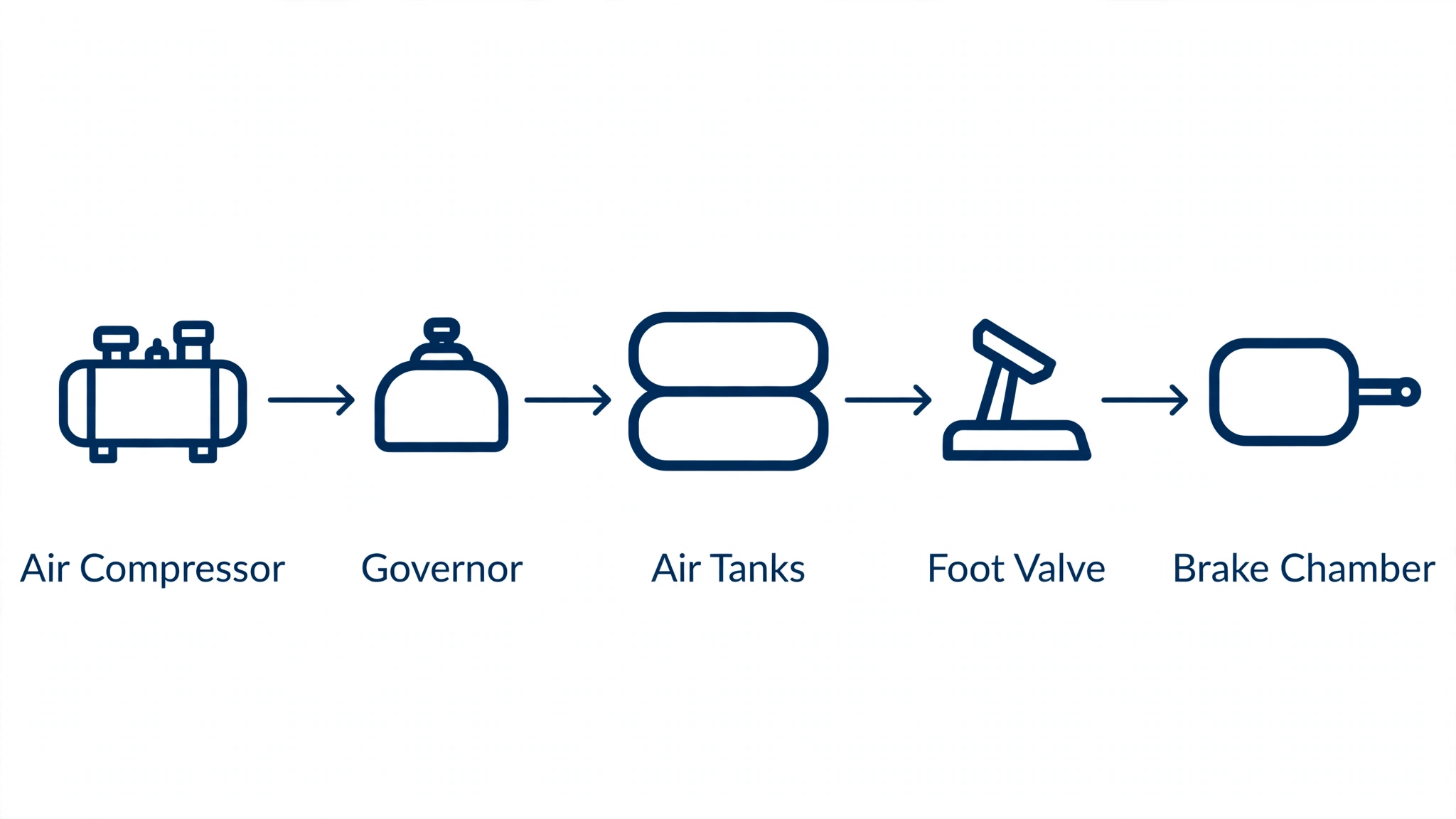
How This Question Bank Is Organized
The bank is split into four sections of 50 questions, matching the way the air brake system itself is built and tested.
- Air Supply System (Questions 1-50): compressor, governor cut-in and cut-out, air dryer, reservoirs, and pressure build-up.
- Brakes, Valves and Controls (Questions 51-100): the dual-circuit system, foot valve, brake chambers, slack adjusters, spring brakes, gauges, and the low-air warning.
- Inspection, Defects and Adjustment (Questions 101-150): the daily circle check, in-cab tests, air loss, defect rules, pushrod stroke, and what the practical test examiner checks.
- Trailer Systems and Safe Operation (Questions 151-200): glad hands, the tractor protection valve, trailer spring brakes, downhill braking, brake fade, and the steps to get and renew the endorsement.
Work through one section at a time. Read every explanation, including the ones for questions you got right — the reasoning is what the real test measures.
Key fact: The DriveTest air brake endorsement package is $66 for both tests — $16 for the knowledge test and $50 for the practical test. Rewriting a failed knowledge test costs another $16, so solid preparation pays for itself.
How to Study With This Bank
Start with the section that matches what you read most recently in the handbook. Cover the answers, say your choice out loud, then check the explanation.
Keep a list of every question you miss. Those misses point at a system you do not fully understand yet, and re-reading that handbook topic is worth more than repeating the question.
When you can work through a full section with only a few misses, switch to the timed-feel challenge on the Ontario air brake practice test page, where the same bank is dealt into eight numbered practice tests.
Study tip: Pressure numbers cause more misses than any other topic. Write the key figures — build-up, cut-in, cut-out, and the low-air warning — on one card and review it daily.
Get the Free PDF
The whole bank is available as a printable PDF with the same questions, answers, and explanations. Use the download button below the introduction to save it.
The PDF is handy for studying away from a screen, for marking up with a pen, and for a final review the night before your test.
Frequently Asked Questions
Are These the Real Z Endorsement Test Questions?
No. These are original practice questions written from the Official MTO Air Brake Handbook topics. The real test questions are not published anywhere, and any site claiming to sell them is misleading you.
How Many Questions Are on the Real Air Brake Knowledge Test?
Ontario does not publish an official count, and study sources disagree. The test is widely reported to be a short multiple-choice test with a pass mark of 80 percent.
Is This Question Bank Really Free?
Yes. All 200 questions on this page and in the PDF are free, with no account or sign-up needed.
How Is This Different From the Practice Test Page?
The practice test page deals the bank into eight numbered tests with scoring, like a rehearsal. This page is the full study library — every question with its answer and explanation visible for review.
What Should I Study Alongside These Questions?
The Official MTO Air Brake Handbook. The questions test understanding of the systems it describes, so read the handbook section behind any question you miss.
This question bank is unofficial and provided for study only. It is not affiliated with the Ontario Ministry of Transportation, DriveTest, or the Government of Ontario. Confirm current requirements and fees with ontario.ca and DriveTest.
Download the Free PDF: All 200 Questions
Air Supply System Questions (50)
Question 1
Why are air brakes well suited to heavy trucks and buses?
- A. They can produce the large braking forces heavy vehicles need using stored compressed air ✓
- B. They need no storage tanks because air is used the moment it is made
- C. They work by filling the brake chambers with brake fluid
- D. They make a heavy vehicle stop in the same distance as a small car
Correct answer: A. Compressed air can be stored under pressure and released in large volumes, giving the strong brake application force that heavy loads require.
Question 2
What is the basic difference between how a hydraulic brake system and an air brake system transmit force?
- A. Hydraulic brakes use compressed air, and air brakes use pressurized liquid
- B. Hydraulic brakes use pressurized liquid, while air brakes use compressed air ✓
- C. Both systems use compressed air, but air brakes use it at lower pressure
- D. Hydraulic brakes store energy in springs, and air brakes store it in batteries
Correct answer: B. The two systems use different working fluids: liquid in a hydraulic system and compressed air in an air brake system.
Question 3
If a small leak develops, why can an air brake system often keep operating longer than a hydraulic system that is losing fluid?
- A. Air leaks seal themselves when the brakes are applied
- B. The reservoirs are larger than the brake chambers, so leaks do not matter
- C. The compressor can keep replacing lost air, while lost hydraulic fluid comes from a limited supply that is gone once it escapes ✓
- D. Hydraulic fluid evaporates, but air cannot escape from a fitting
Correct answer: C. Air is drawn from the atmosphere and compressed on the vehicle, so the compressor can make up for a small loss. Hydraulic fluid is a fixed supply that is lost when it leaks out.
Question 4
Where does an air brake system get the air it uses?
- A. From cylinders the driver swaps when they are empty
- B. From the fuel tank, as a by-product of combustion
- C. From the tires, which share air with the brake system
- D. From the surrounding atmosphere, drawn in and compressed on the vehicle ✓
Correct answer: D. The system uses ordinary air from outside the vehicle. The compressor draws it in, pressurizes it, and stores it in the reservoirs.
Question 5
What is the job of the air compressor in the supply system?
- A. It pumps air, raises it to system pressure, and delivers it to the reservoirs for storage ✓
- B. It cools the brake drums after a hard stop
- C. It releases air from the brake chambers when the pedal is lifted
- D. It measures reservoir pressure for the dashboard gauges
Correct answer: A. The compressor is the pump of the system. It takes in air, compresses it, and sends it to the tanks, where it is stored until a brake application needs it.
Question 6
How is the air compressor on most heavy vehicles driven?
- A. By an electric motor powered only when the parking brake is set
- B. By the vehicle's engine, through gears or a belt drive ✓
- C. By road speed, through a shaft from the wheels
- D. By exhaust pressure from the turbocharger alone
Correct answer: B. The compressor is engine-driven, by gears or a belt, so it can build air whenever the engine is running and the system calls for it.
Question 7
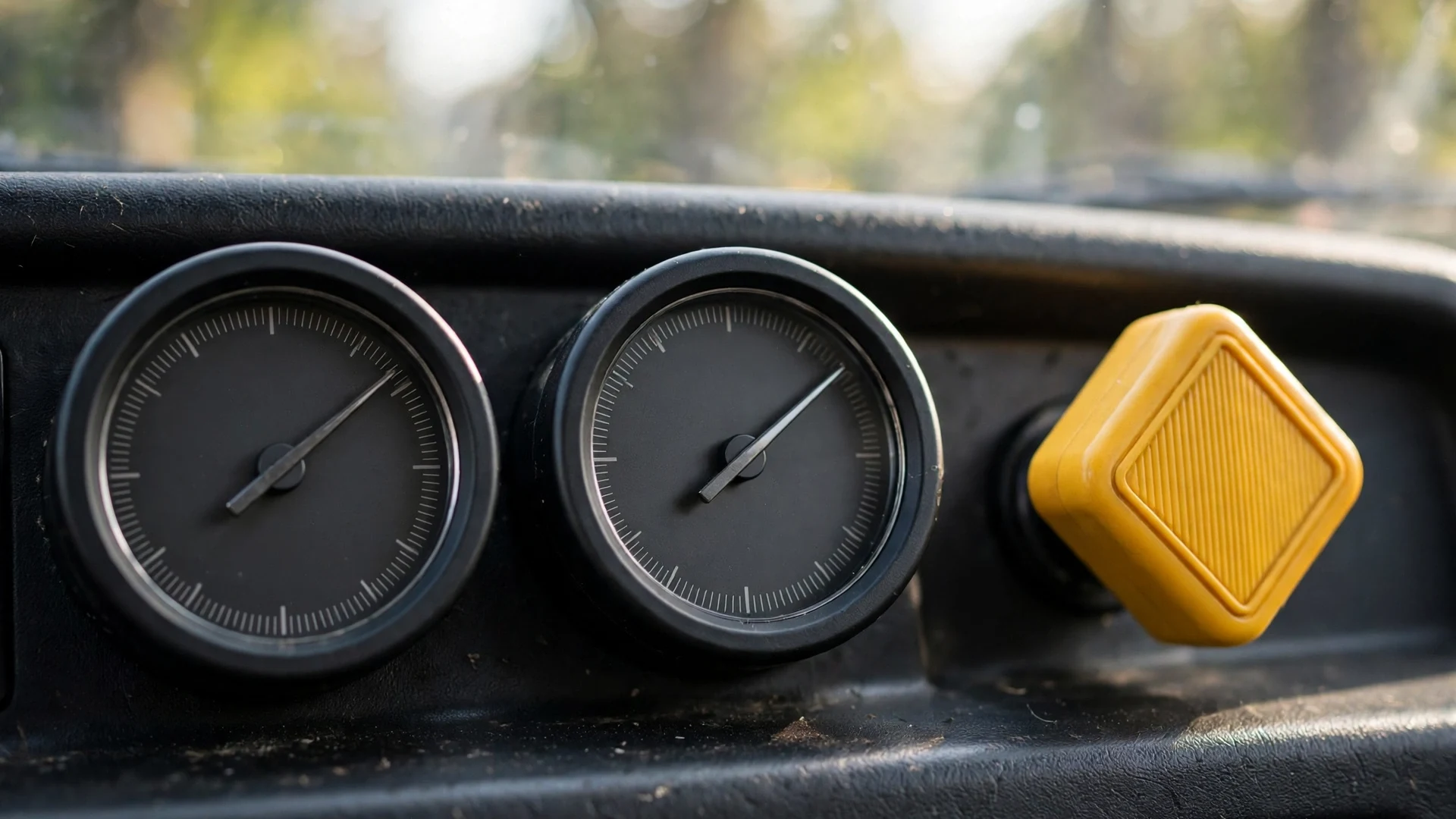
Where does the air compressor draw in its air?
- A. Directly from the supply reservoir
- B. From the exhaust manifold, after combustion
- C. Through a filter, either from the engine's air intake system or through its own intake filter ✓
- D. From inside the cab, through the heater ducts
Correct answer: C. Intake air is filtered before it enters the compressor, either through the engine intake or a filter fitted to the compressor itself, to keep dirt out of the system.
Question 8
What is the likely effect of a badly clogged compressor intake filter?
- A. Reservoir pressure will rise faster than normal
- B. The governor will cut out at a lower pressure
- C. The safety valve will open on every application
- D. The compressor will take in less air, so delivery drops and pressure builds more slowly ✓
Correct answer: D. A restricted intake starves the compressor of air. With less air coming in, it delivers less, and the system takes longer to build pressure.
Question 9
What happens to the air supply if the compressor fails completely while driving?
- A. No new air is pumped, so reservoir pressure gradually falls each time the brakes are used ✓
- B. Pressure stays normal because the reservoirs refill themselves
- C. The governor takes over and pumps air in place of the compressor
- D. The brakes lock on immediately and cannot be released
Correct answer: A. Only the compressor makes compressed air. If it stops, the vehicle runs on the air already stored, and that supply is used up with every brake application.
Question 10
Does the compressor pump air into the reservoirs continuously whenever the engine is running?
- A. Yes, it pumps at full output until the engine is shut off
- B. No, it is loaded and unloaded so it pumps only when the system needs air ✓
- C. Yes, and the extra air is simply vented through the brake pedal
- D. No, it pumps only while the vehicle is moving
Correct answer: B. Once the reservoirs are full, the compressor is unloaded and stops delivering air. It starts pumping again only when pressure drops enough to call for it.
Question 11
What is the main function of the governor?
- A. It limits the vehicle's road speed
- B. It dries the air before it reaches the tanks
- C. It controls when the compressor starts and stops pumping, based on reservoir pressure ✓
- D. It applies the brakes if the driver presses the pedal too hard
Correct answer: C. The governor watches system pressure and tells the compressor when to pump and when to rest, keeping reservoir pressure within its working range.
Question 12
At about what pressure does the governor normally cut out, stopping the compressor from pumping?
- A. About 85 psi (587 kPa)
- B. About 100 psi (690 kPa)
- C. About 150 psi (1034 kPa)
- D. About 125 psi (860 kPa) ✓
Correct answer: D. Cut-out is about 125 psi (860 kPa). At that point the system is considered full and the governor unloads the compressor.
Question 13
At about what pressure does the governor normally cut in, starting the compressor pumping again?
- A. About 100 psi (690 kPa) ✓
- B. About 125 psi (860 kPa)
- C. About 145 psi (1000 kPa)
- D. About 150 psi (1034 kPa)
Correct answer: A. Cut-in is about 100 psi (690 kPa). When reservoir pressure falls to that level, the governor loads the compressor so it rebuilds the supply.
Question 14
How much lower is the governor cut-in pressure than the cut-out pressure?
- A. There is no difference; they happen at the same pressure
- B. Roughly 20 to 25 psi (138 to 173 kPa) lower ✓
- C. About half the cut-out pressure
- D. Just enough that the compressor restarts every few seconds
Correct answer: B. Cut-in sits roughly 20 to 25 psi (138 to 173 kPa) below cut-out, which gives the compressor a rest period instead of switching on and off constantly.
Question 15
What happens in the supply system at the moment the governor cuts out?
- A. The reservoirs are vented so pressure can start over
- B. The compressor begins pumping at double speed
- C. The compressor is unloaded and stops delivering air to the reservoirs ✓
- D. The drain valves open and empty all the tanks
Correct answer: C. Cut-out means the tanks are full. The governor unloads the compressor, so it stops pushing air into the system until pressure falls to cut-in.
Question 16
What happens in the supply system when pressure falls to the governor cut-in point?
- A. The safety valve opens to top up the tanks
- B. The air dryer takes over pumping air
- C. The driver must restart the engine to rebuild pressure
- D. The governor loads the compressor and it resumes pumping air into the reservoirs ✓
Correct answer: D. At cut-in the governor puts the compressor back to work. It pumps until pressure climbs back to cut-out.
Question 17
A compressor's cut-out is considered defective if it rises above which pressure?
- A. 145 psi (1000 kPa) ✓
- B. 125 psi (860 kPa)
- C. 100 psi (690 kPa)
- D. 85 psi (587 kPa)
Correct answer: A. Cut-out should happen at about 125 psi (860 kPa). If the compressor keeps building past 145 psi (1000 kPa), the cut-out is defective.
Question 18
What does the governor sense in order to decide when to load and unload the compressor?
- A. The temperature of the compressor
- B. Reservoir air pressure ✓
- C. The position of the brake pedal
- D. Engine oil pressure
Correct answer: B. The governor responds to air pressure in the reservoirs. High pressure unloads the compressor and lower pressure loads it again.
Question 19
If the governor fails so the compressor never unloads, what is the likely result?
- A. The tanks will slowly lose pressure overnight
- B. The air dryer will stop purging, but pressure stays normal
- C. Pressure can keep rising until the safety valve opens to release it ✓
- D. The compressor will pump only into the secondary tank
Correct answer: C. Without unloading, the compressor keeps pumping into full tanks. Pressure climbs beyond cut-out until the safety valve relieves it.
Question 20
If the governor fails so the compressor never loads again after cutting out, what happens?
- A. Pressure rises until the safety valve opens
- B. Both dry tanks fill, but the supply tank stays empty
- C. The dryer purge runs continuously and refills the tanks
- D. System pressure gradually falls, because the compressor never resumes pumping to replace air that is used ✓
Correct answer: D. Cut-in is what restarts the compressor. If that never happens, every brake application takes air out and nothing puts it back.
Question 21
What is the main job of the air dryer?
- A. It removes moisture and contaminants from the compressed air before the air reaches the reservoirs ✓
- B. It heats the air so the brakes release faster in winter
- C. It raises air pressure above what the compressor can produce
- D. It stores a reserve of air for the parking brakes
Correct answer: A. Compressing air concentrates the moisture in it. The dryer strips that moisture and other contaminants out before the air is stored.
Question 22
Where does the air dryer sit in the path of the air supply?
- A. After the secondary tank, just before the brake chambers
- B. Between the compressor and the supply reservoir ✓
- C. Inside the supply reservoir, submerged in stored air
- D. On the exhaust side of the engine
Correct answer: B. Air flows from the compressor through the dryer and then into the supply tank, so drying happens before the air is stored and distributed.
Question 23
When does the air dryer's purge cycle happen?
- A. Every time the driver applies the service brakes
- B. Only when the driver pulls a manual purge cable
- C. When the governor cuts out and the compressor unloads, the dryer expels the moisture and contaminants it collected ✓
- D. Each time the engine is shut off for the night
Correct answer: C. The purge is tied to cut-out. When the compressor unloads, the dryer blows down and ejects the water and contaminants it trapped during the pumping cycle.
Question 24
A brief burst of air from beneath the vehicle just as the compressor reaches cut-out most likely means what?
- A. A brake chamber diaphragm has ruptured
- B. The safety valve is relieving excess pressure
- C. A reservoir drain valve has been left open
- D. The air dryer is purging the moisture and contaminants it collected ✓
Correct answer: D. That short exhaust blast at cut-out is the dryer purge. It is the normal sound of collected moisture being blown out of the dryer.
Question 25
Why is moisture inside the air brake system a problem?
- A. It can corrode internal parts and freeze in cold weather, blocking air lines and valves ✓
- B. It makes the air too heavy for the compressor to pump
- C. It turns the stored air into hydraulic fluid
- D. It raises reservoir pressure above the safety valve setting
Correct answer: A. Water damages the system two ways: it rusts and corrodes components from inside, and in winter it can freeze and block the passages air needs to move through.
Question 26
If a vehicle is fitted with an air dryer, do the reservoirs still need to be drained and checked?
- A. No, the dryer removes all moisture, so draining is never needed again
- B. Yes, the tanks must still be drained and checked daily, because the dryer does not remove everything and can fail ✓
- C. Only the tires need checking once a dryer is fitted
- D. Yes, but only once a year at the annual inspection
Correct answer: B. A dryer greatly reduces moisture, but it is not perfect and it can malfunction. Daily draining confirms the tanks are not collecting water or oil.
Question 27
What is the purpose of the air reservoirs (tanks) in the supply system?
- A. To muffle the noise of the compressor
- B. To cool the air so it takes up less room in the lines
- C. To store compressed air so a ready supply is available whenever the brakes are applied ✓
- D. To filter dirt out of the air before it reaches the dryer
Correct answer: C. The tanks are storage. They hold enough pressurized air for repeated brake applications, including times when the compressor is unloaded or the engine is off.
Question 28
Which reservoir receives air first as it comes from the compressor and dryer?
- A. The primary tank
- B. The secondary tank
- C. Both dry tanks at exactly the same moment
- D. The supply tank, also called the wet tank ✓
Correct answer: D. Air enters the supply (wet) tank first. From there it flows onward through one-way check valves into the primary and secondary tanks.
Question 29
Why is the supply tank commonly called the wet tank?
- A. Moisture and oil carried with the air tend to collect in it first, before the air moves on to the other tanks ✓
- B. It is filled with water to cool the compressed air
- C. It is mounted low, where road spray keeps it wet
- D. Drivers add water to it to test the drain valve
Correct answer: A. It is the first storage point, so most of the water and oil that get past the dryer settle there. That is why draining it is so important.
Question 30
In a typical dual-circuit system, what does the primary (dry) tank supply?
- A. Air for the horn and suspension only
- B. One of the separate service brake circuits, usually the rear brakes ✓
- C. Air back to the compressor intake
- D. The parking brake circuit only
Correct answer: B. The primary tank feeds one independent service brake circuit, typically the rear brakes, separately from the circuit fed by the secondary tank.
Question 31
In a typical dual-circuit system, what does the secondary (dry) tank supply?
- A. A second supply of air to the compressor
- B. Air used only for draining the wet tank
- C. The other separate service brake circuit, usually the front brakes ✓
- D. Air for the trailer's tires
Correct answer: C. The secondary tank feeds the service circuit the primary tank does not, typically the front brakes, so the two circuits stay independent.
Question 32
Why are the primary and secondary tanks kept as separate circuits?
- A. So one tank can be removed for cleaning while driving
- B. So the driver can choose which tank to brake with
- C. So the governor has two pressures to average
- D. So that if one circuit loses its air, the other circuit can still provide braking ✓
Correct answer: D. Separation is a safety feature. A failure that empties one circuit leaves the other circuit with its own stored air for braking.
Question 33
What do the one-way check valves between the supply tank and the primary and secondary tanks do?
- A. They let air flow forward into the dry tanks but prevent it from flowing back toward the supply tank ✓
- B. They keep the two dry tanks at exactly the same pressure at all times
- C. They drain water automatically whenever pressure drops
- D. They limit how fast the compressor can fill the supply tank
Correct answer: A. A check valve passes air in one direction only. Air moves from the supply tank into each dry tank, but cannot return the way it came.
Question 34
How do the one-way check valves protect the brake circuits if the supply tank or its feed line fails?
- A. They open a bypass that refills the supply tank from the tires
- B. They keep the air already stored in the primary and secondary tanks from escaping back through the failure ✓
- C. They signal the compressor to run at a higher speed
- D. They drain the failed tank so it cannot burst
Correct answer: B. Because air cannot flow backward past the check valves, a rupture on the supply side does not empty the dry tanks. Their stored air remains available for braking.
Question 35
What is a likely sign that a one-way check valve is stuck closed?
- A. The safety valve opens below its normal setting
- B. The dryer purges every time the brakes are applied
- C. A dry tank fails to fill properly even though pressure builds in the supply tank ✓
- D. All tanks drain themselves overnight
Correct answer: C. A check valve stuck shut blocks the path into its tank. The supply side can reach normal pressure while that dry tank stays low or empty.
Question 36
What is the purpose of the drain valves fitted at the bottom of the reservoirs?
- A. To let the driver lower pressure before parking on a hill
- B. To release air for filling the vehicle's tires
- C. To test how loud the air exhaust can be
- D. To let out the water and oil that collect at the bottom of each tank ✓
Correct answer: D. Water and oil settle at the bottom of the tanks. Opening the drain valves blows that contamination out before it can be carried into valves and brake chambers.
Question 37
How often should reservoirs with manual drain valves be drained?
- A. Daily, draining each tank completely ✓
- B. Only when the low-air warning comes on
- C. Only when the weather turns cold
- D. Only during a full brake overhaul
Correct answer: A. Tanks are drained every day. Daily draining keeps the water and oil that collect from building up and damaging the rest of the system.
Question 38
A vehicle has automatic reservoir drain valves. What should the driver still do?
- A. Remove the automatic valves and drain the tanks by hand instead
- B. Still check the tanks daily to confirm the automatic valves are working and contamination is not building up ✓
- C. Nothing; automatic valves remove the need for any tank checks
- D. Leave the engine running overnight so the valves keep cycling
Correct answer: B. Automatic drains can stick or fail. A daily check confirms they are actually expelling moisture and that oil or water is not accumulating in the tanks.
Question 39
When a tank is drained, an unusual amount of oil comes out. What does that most likely indicate?
- A. The air dryer is working better than normal
- B. The governor cut-in is set too low
- C. The compressor is worn and passing oil into the air system ✓
- D. The check valves are installed backwards
Correct answer: C. Some oil mist is normal, but a lot of oil at the drain points to a worn compressor letting its lubricating oil blow by into the discharge air.
Question 40
When a tank is drained, far more water than usual comes out. What is a likely cause?
- A. The reservoirs were overfilled with air
- B. The compressor drive belt is too tight
- C. The safety valve is set too high
- D. The air dryer is not removing moisture properly, or the tanks have not been drained as often as they should be ✓
Correct answer: D. Excess water means moisture is getting past the drying stage or has been allowed to accumulate. The dryer and the draining routine both need attention.
Question 41
How can frozen moisture in the air system affect braking in winter?
- A. Ice can block air passages, which can prevent brakes from applying or releasing properly ✓
- B. Ice makes the stored air denser, so the brakes apply too hard
- C. Ice lubricates the valves, making them work faster
- D. Ice only affects the horn, never the brakes
Correct answer: A. Water that freezes inside lines and valves can stop air from reaching or leaving the brake chambers, so a brake may fail to apply or fail to release.
Question 42
In the pressure build-up test, from what pressure should the system start?
- A. From about 125 psi (860 kPa), after the governor cuts out
- B. From 85 psi (587 kPa) ✓
- C. From completely empty tanks
- D. From about 150 psi (1034 kPa), with the safety valve open
Correct answer: B. The build-up test times the rise starting at 85 psi (587 kPa). That starting point makes results comparable from one test to the next.
Question 43
To pass the pressure build-up test, how far and how fast must pressure rise?
- A. From cut-in to cut-out in the time it takes to walk around the vehicle
- B. From empty to full before the engine warms up
- C. From 85 psi (587 kPa) to 100 psi (690 kPa) within 2 minutes ✓
- D. From 100 psi (690 kPa) back down to 85 psi (587 kPa) within 2 minutes
Correct answer: C. A healthy system climbs from 85 psi (587 kPa) to 100 psi (690 kPa) in 2 minutes or less. Taking longer points to a supply problem.
Question 44
At what engine speed is the pressure build-up test performed?
- A. At idle with the throttle untouched, whatever speed that is
- B. At maximum governed engine speed
- C. With the engine off, using stored starter air
- D. At 600 to 900 rpm ✓
Correct answer: D. The test is run at 600 to 900 rpm. Holding that steady speed makes the 2-minute build-up standard a fair measure of compressor health.
Question 45
During a build-up test, pressure takes longer than 2 minutes to rise from 85 psi (587 kPa) to 100 psi (690 kPa). How is this treated?
- A. As a defect in the air supply system that must be corrected ✓
- B. As normal for any vehicle on a cold morning
- C. As a sign the safety valve needs adjusting
- D. As acceptable if the brakes still feel firm
Correct answer: A. Slow build-up means the supply side cannot keep up as it should. It is recorded as a defect, whether the cause is a worn compressor, a restriction, or a leak.
Question 46
Which of these conditions could cause abnormally slow pressure build-up?
- A. A freshly cleaned compressor intake filter
- B. A slipping compressor drive belt, so the compressor turns more slowly than it should ✓
- C. Draining the reservoirs every day
- D. A governor that cuts out at about 125 psi (860 kPa)
Correct answer: B. If the belt slips, the compressor does not turn at full speed and delivers less air, so pressure climbs slowly even though the engine speed is correct.
Question 47
What is the job of the safety valve in the air supply system?
- A. It warns the driver with a buzzer when pressure is low
- B. It holds air in the tanks when the vehicle is parked
- C. It automatically releases air if system pressure rises too high, protecting the system from overpressure damage ✓
- D. It keeps the compressor from starting when the engine is cold
Correct answer: C. The safety valve is the last line of defence against too much pressure. If pressure climbs beyond its setting, it opens and vents air.
Question 48
At about what pressure does the safety valve open?
- A. About 100 psi (690 kPa)
- B. About 125 psi (860 kPa)
- C. About 85 psi (587 kPa)
- D. About 150 psi (1034 kPa) ✓
Correct answer: D. The safety valve opens at about 150 psi (1034 kPa), above the normal cut-out of about 125 psi (860 kPa), so it only acts when something else has gone wrong.
Question 49
Where is the safety valve typically fitted?
- A. On the supply (wet) reservoir ✓
- B. On the brake pedal assembly in the cab
- C. Inside each brake chamber
- D. On the compressor intake filter housing
Correct answer: A. It is mounted on the supply tank, the first tank in the system, so it can relieve pressure for the whole supply side if the compressor fails to unload.
Question 50
The safety valve keeps popping off repeatedly during normal driving. What does this most likely mean?
- A. The tanks need draining and nothing more
- B. The compressor is not unloading as it should, for example because of a governor fault, and the defect must be fixed ✓
- C. The system is working perfectly, since the valve is doing its job
- D. The driver is applying the brakes too often
Correct answer: B. The valve should almost never open in normal service. Repeated popping means pressure is regularly going too high, usually because the compressor is not being unloaded at cut-out.
Brakes, Valves and Controls Questions (50)
Question 51
What is a dual, or split, air brake system?
- A. Two separate air circuits, each with its own supply, that operate the brakes ✓
- B. One air circuit that is shared by two vehicles at the same time
- C. A system with two brake pedals, one for each foot
- D. A system where the parking brake does all of the normal stopping
Correct answer: A. A dual system splits the brakes into primary and secondary circuits. Each circuit has its own air supply, so one failure does not remove all braking.
Question 52
If the primary circuit of a dual air brake system loses its air pressure, what should still happen?
- A. All service braking is lost at once
- B. The secondary circuit should still provide some service braking ✓
- C. The spring brakes will release on their own
- D. The steering will be powered by the remaining air
Correct answer: B. The two circuits are independent, so the secondary circuit can still apply some brakes if the primary circuit fails. Braking will be reduced, so the vehicle must be stopped safely.
Question 53
What is the main job of the secondary circuit in a dual air brake system?
- A. To supply air only to the horn and wipers
- B. To cool the brake drums after a stop
- C. To provide a back-up air supply for part of the service brakes ✓
- D. To hold the spring brakes off while parked
Correct answer: C. The secondary circuit is a separate back-up supply for part of the service brake system. It works together with the primary circuit during normal driving.
Question 54
Why is a dual air brake system safer than a single-circuit system?
- A. It lets the driver use higher air pressure than normal
- B. It removes the need to check the air gauges
- C. It makes the brake chambers larger
- D. A leak or failure in one circuit does not cause a total loss of service brakes ✓
Correct answer: D. With two independent circuits, a single leak or failure leaves the other circuit able to brake. A single-circuit failure could remove service braking completely.
Question 55
What does the foot valve, also called the treadle valve, do?
- A. It controls the flow of air to the brake chambers when the driver presses the brake pedal ✓
- B. It builds up air pressure in the reservoirs
- C. It adjusts the slack adjusters automatically
- D. It turns the brake lights on and off by hand
Correct answer: A. Pressing the brake pedal operates the foot valve. The valve sends air to the brake chambers to apply the service brakes.
Question 56
How is the application of the foot valve graduated?
- A. It is either fully on or fully off, with nothing in between
- B. The harder the pedal is pressed, the more air pressure is sent to the brakes ✓
- C. It applies more air the faster the pedal is pumped
- D. It applies the parking brake first, then the service brakes
Correct answer: B. The foot valve is graduated, meaning pedal pressure controls how much air reaches the brakes. A light press gives light braking and a firm press gives stronger braking.
Question 57
What does the 'feel' of the foot valve give the driver?
- A. A warning that the reservoirs are empty
- B. A way to check the slack adjusters without leaving the cab
- C. A sense of how much braking force is being applied ✓
- D. Control of the trailer supply valve
Correct answer: C. The resistance in the pedal gives the driver a feel for how hard the brakes are being applied. This helps the driver brake smoothly and avoid locking or grabbing.
Question 58
What happens inside the air brake system when the driver lets go of the foot valve?
- A. More air is sent to the brake chambers
- B. The spring brakes apply automatically
- C. The reservoirs begin to refill from the brake chambers
- D. Air is let out of the brake chambers so the service brakes release ✓
Correct answer: D. Releasing the pedal closes the supply from the foot valve and opens an exhaust path. Air leaves the chambers and the brakes come off.
Question 59
What is the job of a brake chamber?
- A. To change air pressure into mechanical force that applies the brakes ✓
- B. To store compressed air for the whole system
- C. To remove water from the compressed air
- D. To warn the driver when air pressure is low
Correct answer: A. A brake chamber receives air from the foot valve and turns that pressure into a pushing force. That force is what actually applies the brake at the wheel.
Question 60
What does the pushrod in a brake chamber do?
- A. It carries air from the reservoir to the chamber
- B. It moves out of the chamber and carries the applying force to the slack adjuster ✓
- C. It measures the air pressure in the chamber
- D. It holds the parking spring in place
Correct answer: B. When air fills the chamber, it pushes the pushrod outward. The pushrod transfers that movement to the slack adjuster and then to the brake.
Question 61
What role does the diaphragm play inside a service brake chamber?
- A. It filters dirt out of the incoming air
- B. It cools the air before it reaches the brakes
- C. Air pressure pushes against it, and it moves the pushrod ✓
- D. It seals the reservoir when the engine is off
Correct answer: C. The diaphragm is a flexible disc inside the chamber. Air pressure pushes on it, and that movement drives the pushrod out to apply the brake.
Question 62
During an inspection, a pushrod that travels much farther than normal most likely means what?
- A. The reservoirs are overfilled with air
- B. The foot valve is applying too much pressure
- C. The brake lights are about to fail
- D. The brake is out of adjustment and needs attention ✓
Correct answer: D. As brake linings wear, pushrod travel grows if the brake is not adjusted. Excess travel means less effective braking and the brake must be adjusted or repaired.
Question 63
What does a slack adjuster do?
- A. It passes the pushrod's movement to the brake camshaft, which applies the brake shoes ✓
- B. It stores extra air for long downhill grades
- C. It releases the spring brakes when the pedal is pressed
- D. It shows the driver the reservoir pressure
Correct answer: A. The slack adjuster is the link between the pushrod and the brake camshaft. When the pushrod moves it, the cam turns and forces the brake shoes against the drum.
Question 64
Why does the adjustment provided by the slack adjuster matter?
- A. It controls how loud the low-air buzzer sounds
- B. It keeps the right amount of clearance and pushrod travel so the brakes apply fully and on time ✓
- C. It decides which circuit fills first
- D. It keeps the brake pedal from returning
Correct answer: B. Correct adjustment keeps pushrod travel within its proper range. If travel is too long, the brakes apply weakly and late.
Question 65
How is a manual slack adjuster kept in proper adjustment?
- A. It adjusts itself every time the brakes are used
- B. It is adjusted by changing the air pressure setting
- C. It must be checked and adjusted by hand as part of regular inspection and maintenance ✓
- D. It never needs checking once it is installed
Correct answer: C. A manual slack adjuster does not adjust itself. Its adjustment must be checked regularly and corrected by hand when pushrod travel is out of range.
Question 66
How does an automatic slack adjuster differ from a manual one?
- A. It uses no pushrod
- B. It only works when the vehicle is parked
- C. It replaces the brake chamber
- D. It adjusts itself during use to keep pushrod travel in the proper range as parts wear ✓
Correct answer: D. An automatic slack adjuster corrects its own adjustment as linings wear. This keeps pushrod travel consistent without a manual adjustment each time.
Question 67
If a vehicle has automatic slack adjusters, what must the driver still do?
- A. Check pushrod travel and brake operation during inspections, because automatic adjusters can still fail or be damaged ✓
- B. Nothing at all, because the brakes can never go out of adjustment
- C. Adjust them by hand at every stop
- D. Remove them before driving in winter
Correct answer: A. Automatic slack adjusters reduce routine adjusting, but they are not a guarantee. Travel and operation still need to be inspected, and a brake that keeps going out of adjustment needs repair, not repeated adjusting.
Question 68
Which brakes are the service brakes?
- A. The brakes applied by the yellow dash knob
- B. The main brakes the driver uses with the foot pedal for normal slowing and stopping ✓
- C. The brakes that apply only when air pressure is lost
- D. The brakes used only while the vehicle is parked
Correct answer: B. The service brakes are the regular foot-operated brakes used for everyday slowing and stopping. They are separate from the spring brakes used for parking and emergencies.
Question 69
What is the purpose of a quick-release valve?
- A. To build reservoir pressure more quickly
- B. To apply the spring brakes faster in an emergency
- C. To let air out of the brake chambers quickly so the brakes release without delay ✓
- D. To warn the driver sooner when pressure drops
Correct answer: C. A quick-release valve is placed close to the chambers it serves. When the driver lets off the pedal, it vents chamber air right there instead of sending it all the way back to the foot valve.
Question 70
What is the main purpose of a relay valve?
- A. To replace the foot valve on large vehicles
- B. To keep the spring brakes from applying
- C. To increase the maximum reservoir pressure
- D. To speed up the application and release of the brakes on a long vehicle ✓
Correct answer: D. On a long vehicle, air from the foot valve would take too long to reach distant brakes. A relay valve uses a small signal from the foot valve to move a large volume of air close to those brakes.
Question 71
How does a relay valve get the air it sends to the brake chambers?
- A. It takes air from a nearby reservoir when it receives the signal from the foot valve ✓
- B. It makes its own compressed air with an electric motor
- C. It borrows air from the spring brake chambers
- D. It uses air that has already been used by the front brakes
Correct answer: A. The foot valve sends only a control signal to the relay valve. The relay valve then draws the larger volume of air it needs from a reservoir mounted close by.
Question 72
Without a relay valve, what problem would a long vehicle have with its rear brakes?
- A. The rear brakes would apply too strongly
- B. There would be a noticeable delay before the rear brakes applied and released ✓
- C. The rear brakes would only work while parked
- D. The rear reservoirs would fill too quickly
Correct answer: B. Air takes time to travel the length of a long vehicle through a small line. A relay valve shortens that path, so distant brakes respond at nearly the same time as the closer ones.
Question 73
What holds the spring brakes off during normal driving?
- A. The driver's foot on the brake pedal
- B. A cable from the parking brake lever
- C. Air pressure, which keeps the powerful spring compressed ✓
- D. The weight of the vehicle
Correct answer: C. Spring brakes are held off by air pressure acting against a strong spring. As long as enough air pressure is present, the spring stays compressed and the brake stays released.
Question 74
What actually applies a spring brake when it engages?
- A. Air pressure in the service chamber
- B. An electric motor on each wheel
- C. Hydraulic fluid from the foot valve
- D. The force of a powerful mechanical spring ✓
Correct answer: D. A spring brake is applied by spring force, not by air. Air is used to hold it off, and when that air is removed or lost, the spring applies the brake.
Question 75
At about what system pressure will the spring brakes begin to apply automatically as air is lost?
- A. About 20 to 45 psi (140 to 310 kPa) ✓
- B. About 90 to 100 psi
- C. Only when pressure reaches exactly zero
- D. As soon as pressure drops just below full pressure
Correct answer: A. As pressure falls, the air can no longer hold the springs back, and the spring brakes start to apply at about 20 to 45 psi (140 to 310 kPa). This is a built-in fail-safe.
Question 76
How can the driver recognize the spring, or parking, brake control on the dash?
- A. It is a round blue knob
- B. It is a yellow knob shaped like a diamond ✓
- C. It is a red lever under the steering column
- D. It is a small black switch beside the headlights
Correct answer: B. The parking brake control is a yellow, diamond-shaped knob on the dash. Its distinct colour and shape let the driver find it by touch and sight.
Question 77
What happens when the driver pushes the yellow diamond knob in?
- A. The spring brakes apply for parking
- B. Air is let out of the spring brake chambers
- C. Air is supplied to the spring brake chambers, which releases the spring brakes ✓
- D. The service brakes are locked on
Correct answer: C. Pushing the knob in sends air to the spring brake chambers. That air compresses the springs and releases the parking brakes so the vehicle can move.
Question 78
What happens when the driver pulls the yellow diamond knob out?
- A. The spring brakes are released
- B. The reservoirs fill faster
- C. Only the front brakes apply
- D. Air leaves the spring brake chambers and the spring brakes apply for parking ✓
Correct answer: D. Pulling the knob out exhausts air from the spring brake chambers. With nothing holding them back, the springs apply the brakes to hold the vehicle parked.
Question 79
Why must a driver never rely on the service brakes to hold a parked vehicle?
- A. Air can leak from the system over time, letting the service brakes release and the vehicle roll ✓
- B. Service brakes become stronger the longer they are held
- C. Service brakes use too much fuel while parked
- D. The foot valve locks the pedal down automatically
Correct answer: A. Service brakes depend on air that the driver must keep applying with the pedal, and air systems can leak. The spring brakes, applied by mechanical spring force, are the ones that hold a parked vehicle.
Question 80
What does the parking brake control valve control?
- A. The pressure in the primary reservoir only
- B. The supply and release of air at the spring brake chambers, which applies or releases the spring brakes ✓
- C. The brightness of the dash warning lights
- D. The speed at which the compressor fills the reservoirs
Correct answer: B. The parking brake control valve is the dash control for the spring brakes. It either sends air to hold them off or vents that air to let the springs apply them.
Question 81
Besides parking, what other role do the spring brakes play?
- A. They act as a back-up steering system
- B. They replace the service brakes for normal stopping
- C. They serve as emergency brakes, applying on their own if system air pressure is lost ✓
- D. They keep the reservoirs from overfilling
Correct answer: C. Because they apply automatically when air pressure falls too low, spring brakes double as emergency brakes. That fail-safe action helps bring the vehicle to a stop after a major air loss.
Question 82
A driver notices the spring brakes starting to come on during a trip because of falling air pressure. What does this tell the driver?
- A. It is normal and the trip can continue as planned
- B. The brakes are adjusting themselves
- C. The reservoirs are completely full
- D. The air system is losing pressure and the vehicle must be stopped safely as soon as possible ✓
Correct answer: D. Spring brakes only begin to apply on their own when pressure has fallen to a low, unsafe level. The driver should stop safely before braking is lost or the springs drag the vehicle to a stop.
Question 83
What do the air pressure gauges on the dash allow the driver to monitor?
- A. The air pressure in the primary and secondary circuits and the supply system ✓
- B. The temperature of the brake drums
- C. The thickness of the brake linings
- D. The amount of fuel in the tank
Correct answer: A. The gauges show the pressure available in each part of the air system. Watching them tells the driver whether pressure is building normally or being lost.
Question 84
While driving, a gauge shows air pressure steadily falling even though the engine is running. What should the driver do?
- A. Ignore it if the brakes still feel normal
- B. Stop the vehicle in a safe place and find the cause before continuing ✓
- C. Pump the brake pedal to build the pressure back up
- D. Push the yellow knob in and keep driving
Correct answer: B. Falling pressure means air is being lost faster than it is being replaced. Continuing to drive risks the spring brakes applying and the service brakes weakening, so the vehicle must be stopped safely.
Question 85
What is the purpose of the low air pressure warning device?
- A. To tell the driver the reservoirs have reached full pressure
- B. To apply the brakes automatically at the first sign of a leak
- C. To warn the driver with a light, and often a buzzer, before pressure falls to a dangerously low level ✓
- D. To show how much pressure each brake application is using
Correct answer: C. The warning comes on while there is still enough pressure to stop safely. It gives the driver time to get off the road before the spring brakes begin to apply.
Question 86
The low air pressure warning must come on before pressure falls below 60 psi. When is the warning considered defective?
- A. If it comes on at exactly full pressure
- B. If the buzzer is louder than the light is bright
- C. If it comes on while the engine is running
- D. If it has still not activated by the time pressure falls to 55 psi (380 kPa) ✓
Correct answer: D. The warning must activate before pressure drops below 60 psi. If it fails to activate by 55 psi (380 kPa), it is defective and must be repaired before driving.
Question 87
How is the low air pressure warning tested during an inspection?
- A. With the engine off, pump the brake pedal to lower the air pressure and watch for the warning light or buzzer ✓
- B. By driving at highway speed and braking hard
- C. By pulling the yellow knob out and listening for air
- D. By checking that the warning comes on at full pressure
Correct answer: A. With the engine off, repeated brake applications drain reservoir pressure in a controlled way. The driver watches the gauges and confirms the warning activates at the proper pressure.
Question 88
The low air pressure warning light and buzzer come on while you are driving. What is the correct response?
- A. Turn the warning off and finish the trip
- B. Stop the vehicle in a safe place as soon as you can, before pressure falls further ✓
- C. Speed up so the compressor can catch up
- D. Apply the service brakes lightly for the rest of the trip
Correct answer: B. The warning means pressure is already low and still falling. Stop safely while you still have braking, rather than waiting for the spring brakes to apply on their own.
Question 89
What does the stop-light switch do in an air brake system?
- A. It stops air from reaching the rear brakes
- B. It turns off the dash lights when braking
- C. It is operated by air pressure during a brake application and turns on the vehicle's brake lights ✓
- D. It releases the spring brakes when the pedal is pressed
Correct answer: C. When the service brakes are applied, air pressure activates the stop-light switch. The switch completes the circuit that lights the brake lights to warn traffic behind.
Question 90
Where fitted, what does an application pressure gauge show?
- A. The pressure stored in the reservoirs
- B. The pressure in the spring brake chambers only
- C. The pressure of the air in the tires
- D. How much air pressure is being delivered to the brakes during an application ✓
Correct answer: D. An application gauge reads the pressure the foot valve is sending to the brakes at that moment. It rises and falls with pedal pressure, unlike the supply gauges that show stored pressure.
Question 91
What is the full, normal reservoir pressure in an air brake system?
- A. About 125 psi (860 kPa) ✓
- B. About 60 psi
- C. About 45 psi (310 kPa)
- D. About 300 psi
Correct answer: A. A fully charged system holds about 125 psi (860 kPa) in its reservoirs. Readings well below that during normal operation mean the system is not building or holding pressure properly.
Question 92
When the service brakes release, what returns the brake shoes away from the drum?
- A. Air pressure pushing in the opposite direction
- B. Return springs, once the air has been exhausted from the brake chambers ✓
- C. The parking brake control valve
- D. The driver pulling the pedal back up by hand
Correct answer: B. Releasing the pedal vents air from the chambers, so the pushrod retracts. Return springs then pull the brake shoes clear of the drum.
Question 93
Many rear brake chambers are combination units. What two parts do they combine?
- A. A reservoir and a compressor
- B. A relay valve and a quick-release valve
- C. A service brake section and a spring brake section in one housing ✓
- D. A gauge and a warning switch
Correct answer: C. A combination chamber has a service section that works with the foot pedal and a spring section for parking and emergency use. They share one housing and act on the same pushrod.
Question 94
How does the foot valve handle the two circuits of a dual system during a normal brake application?
- A. It supplies only the primary circuit, and the secondary works by itself
- B. It applies the circuits one at a time, a second apart
- C. It shuts one circuit off so the other can work harder
- D. Its separate sections send air to the primary and secondary circuits at the same time ✓
Correct answer: D. The foot valve is built with a section for each circuit. One pedal press therefore applies the brakes in both circuits together, while the circuits stay separate if one fails.
Question 95
The primary gauge reads normally but the secondary gauge reads much lower. What does this most likely indicate?
- A. A problem in the secondary circuit, such as a leak or a failed supply, that must be checked before driving ✓
- B. The system is working exactly as designed
- C. The reservoirs are both completely full
- D. The low air warning is about to turn off
Correct answer: A. Each gauge reports on its own circuit, so a big difference points to trouble in the low-reading circuit. The vehicle should not be driven until the cause is found.
Question 96
One circuit of a dual system fails completely while driving. How should the driver treat the remaining braking?
- A. As equal to normal braking, with no change in driving
- B. As reduced braking: stop safely and do not continue the trip as normal ✓
- C. As a reason to rely on the spring brakes for all stopping
- D. As a minor issue to report at the end of the week
Correct answer: B. Losing one circuit removes part of the service brakes, so stopping ability is reduced. The safe action is to stop and have the system repaired, not to carry on.
Question 97
What does 'caging' a spring brake mean?
- A. Locking the yellow knob so it cannot be pulled
- B. Covering the brake chamber to keep dirt out
- C. Using a bolt to mechanically compress and hold the spring so the brake can be released when there is no air pressure ✓
- D. Testing the spring by pulling the knob at speed
Correct answer: C. Caging uses a bolt to wind the power spring back by hand. It is a temporary measure for moving or towing a vehicle that has no air to release its spring brakes.
Question 98
Before leaving a vehicle parked, what should the driver do with the brakes?
- A. Leave the service brakes applied by holding the pedal with a block
- B. Drain all the air so the brakes set themselves
- C. Push the yellow knob in so the vehicle is ready to go
- D. Pull the yellow knob out to apply the spring, or parking, brakes ✓
Correct answer: D. Applying the spring brakes with the dash control sets a mechanical brake that does not depend on the driver's foot. That is the brake meant to hold a parked vehicle.
Question 99
After starting the engine, why should the driver wait for air pressure to build before pushing in the yellow knob to release the spring brakes?
- A. There must be enough air pressure to hold the springs off and to give full service braking ✓
- B. The knob will not move until the fuel tank is full
- C. Cold air cannot reach the brake chambers
- D. The warning buzzer must stop before the knob can be touched
Correct answer: A. Releasing the spring brakes and having proper service brakes both depend on adequate air pressure. The driver should let pressure build to its normal range and confirm the gauges and warning light look right first.
Question 100
In addition to a dash warning light, how else may a low air pressure warning alert the driver?
- A. By sounding a buzzer while the low pressure condition lasts
- B. By flashing the headlights ✓
- C. By applying the service brakes in pulses
- D. By locking the steering wheel
Correct answer: B. Many systems pair the warning light with an audible buzzer. Both are meant to get the driver's attention while there is still time to stop safely.
Inspection, Defects and Adjustment Questions (50)
Question 101
During a daily circle check of an air brake vehicle, why should you walk around and listen carefully near the wheels, hoses, and tanks?
- A. A hissing sound can reveal an air leak that needs to be reported ✓
- B. A hissing sound means the compressor is working extra hard and is normal
- C. Listening helps you estimate how much fuel is left in the tank
- D. It is only a way to check that the horn is loud enough
Correct answer: A. Air escaping under pressure often makes a hissing sound. An audible air leak is a defect and must be reported.
Question 102
Why are the air tanks drained as part of the daily inspection?
- A. To make room for fuel vapour in the tanks
- B. To remove moisture and contaminants that collect inside the tanks ✓
- C. To lower the governor cut-out pressure for the day
- D. To test how loud the air escaping from the valve sounds
Correct answer: B. Water and other contaminants collect in air tanks. Draining them daily protects valves and other parts from damage and freezing.
Question 103
What should you check about the air pressure gauges during the in-cab inspection?
- A. Only that the gauge lights turn on with the headlights
- B. That the needles are painted a bright colour
- C. That the gauges respond and show pressure building as the system charges ✓
- D. That both needles always point to exactly the same number at rest
Correct answer: C. The gauges tell you how much air pressure is in the system. If a gauge does not respond as pressure builds, that is a problem to report.
Question 104
Which item must be checked as part of the daily air brake inspection in the cab?
- A. The radio preset buttons
- B. The windshield washer fluid colour
- C. The seat adjustment lever
- D. The low-air pressure warning device ✓
Correct answer: D. The low-air warning device is a required safety item. It must be checked to make sure it will warn you if pressure falls too low.
Question 105
At what engine speed should the air pressure build-up test be performed?
- A. 600 to 900 rpm ✓
- B. At idle only, with no throttle at all
- C. At full throttle in neutral
- D. At highway cruising speed on the road
Correct answer: A. The build-up test is done with the engine running at 600 to 900 rpm. That steady speed gives a fair measure of how well the compressor works.
Question 106
What result is required to pass the air pressure build-up test?
- A. Pressure rises from 50 psi (345 kPa) to 60 psi (414 kPa) in 5 minutes
- B. Pressure rises from 85 psi (587 kPa) to 100 psi (690 kPa) within 2 minutes ✓
- C. Pressure rises to any level as long as the engine sounds normal
- D. Pressure stays steady and does not rise at all for 2 minutes
Correct answer: B. Pressure must build from 85 psi (587 kPa) to 100 psi (690 kPa) within 2 minutes at 600 to 900 rpm. Slower building is a defect.
Question 107
During a build-up test, the pressure takes longer than 2 minutes to rise from 85 psi (587 kPa) to 100 psi (690 kPa). What does this mean?
- A. The system passed, because any build-up is acceptable
- B. The tanks are simply too clean and need more moisture
- C. The slow build-up is a defect that must be reported ✓
- D. The governor cut-out pressure should be raised to fix it
Correct answer: C. Building pressure too slowly shows the compressor or system is not working properly. It is a defect, not a normal variation.
Question 108
At what pressure should you begin the low-air warning test?
- A. At any pressure below 30 psi (207 kPa)
- B. Only after the spring brakes have already applied
- C. Exactly when the governor cuts out, with the engine racing
- D. Above 90 psi (621 kPa) ✓
Correct answer: D. Start the warning test with pressure above 90 psi (621 kPa). Then reduce pressure and watch when the warning comes on.
Question 109
The low-air warning device is defective if it fails to activate by what pressure?
- A. 55 psi (380 kPa) ✓
- B. 85 psi (587 kPa)
- C. 100 psi (690 kPa)
- D. 125 psi (860 kPa)
Correct answer: A. The warning must activate by 55 psi (380 kPa) as pressure falls. If it has not come on by then, it is defective.
Question 110
How is the air loss (leakage) test performed?
- A. With the engine racing and the brake pedal pumped rapidly
- B. With the engine off and the service brakes fully applied ✓
- C. While driving slowly in a parking lot with the windows open
- D. With the spring brakes applied and the brake pedal released
Correct answer: B. For the air loss test, the engine is off and the service brakes are held fully applied. You then watch the gauge for pressure loss.
Question 111
When measuring air loss, over what period do you watch the pressure gauge?
- A. For 10 seconds immediately after pressing the pedal
- B. For as long as it takes the compressor to restart
- C. For 1 minute, after the pressure has first stabilized ✓
- D. For 5 minutes while the engine idles
Correct answer: C. Let the needle settle first, then measure the loss over 1 minute with the brakes fully applied. That gives a true reading of leakage.
Question 112
What must be true about the spring (parking) brakes during the air loss test?
- A. They must be fully applied throughout the test
- B. They must be applied halfway using the trailer brake valve
- C. They only matter if the vehicle is parked on a hill
- D. They must be released during the test ✓
Correct answer: D. The spring brakes are released for the air loss test so the service brake system is being measured. Chock the wheels first so the vehicle cannot roll.
Question 113
How do you test that the spring brakes will apply on their own?
- A. Reduce air pressure by fanning the brake pedal and watch for the spring brakes to apply automatically ✓
- B. Pull the parking brake valve once at highway speed
- C. Disconnect an air hose and listen for escaping air
- D. Shut off the engine overnight and check in the morning
Correct answer: A. Fanning the brakes lowers system pressure in a controlled way. The spring brakes should apply automatically as pressure falls.
Question 114
At approximately what pressure range do spring brakes apply automatically?
- A. Between 90 psi (621 kPa) and 100 psi (690 kPa)
- B. Between 20 psi (140 kPa) and 45 psi (310 kPa) ✓
- C. Only at exactly 125 psi (860 kPa)
- D. They never apply unless the driver pulls the valve
Correct answer: B. Spring brakes are held off by air pressure. When pressure drops to about 20 to 45 psi (140 to 310 kPa), the springs apply the brakes automatically.
Question 115
What is the governor cut-in pressure, approximately?
- A. 55 psi (380 kPa)
- B. 85 psi (587 kPa)
- C. 100 psi (690 kPa) ✓
- D. 140 psi (965 kPa)
Correct answer: C. Cut-in is about 100 psi (690 kPa). At that point the governor tells the compressor to start building pressure again.
Question 116
What is the governor cut-out pressure, approximately?
- A. 45 psi (310 kPa)
- B. 90 psi (621 kPa)
- C. 100 psi (690 kPa)
- D. 125 psi (860 kPa) ✓
Correct answer: D. Cut-out is about 125 psi (860 kPa). At that point the compressor stops building pressure because the system is fully charged.
Question 117
How do you check the governor cut-in and cut-out during an inspection?
- A. Fan the brakes to lower pressure and note where the compressor resumes building, then watch where building stops ✓
- B. Tap the gauge glass until the needle moves freely
- C. Read the numbers stamped on the air tank drain valve
- D. Ask another driver what pressures their vehicle uses
Correct answer: A. Lowering pressure by fanning the brakes lets you observe cut-in, and building back up lets you observe cut-out. Both should be near their normal values.
Question 118
You can clearly hear air hissing from a fitting while the system is charged. How is this classified?
- A. Normal operation for a vehicle of that age
- B. An audible air leak, which is a defect ✓
- C. Proof the governor is cutting out correctly
- D. A sign the tanks need to be drained more often only
Correct answer: B. You should not be able to hear air escaping from a charged system. An audible leak is a defect that must be reported.
Question 119
During the circle check you find an air hose that is cracked and worn. What should happen?
- A. Wrap it in tape and finish the trip without recording it
- B. Ignore it if the brakes still feel firm
- C. Report it as a defect, because damaged hoses can fail under pressure ✓
- D. Spray it with water to see if the crack gets bigger
Correct answer: C. Cracked or damaged hoses can burst or leak when pressure is applied. They are defects and must be reported before relying on the brakes.
Question 120
Why is an insecurely mounted air compressor a defect?
- A. It makes the engine sound louder than usual
- B. It only affects the appearance of the engine bay
- C. It can be ignored if the mounting bolts are only slightly loose
- D. A loose compressor can shift, damage connections, and stop supplying air properly ✓
Correct answer: D. The compressor supplies all the air for braking. If its mounting is insecure, movement can damage lines and interrupt the air supply.
Question 121
The low-air warning device does not work at all during your inspection. What is the correct conclusion?
- A. It is a defect, because you would get no warning if pressure fell dangerously low ✓
- B. It is acceptable if you promise to watch the gauge constantly
- C. It only matters for vehicles driven at night
- D. It can be replaced by honking the horn when pressure looks low
Correct answer: A. The warning device is your alert that pressure is getting dangerously low. If it does not work, that is a defect.
Question 122
What is the most likely meaning of a system that has recently become slow to build up pressure?
- A. The vehicle is simply getting better fuel economy
- B. Something in the compressor or air system is worn or leaking and it should be reported as a defect ✓
- C. The driver has been draining the tanks too often
- D. The gauges need to be replaced with larger ones
Correct answer: B. Slow build-up is a symptom of a problem such as wear or leakage. It is treated as a defect and must be reported.
Question 123
What must happen when a major defect is found during a daily inspection?
- A. The vehicle may be driven slowly to the next delivery first
- B. The defect can wait until the next scheduled service
- C. The vehicle must not be driven and is out of service until the defect is repaired ✓
- D. Only the driver who found it needs to know about it
Correct answer: C. A major defect makes the vehicle unsafe or illegal to operate. It must not be driven until it has been repaired.
Question 124
What is a driver's duty when a defect is found during an inspection?
- A. Fix every defect personally before telling anyone
- B. Mention it only if someone asks later
- C. Hide the inspection report so the vehicle stays in service
- D. Record it in the inspection report and report it to the operator ✓
Correct answer: D. Defects must be documented and reported promptly. That creates a record and ensures the repair actually gets made.
Question 125
Before driving, what must the driver do with the daily vehicle inspection report?
- A. Complete the inspection and the report, noting any defects found ✓
- B. Sign a blank report and fill it in at the end of the week
- C. Complete a report only when a police officer asks for one
- D. Let the next driver complete it at the end of the shift
Correct answer: A. The inspection and its report are completed before the vehicle is driven. The report is the written record that the check was done and what was found.
Question 126
Under what condition is pushrod stroke measured to check brake adjustment?
- A. With the brakes completely released and the engine off
- B. With the brakes fully applied ✓
- C. While another person rocks the vehicle back and forth
- D. Only while the vehicle is moving slowly
Correct answer: B. Stroke is measured with the brakes fully applied. That shows how far the pushrod travels when the brake is working hardest.
Question 127
What is the basic mark-and-measure method for checking pushrod stroke?
- A. Measure the length of the slack adjuster arm only
- B. Count how many times the pedal can be pumped in a minute
- C. Mark the pushrod at the brake chamber with the brakes released, apply the brakes fully, then measure how far the mark moved ✓
- D. Measure the distance from the pedal to the floor of the cab
Correct answer: C. Marking the pushrod at the chamber face, then applying the brakes, lets you measure the actual stroke. Comparing that travel tells you if adjustment is within limits.
Question 128
A brake is found to have pushrod stroke beyond the adjustment limit. How is this treated?
- A. As normal wear that never needs attention
- B. As a problem only if the driver notices a soft pedal
- C. As something to check again next month
- D. As a defect — the brake is out of adjustment ✓
Correct answer: D. Stroke beyond the limit means the brake is out of adjustment. That is a defect, even if the vehicle still seems to stop.
Question 129
A vehicle has automatic slack adjusters. What is still required?
- A. The brake adjustment still needs to be checked regularly, including pushrod stroke ✓
- B. No adjustment checks are ever needed again
- C. The adjusters must be backed off by hand every day
- D. Only the warning device needs checking from then on
Correct answer: A. Automatic slack adjusters can fail or fall behind. Their brakes still need regular stroke checks like any other brake.
Question 130
You discover one brake is out of adjustment before a trip. What is the correct action?
- A. Drive carefully and rely on the other brakes
- B. Do not drive the vehicle with a brake out of adjustment; report it and have it corrected ✓
- C. Pump the pedal several times at each stop to compensate
- D. Apply the spring brakes slightly while driving to help out
Correct answer: B. An out-of-adjustment brake does not provide its full braking force. The vehicle must not be driven that way.
Question 131
Why does excessive pushrod stroke weaken a brake?
- A. It makes the brake drum spin faster
- B. It drains the fuel tank more quickly
- C. The chamber runs out of effective travel, so less force is applied to the brake ✓
- D. It causes the low-air warning to sound constantly
Correct answer: C. A brake chamber has a limited range of travel. If stroke is excessive, much of that travel is wasted and the brake applies with less force.
Question 132
Which item should you bring to the practical (road) test for the Z endorsement?
- A. A spare air compressor
- B. A second driver to demonstrate the tests for you
- C. A set of jumper cables
- D. Wheel chocks ✓
Correct answer: D. Wheel chocks are required equipment for the practical test. They keep the vehicle from rolling during the engine-off tests.
Question 133
Why should you bring a stopwatch or other timing device to the practical test?
- A. Timed tests, such as the build-up and air loss tests, must be measured accurately ✓
- B. The examiner uses it to time your parallel parking
- C. It is used to check how fast the vehicle can accelerate
- D. It replaces the need to watch the pressure gauges
Correct answer: A. Several air brake tests have time limits, including build-up and air loss. You need a way to time them during the demonstration.
Question 134
Why do you need a way to hold the service brake fully applied during the practical test?
- A. So you can leave the vehicle and take a break
- B. So the brakes stay fully applied while you measure pushrod stroke and perform the air loss test ✓
- C. So the examiner does not have to sit in the cab
- D. It is only used to keep the pedal from squeaking
Correct answer: B. Some checks require the brakes to stay fully applied while you are outside measuring. A suitable holding method keeps the application steady and safe.
Question 135
When would protective eyewear be appropriate during the practical test and inspection work?
- A. Only when driving into bright sunlight
- B. Never, because air brake work has no eye hazards
- C. When working around components where debris, dirt, or a sudden release could endanger your eyes ✓
- D. Only if the examiner is wearing it first
Correct answer: C. Checking components under and around a vehicle can expose your eyes to dirt and debris. Protective eyewear, and headgear where required, is basic safety gear for that work.
Question 136
What does the examiner expect during the practical test demonstration?
- A. That you rush through the tests as quickly as possible
- B. That you skip any test you find difficult
- C. That you let the examiner perform the tests while you watch
- D. That you demonstrate the required tests in order and explain what you are doing and what the results mean ✓
Correct answer: D. You must show you can actually perform each test correctly, in sequence. Explaining the steps and pass/fail meaning shows you understand the system.
Question 137
Why are the wheels chocked before starting the engine-off air brake tests?
- A. To prevent the vehicle from rolling while the spring brakes are released and the engine is off ✓
- B. To make the pushrod stroke appear shorter
- C. To raise the vehicle so the drums can be seen
- D. Chocks are only a traditional decoration for the test
Correct answer: A. With the engine off and spring brakes released for testing, nothing else holds the vehicle. Chocks keep it safely in place.
Question 138
Before starting the air loss test, how should the air system be prepared?
- A. Drain all tanks completely so the test starts at zero
- B. Build pressure up to governor cut-out so the system starts fully charged ✓
- C. Apply the spring brakes and disconnect the glad hands
- D. Turn the engine off before any pressure has built up
Correct answer: B. Start from a fully charged system at governor cut-out. That way any loss you measure is leakage, not a system that was undercharged to begin with.
Question 139
When draining air tanks during the inspection, what should you do at each drain valve?
- A. Open it for a split second only, to save air
- B. Remove the valve completely and leave it off
- C. Open it and leave it open until air, moisture, and contaminants have stopped coming out ✓
- D. Drain only the tank that is easiest to reach
Correct answer: C. Each tank should be drained fully so collected water and contaminants are expelled. Draining only partway leaves moisture behind.
Question 140
What should you look for on air hoses and lines during the circle check?
- A. That they are all painted the same colour
- B. That they hang low enough to touch the ground
- C. That they are as short as possible, even if strained tight
- D. Cracks, cuts, bulges, chafing, and insecure fittings ✓
Correct answer: D. Hose damage and loose fittings are common sources of leaks and sudden failures. Any of these findings is a defect to report.
Question 141
During the under-vehicle part of the circle check, what brake parts should you look at?
- A. The brake chambers, slack adjusters, and pushrods, for damage, looseness, or missing parts ✓
- B. Only the muffler and its hangers
- C. The licence plate lighting
- D. The colour of the brake drums
Correct answer: A. Chambers, slack adjusters, and pushrods are the working parts of the foundation brake. Damage or insecurity in any of them affects braking.
Question 142
How can you check that the spring (parking) brakes will hold the vehicle?
- A. Release them on a steep hill and see what happens
- B. Apply them and gently try to move the vehicle; it should stay held in place ✓
- C. Read the pressure gauge and assume they hold at any reading
- D. Ask a passenger to watch the wheels from outside while driving
Correct answer: B. With the spring brakes applied, a gentle attempt to move should not move the vehicle. That confirms the parking brake is holding.
Question 143
How is the low-air warning test carried out once pressure is above 90 psi (621 kPa)?
- A. Turn the engine to full throttle and wait for the warning
- B. Disconnect the battery so all warnings light up
- C. With the ignition on, repeatedly apply and release (fan) the brake pedal to drop pressure, and watch for the warning to activate ✓
- D. Cover the gauge with your hand and listen for a buzzer only
Correct answer: C. Fanning the pedal uses air and lowers pressure in a controlled way. The warning should come on as pressure falls, and no later than 55 psi (380 kPa).
Question 144
The pressure gauge needle does not rise at all while the engine runs and the compressor should be charging. What does this indicate?
- A. The system is so efficient it needs no pressure
- B. It is normal for the first hour of driving
- C. The tanks should be drained and the test ignored
- D. A defect in the charging system or gauge that must be reported ✓
Correct answer: D. No pressure build-up means no air for braking. Whether the fault is in the compressor, lines, or gauge, it is a defect that must be reported.
Question 145
What should you check about the air tanks themselves during the circle check?
- A. That they are securely mounted and their drain valves are present and working ✓
- B. That they are polished and free of road dust
- C. That they are warm to the touch
- D. That they are painted to match the cab
Correct answer: A. A loose tank can damage lines and a seized drain valve prevents draining. Secure mounting and working drains are part of the inspection.
Question 146
In what order should you set up for the air loss test?
- A. Release the spring brakes first, then think about chocking later
- B. Chock the wheels, build to governor cut-out, shut the engine off, release the spring brakes, and fully apply the service brakes ✓
- C. Shut the engine off at low pressure and pump the pedal by hand
- D. Apply the spring brakes and never touch the service brake pedal
Correct answer: B. Chocking first keeps the vehicle safe once the spring brakes are released. Then, with a fully charged system and the engine off, the loss test can be measured.
Question 147
The air loss test shows excessive pressure loss during the 1-minute measurement. What is the correct outcome?
- A. Pass, as long as the compressor can keep up while driving
- B. Retest with the spring brakes applied to get a better number
- C. It is a defect; the leakage must be found, reported, and repaired rather than driven with ✓
- D. Add more air by racing the engine during the next test
Correct answer: C. Excessive loss in 1 minute means the system cannot hold its air. That leakage is a defect and the vehicle should not simply be driven anyway.
Question 148
Why should air brake checks not end with the morning inspection?
- A. Because the inspection report expires every hour
- B. Because defects repair themselves if you wait
- C. Because the examiner may follow you on your route
- D. Because defects can develop during a trip, so checks during stops help catch new leaks or damage ✓
Correct answer: D. Hoses can chafe through and fittings can loosen while driving. Rechecking at stops catches defects that were not present in the morning.
Question 149
A hose is found with a leak that makes it a major defect shortly before departure. What must happen?
- A. The vehicle stays out of service until the hose is properly repaired or replaced ✓
- B. The driver leaves as scheduled and reports it on return
- C. The driver avoids using the brakes on hills only
- D. Another driver takes the vehicle so the report is not linked to you
Correct answer: A. A major defect takes the vehicle out of service. It does not matter whose shift it is; the repair comes before the trip.
Question 150
What is a key reason the practical test requires you to demonstrate the tests yourself instead of just describing them from memory?
- A. Describing them is considered too easy to grade
- B. Performing them proves you can carry out the inspection procedures correctly and safely on a real vehicle ✓
- C. The examiner is not allowed to ask any questions
- D. It shortens the test by several hours
Correct answer: B. The Z endorsement certifies practical competence. Demonstrating each test on the vehicle shows you can do the inspection, not just talk about it.
Trailer Systems and Safe Operation Questions (50)
Question 151
What are glad hands used for on a tractor-trailer combination?
- A. To connect the tractor's air lines to the trailer ✓
- B. To lock the trailer cargo doors shut
- C. To adjust the trailer's brake shoes
- D. To connect the trailer's lights only
Correct answer: A. Glad hands are the couplers at the ends of the air lines. They join the tractor and trailer air systems so air can pass between them.
Question 152
Why should glad hand seals be kept clean and in good condition?
- A. They make coupling faster in cold weather
- B. They help create a tight, leak-free connection between the air lines ✓
- C. They raise the air pressure inside the trailer tanks
- D. They keep the trailer from rolling while it is parked
Correct answer: B. A clean, undamaged seal lets the two glad hands seal against each other. Dirt or a cracked seal lets air escape at the connection.
Question 153
What is the purpose of dummy couplers when trailer air lines are not connected to a trailer?
- A. To test the tractor's air compressor
- B. To drain moisture from the air tanks
- C. To protect unused air lines and couplers from dirt and moisture ✓
- D. To release the trailer spring brakes
Correct answer: C. Dummy couplers cap the ends of unused lines. This keeps dirt and moisture out of the air system and protects the couplers from damage.
Question 154
What does the trailer supply line, also called the emergency line, do?
- A. It carries only the brake application signal
- B. It supplies power to the trailer lights
- C. It releases the tractor parking brakes only
- D. It fills the trailer air tanks and controls the trailer spring brakes ✓
Correct answer: D. The supply line delivers air to fill the trailer's tanks. That same air supply also holds the trailer spring brakes released while driving.
Question 155
What is the job of the trailer service line?
- A. It carries the air pressure signal that applies the trailer service brakes when the driver presses the brake pedal ✓
- B. It fills the trailer air tanks on a long trip
- C. It holds the trailer spring brakes off
- D. It drains water from the trailer air tanks
Correct answer: A. The service line carries the application signal from the tractor. The harder the driver brakes, the stronger the signal sent to the trailer brakes.
Question 156
What is the main purpose of the tractor protection valve?
- A. To protect the trailer cargo during a sudden stop
- B. To protect the tractor's air supply if the trailer breaks away or a trailer supply line fails ✓
- C. To keep the trailer brakes from wearing too quickly
- D. To protect the glad hands from road damage
Correct answer: B. If trailer air is suddenly lost, the tractor protection valve closes. This keeps enough air in the tractor for the driver to stop safely.
Question 157
How does the tractor protection valve respond when trailer supply pressure is lost, such as in a breakaway?
- A. It must be closed by hand with a wrench
- B. It opens wider to send more air to the trailer
- C. It closes automatically when the pressure drops ✓
- D. It only works when the vehicle is parked
Correct answer: C. The valve reacts to falling supply pressure on its own. It shuts automatically, which also causes the trailer supply valve knob to pop out.
Question 158
How can you identify the trailer supply valve in the cab?
- A. It is a blue round knob near the steering wheel
- B. It is a yellow diamond-shaped knob on the floor
- C. It is a black lever under the driver's seat
- D. It is a red octagonal, or eight-sided, knob ✓
Correct answer: D. The trailer supply valve is the red eight-sided knob. Pushing it in supplies air to the trailer system.
Question 159
What happens when you push the trailer supply valve in after coupling to a trailer?
- A. Air flows to the trailer, filling its tanks and releasing its spring brakes ✓
- B. The trailer service brakes lock on for parking
- C. Air is drained from the trailer tanks
- D. The tractor protection valve is bypassed
Correct answer: A. Pushing the red knob in sends air through the supply line to the trailer. The trailer tanks charge and the spring brakes release.
Question 160
What is the trailer hand valve meant to be used for?
- A. Holding the trailer parked overnight
- B. Applying the trailer brakes on their own, for example to test them or control trailer swing ✓
- C. Filling the trailer air tanks faster
- D. Releasing the trailer spring brakes
Correct answer: B. The hand valve lets the driver apply only the trailer service brakes. It is a testing and control tool, not a parking brake.
Question 161
Why must the trailer hand valve never be used for parking?
- A. It uses too much air from the compressor
- B. It only works when the engine is running
- C. It applies the service brakes, which can leak off over time and let the trailer roll ✓
- D. It damages the glad hand seals
Correct answer: C. Service brakes depend on air pressure that can slowly leak away. Parked trailers must be held by spring brakes, not by the hand valve.
Question 162
If a trailer breaks away from the tractor while driving, how do its brakes respond?
- A. They release completely so the trailer can roll freely
- B. They keep working normally from the trailer lights
- C. They only apply if the driver pulls the hand valve
- D. Its spring brakes apply automatically because air pressure is lost ✓
Correct answer: D. Losing the air supply lets the strong springs press the trailer brakes on. This is designed to stop the runaway trailer.
Question 163
After coupling and charging the trailer air system, how can you check that the trailer brakes are working?
- A. Make a brake application and check that the trailer brakes apply and release as expected ✓
- B. Listen to the trailer lights buzz when switched on
- C. Shake the glad hands to see if they feel loose
- D. Watch the trailer tank gauge climb while parked only
Correct answer: A. A brake application check confirms air is reaching the trailer and the brakes respond. This should be done before the combination moves off.
Question 164
What does the relay emergency valve on a trailer help do?
- A. It charges the trailer's electrical battery
- B. It speeds up trailer brake application and release, and applies the trailer brakes if supply air is lost ✓
- C. It warns the driver about low fuel
- D. It drains the trailer tanks automatically every trip
Correct answer: B. The relay emergency valve reacts to the service signal and to supply pressure. It applies the brakes quickly and triggers braking if supply air fails.
Question 165
Why is it important not to cross-connect the supply and service lines when coupling?
- A. Crossed lines make the trailer too heavy to tow
- B. Crossed lines only affect the trailer lights
- C. The trailer brakes will not work properly, and the spring brakes may not release or apply as they should ✓
- D. Crossed lines damage the tractor's paint
Correct answer: C. Each line has a different job, so swapping them breaks the system. Always match supply to supply and service to service.
Question 166
You hear air hissing at a glad hand connection after coupling. What should you do?
- A. Ignore it, because small leaks are normal
- B. Speed up so the connection seals itself
- C. Add tape around the glad hands and continue
- D. Stop, separate the couplers, check the seals for dirt or damage, and reconnect them properly ✓
Correct answer: D. Hissing means air is escaping at the connection. Cleaning or replacing a bad seal and reconnecting correctly usually fixes the leak.
Question 167
Which colour is commonly used to identify the trailer supply, or emergency, line?
- A. Red ✓
- B. Blue
- C. Green
- D. Yellow
Correct answer: A. The supply line and its glad hand are commonly marked red. The service line is commonly marked blue.
Question 168
Which colour is commonly used to identify the trailer service line?
- A. Red
- B. Blue ✓
- C. Black
- D. Orange
Correct answer: B. The service line is commonly marked blue. Matching colours helps drivers avoid cross-connecting the lines.
Question 169
Before connecting the glad hands, what should you check?
- A. That the trailer doors are locked
- B. That the trailer is loaded evenly
- C. That the seals are in place, clean, and not cracked or missing ✓
- D. That the hand valve is pulled down
Correct answer: C. A quick seal check before coupling prevents leaks later. A missing or cracked seal will not hold air properly.
Question 170
What do the air tanks on a trailer store?
- A. Fuel for long trips
- B. Water for washing the trailer
- C. Extra engine oil
- D. Compressed air used to apply and release the trailer brakes ✓
Correct answer: D. Trailer tanks hold a reserve of compressed air supplied from the tractor. That stored air is what operates the trailer brakes.
Question 171
How are trailer spring brakes released for normal driving?
- A. Air pressure is applied to compress the spring and hold the brake off ✓
- B. The driver pulls a cable under the trailer
- C. The hand valve is held down the whole trip
- D. The glad hands are disconnected
Correct answer: A. Air pressure works against the powerful spring to release the brake. If that air is lost, the spring applies the brake on its own.
Question 172
During a pre-trip check, how can you confirm the trailer service brakes respond to the brake pedal?
- A. Rev the engine and listen for a louder exhaust
- B. Have the brakes applied and observe or feel that the trailer brakes apply, then release when the pedal is let up ✓
- C. Push the trailer by hand on level ground
- D. Check that the trailer supply knob stays in while parked
Correct answer: B. Applying and releasing the pedal should apply and release the trailer brakes. A brake that does not respond must be fixed before driving.
Question 173
What does it usually mean if the trailer supply valve knob pops out on its own?
- A. The trailer tanks are fully charged
- B. The trailer lights have been switched on
- C. Air pressure to the trailer has been lost, so the tractor protection system has shut off supply air ✓
- D. The hand valve needs adjusting
Correct answer: C. The knob pops out when supply pressure falls, such as after a line failure. The trailer spring brakes will apply as that air is lost.
Question 174
When driving the tractor without a trailer, often called bobtailing, what should be done with the air lines?
- A. Leave them hanging loose behind the cab
- B. Tie them to the exhaust pipe
- C. Remove them from the tractor completely
- D. Connect them to the dummy couplers so they are protected and secured ✓
Correct answer: D. Dummy couplers keep loose lines clean, dry, and secured. Loose lines can drag, get damaged, and let dirt into the system.
Question 175
Why should air lines be secured so they do not drag on the ground or rub against parts of the vehicle?
- A. Dragging or rubbing can wear through a line and cause an air loss and brake failure ✓
- B. It only makes the vehicle look untidy
- C. Loose lines increase fuel use
- D. Loose lines make the trailer brakes apply harder
Correct answer: A. A worn-through line can dump air quickly. Securing the lines protects them for the whole trip.
Question 176
What causes brake fade on a long downhill grade?
- A. Cold brake drums grip too hard
- B. Overheated brake parts lose their ability to create friction and slow the vehicle ✓
- C. The air compressor runs too fast
- D. The trailer tanks become too full of air
Correct answer: B. Riding the brakes builds up heat in the drums and linings. When they overheat, braking power fades even though the pedal feels pressed.
Question 177
What is the best way to control speed on a long, steep downhill grade?
- A. Shift to neutral and coast to save fuel
- B. Stay in a high gear and brake hard at the bottom
- C. Select a lower gear before starting down and let engine braking hold your speed ✓
- D. Turn the engine off and use the brakes alone
Correct answer: C. A lower gear lets the engine hold the vehicle back. Choosing it before the descent keeps speed low without overheating the brakes.
Question 178
What does the snubbing technique for downhill braking involve?
- A. Pressing the brake pedal lightly for the whole descent
- B. Braking only with the trailer hand valve
- C. Pumping the brake pedal as fast as possible
- D. Applying the brakes firmly to slow to a safe lower speed, releasing them to let them cool, then repeating as needed ✓
Correct answer: D. Snubbing uses short, firm applications instead of constant light pressure. The release time between applications lets the brakes cool.
Question 179
Why should you never ride the brakes, keeping light steady pressure on them, all the way down a hill?
- A. Constant light pressure overheats the brakes and can cause brake fade ✓
- B. It drains the trailer tanks in a few seconds
- C. It locks the trailer spring brakes on
- D. It makes the engine stall
Correct answer: A. Light, constant pressure never lets the brakes cool down. The heat builds until the brakes can fade badly.
Question 180
How do wet or icy roads change stopping for a heavy air brake vehicle?
- A. Stopping distance gets shorter because the vehicle is heavy
- B. Stopping distance increases, so you need more following distance and earlier, gentler braking ✓
- C. Stopping distance stays exactly the same
- D. Brake lag disappears on slippery roads
Correct answer: B. Slippery surfaces reduce tire grip, so braking takes much longer. Slowing early and leaving extra space helps you stop without skidding.
Question 181
What is brake lag in an air brake system?
- A. The time the driver takes to notice a hazard
- B. The time needed for the brakes to cool after a stop
- C. The short delay while air travels through the lines to apply the brakes after the pedal is pressed ✓
- D. The delay before the air compressor starts
Correct answer: C. Air needs a moment to flow through the system and build pressure at the brakes. During that lag time the vehicle keeps moving at full speed.
Question 182
Which list gives the parts that make up total stopping distance?
- A. Brake lag distance only
- B. Perception distance plus braking distance only
- C. Reaction distance plus brake lag distance only
- D. Perception distance, reaction distance, brake lag distance, and braking distance ✓
Correct answer: D. Total stopping distance adds up all four parts. Brake lag is the extra part that air brake vehicles have compared with hydraulic brakes.
Question 183
The low-air warning comes on while you are driving. What should you do?
- A. Stop safely as soon as possible, because the spring brakes will apply when pressure falls further ✓
- B. Keep driving slowly to the end of your route
- C. Press the brake pedal repeatedly to raise the pressure
- D. Turn off the warning and check it at your next break
Correct answer: A. Low air means the system is losing its ability to brake. Stop in a safe place before pressure drops enough for the spring brakes to come on.
Question 184
Why must spring brakes never be used as service brakes for normal stopping?
- A. They use too little air to matter
- B. They are not designed to be controlled or modulated for regular stops and can apply harshly and unevenly ✓
- C. They only work on the front wheels
- D. They make the vehicle stop too gently
Correct answer: B. Spring brakes are a parking and emergency system with no fine control. Normal stopping must be done with the service brakes.
Question 185
When parking a heavy vehicle on a grade, what should you do besides applying the parking brakes?
- A. Leave the transmission in neutral
- B. Rely on the trailer hand valve to hold it
- C. Use wheel chocks against the wheels to help keep the vehicle from rolling ✓
- D. Drain the air tanks completely
Correct answer: C. Chocks add a physical block against rolling on a slope. They back up the parking brakes, which is especially important on grades.
Question 186
What is the safest approach to braking on an icy road in a heavy vehicle?
- A. Brake hard at the last moment so the stop is short
- B. Use the trailer hand valve for every stop
- C. Apply the spring brakes while moving
- D. Slow down well in advance, brake gently and early, and leave much more following distance ✓
Correct answer: D. Gentle, early braking keeps the tires gripping on ice. Hard braking can lock wheels and start a skid that is hard to recover.
Question 187
When should you shift down to a lower gear for a long downhill grade?
- A. Before you start down the grade, while your speed is still low ✓
- B. Halfway down, once your speed has built up
- C. Only after the brakes begin to smell hot
- D. At the bottom of the hill
Correct answer: A. Shifting down is safest before the descent begins. Trying to shift down once speed builds can be difficult or impossible.
Question 188
You notice a hot, burning smell and weaker braking partway down a long grade. What is the best response?
- A. Press the brakes harder to get through the grade faster
- B. Pull over and stop safely as soon as you can, and let the brakes cool before continuing ✓
- C. Switch to the trailer hand valve for the rest of the hill
- D. Pour water on the drums and keep driving
Correct answer: B. Those are signs of overheating and brake fade. Stopping safely and letting the brakes cool restores braking power.
Question 189
Why do heavy air brake vehicles need a longer following distance in wet weather?
- A. Rain makes the air compressor work slower
- B. Their headlights are dimmer in rain
- C. Brake lag, their weight, and reduced tire grip in the wet all add up to a longer stopping distance ✓
- D. Wet roads make glad hand seals swell shut
Correct answer: C. A loaded vehicle already needs more room to stop. Wet roads stretch that distance further, so extra following space is needed.
Question 190
Before leaving a vehicle parked on a grade, which combination best keeps it from rolling?
- A. Service brakes held by the hand valve
- B. Transmission in gear with the engine running
- C. Steering turned straight with no brakes applied
- D. Parking or spring brakes applied and wheel chocks in place ✓
Correct answer: D. Spring brakes hold the vehicle and chocks block the wheels. Using both gives a backup if one method fails.
Question 191
Which vehicles require the driver to hold a Z endorsement in Ontario?
- A. Vehicles equipped with air brakes or air-over-hydraulic brakes ✓
- B. Any vehicle pulling a small utility trailer
- C. Only vehicles with manual transmissions
- D. Only buses carrying passengers
Correct answer: A. The Z endorsement covers vehicles with air brake or air-over-hydraulic brake systems. It is added to your regular licence class.
Question 192
What licence must you already hold to follow the approved course path to a Z endorsement?
- A. A G2 licence is enough to be admitted
- B. A valid Ontario licence of Class G or higher ✓
- C. No licence is needed before the course
- D. Only a Class A licence qualifies
Correct answer: B. You must hold a valid Class G licence or higher for the course path. G2 drivers are not admitted to the course.
Question 193
What are the two routes to getting a Z endorsement in Ontario?
- A. An online video course or a letter from an employer
- B. A police check or a medical exam only
- C. Completing an MTO-approved air brake course, or passing the DriveTest knowledge and practical tests ✓
- D. A road test in a car or a written test at a college
Correct answer: C. You can take the approved course route or go directly through DriveTest. Both routes lead to the same Z endorsement.
Question 194
How long is the MTO-approved air brake course on the course route?
- A. A 2-hour evening seminar
- B. A 4-hour online video
- C. A full week of classes
- D. A 12-hour course ✓
Correct answer: D. The approved course is 12 hours long. It covers air brake theory and hands-on practical training.
Question 195
Who can deliver the MTO-approved air brake course?
- A. Fleet owners, community colleges, and safety organizations approved for the program ✓
- B. Any driving instructor with a car
- C. Only DriveTest centres themselves
- D. Any employer, approved or not
Correct answer: A. Approved providers include fleet owners, community colleges, and safety organizations. Note that Class B, C, D, E, F, and G licence holders taking the course must use a fleet owner.
Question 196
After you finish the approved air brake course, what do you receive and what must you do with it?
- A. A permanent licence card that needs no further steps
- B. A referral envelope, which you take to a DriveTest centre within 6 months ✓
- C. A coupon for a free retest with no time limit
- D. A training certificate that you keep at home forever
Correct answer: B. The course provider gives you a referral envelope. You must bring it to DriveTest within 6 months to have the endorsement added.
Question 197
What is the total DriveTest fee package for the Z endorsement tests?
- A. $16 in total
- B. $50 in total
- C. $66 in total, made up of a $16 knowledge test and a $50 practical test ✓
- D. $116 in total
Correct answer: C. The DriveTest Z package is $66. That is $16 for the knowledge test plus $50 for the practical test.
Question 198
How much does the Official MTO Air Brake Handbook cost?
- A. It is always free
- B. $9
- C. $66
- D. $23 ✓
Correct answer: D. The official handbook is priced at $23. It is the study source the knowledge test is based on.
Question 199
Under the current renewal rules, how is a Z endorsement renewed in Ontario?
- A. By completing an online learning module and getting a certificate, not by taking a knowledge test ✓
- B. By retaking the full knowledge test at DriveTest
- C. By redoing the entire 12-hour course
- D. It never needs to be renewed
Correct answer: A. Renewal now uses an online learning module followed by a certificate. A knowledge test is no longer part of the renewal.
Question 200
What score do you need to pass the Z endorsement knowledge test?
- A. 70 percent
- B. 80 percent ✓
- C. 90 percent
- D. 100 percent
Correct answer: B. The pass mark for the knowledge test is 80 percent. Studying the official handbook is the best way to prepare for it.
Ready for Test Conditions?
When you can clear all 200 questions, prove it under test conditions: take the eight numbered air brake practice tests with instant scoring. New to commercial licensing? Start at the free G1 practice test homepage.